Chatting Critically Meeting, June 28th- Artificial Intelligence as Promise and Threat

Our next CC meeting will take place on Wednesday, June 28th at a new venue – Γάιδαρος ΚοινΣΕπ in Vamos – from 10.30 a.m to noon.

Brenda Foulds will be leading a discussion on the rise of Artificial Intelligence and its implications.

As of May 31st Brenda writes:

Three years ago I produced a handout for a discussion on Artificial Intelligence (AI) as Promise and Threat.  Within these three years, things have moved on fast. 

Artificial Intelligence Surpasses Human Understanding - ICA Agency Alliance, Inc.

Page One is that handout.

1 Areas in which AI could be a Good Thing
1.1 Education and research
1.2 Medicine
1.3 Military
1.4 Transport
1.5 Daily Life
1.6 Entertainment

2 Threats posed by AI
2.1 Hackers and viruses
2.2 Loss of privacy
2.3 Stock market flash crashes
2.4 Money rules
2.5  Political interference
2.6 Rubbish in = rubbish out
2.7  Humankind becoming redundant

3 Questions for discussion posed in 2020
Q1 What will happen to society, politics and daily life when algorithms know us better than we know ourselves?
Q2 Our mentality is not that of AI. Which is more valuable?
Q3 How might AI affect employment and thereby politics?
Q4 What will happen to us when nanotechnology and regenerative medicine turn 80 into the new 50?
Q5 If AI is to be regulated, who should regulate it?


Page Two
Right now, May 2023, in a letter posted on the Future Life Institute’s site, names including Elon Musk and Steve Wozniak have called for an immediate halt to the training of AI systems more powerful than GPT-4, a chatbot, and a 6-month pause in future developments whilst stock is taken of where we are heading.
GPT-4 is a chatbot that can have conversations with humans.  It is “the latest milestone in OpenAI’s effort in scaling up deep learning. GPT-4 is a large multimodal model (accepting image and text inputs, emitting text outputs) that, while less capable than humans in many real-world scenarios, exhibits human-level performance on various professional and academic benchmarks.”  (OpenAI website).

Radio 4 is all over this at present, and there are so many programmes addressing AI.  If you can listen to some and take a look at this handout beforehand I think we can have a great and timely discussion of this topic.

* * * * * * * * * * * * *
I recommend reading “Homo Deus” by Noah Yuval Harari.  It’s erudite, big but very readable and a chilling view of our possible futures!
On a fiction level, “The Circle” by Dave Eggar (now also a film).
Hannah Fry’s “How to be Human in the Age of the Machine” is currently available as a podcast on BBC Sounds, 75 minutes listening.  https://www.bbc.co.uk/sounds/brand/m001mdn2
https://www.bbc.co.uk/sounds/play/w172z06yccyz8f3  Newsday: A warning on AI from US big tech,
And if you can still get them on BBC iPlayer, the Black Mirror series has a series of brilliant dramas set in very possible AI situations, in the near future!  Light, but thought-provoking!

So, what questions would you all suggest for discussion in 2023?

Page Three
Artificial Intelligence – Some examples

Some pros:
Education and Research. 
 AI can teach an individual better than a human.  It learns how we like to learn and what we need to learn: it adapts its curriculum and teaching style accordingly.  All the world’s data can be collected, delivered and crunched in seconds at appropriate places. Consider space exploration and undersea probes and rovers.
Medicine.  Depression, epilepsy and Parkinson’s are now routinely controlled by neural implants which read us and react autonomously. Brain implants also conquer deafness, blindness, paralysis and control exoskeletons and remote mechanical devices. Microchips can read our vital signs and administer drugs.  Pacemakers can respond by the moment.  Robotic limbs, connected to nerves.  Fitbits monitor our systems and nudge us into health.  AI “doctors” can already diagnose us earlier and with fewer misdiagnoses, and chatbot therapy is now available.  
Military.  Drones keep watch and collect data.  -They remotely and precisely deliver weapons, particularly nano-weapons which can be up to 1,000x as strong as conventional ones.   “Attention helmets” increase a user’s focus and reduce “collateral damage”.  Satellites offer total surveillance for counter-terrorism.  -Neural implants will increase control of military personnel.  (Remote-controlled cockroaches are already here!)  Search and rescue animals. -De-mining devices.  
Transport.  Driverless cars are happening.  Smart highways and interconnected satnavs rationalise traffic, whilst AI-controlled car sharing, delivery by drones, under-our-feet “fulfillment warehouses” and working online can reduce it.  Ships cruise and planes fly mostly on autopilot, as do space missions.
Daily Life.    Predictive text.  Personalised advertising. -Hive home-control and security. -Self-restocking fridges. Smart harnesses for dogs for the blind. -Apps of every sort. Big data in e.g. supermarkets and hospitals helps them be ahead of our needs.  You can have a 24/7 friend in a chatbot – though it may prove to be somewhat of an echo chamber.
Entertainment.  Shared interactive video games. Virtual reality. Virtual tours. Online concerts. Zoom! Spotify, Netflix, Alexa etc.
Agriculture.      Intelligent machines quarter fields analysing the soil and dosing it with seeds/fertiliser/moisture autonomously.  Robots harvest crops, sensing ripeness.


Some cons:
Hackers and Viruses.  Implants, nanobots and apps, with our permission, control our brains, pic lines, impulses, moods, and our share portfolios.  Deciding for us e.g. on the next drug dose (and administering it), what to eat, which job to take, whom to date, when and how to exercise – and we are open to hackers or viruses. Troll factories control political propaganda – and who knows now what is deep fake and what is real?
Loss of privacy.  Our e-books are reading us as we read them, our computers using us (as data bytes) as we use them.  They know more about us than we do – what we like, prefer, worry about, if we are gay, who we will vote for.  AI can identify and target floating voters and will know how to persuade them…   Police state monitoring is a worry, and led to reluctance to take up “track and trace” for covid.
Cyber 9/11 is just around the corner.  Flash crashes on stock markets are probably induced by algorithms. In the meantime – we are subject to internet outages when everything stops, and to AI’s mistakes.
Money rules The richest few with the best AI (even just able to afford the most up-to-date Alexa/Siri/Cortana) will always have the upper hand and will be unlikely ever to lose it.
Rubbish in – rubbish out  AI is not always so intelligent. Biases will be perpetuated.
Redundancy of humankind?

Many thanks to Brenda for thiis stimulating background

Chatting Critically Meeting, May 24 – Immigration

Our next CC meeting will take place on Wednesday, May 24th at a new venue – Γάιδαρος ΚοινΣΕπ in Vamos – from 10.30 a.m to noon.

At the meeting, Pete Morton will be leading off a debate on “Immigration; build a wall or a door?”

As promised he has provided links to three articles about immigration that might help stimulate discussion on 24/5 and also provide some data to underpin such discussion.

Pete comments, “there are countless other possible articles. In choosing these I have tried to avoid extreme views at either end of the spectrum. See what you think”.

The first is a piece from the Pew Research Centre entitled “Key facts about recent trends in global migration” and is a data driven article. Pew Research describes itself in these terms “We are a nonpartisan fact tank that informs the public about the issues, attitudes and trends shaping the world. We conduct public opinion polling, demographic research, content analysis and other data-driven social science research. We do not take policy positions.”

The second item is a piece entitled “Multiculturalism is madness” which makes the case for greater controls on immigration and the defence of what the writer sees as the essential culture of the U.K. The source is a website called “Merion West” which was founded in 2016. It claims to bring a new and independent voice to the current media environment which it sees as too partisan and polarising. It claims that it is “nonpartisan and publishes critical commentary and in-depth interviews from across the political spectrum.”

https://merionwest.com/2023/01/19/multiculturalism-is-madness/

The third is a piece from the director of immigration studies at the Cato Institute which describes itself as a public policy research organisation that creates a presence for and promotes libertarian ideas in policy debates. It says that its “mission is to originate, disseminate, and advance solutions based on the principles of individual liberty, limited government, free markets, and peace.”

In addition, Brenda Foulds has sent Pete a number of articles translated from the Italian, of which this is one.

https://drive.google.com/file/d/13cepUVw1IWIZ5VBaD_YrK47favonqhUs/view?usp=share_link

No country for immigrants
By Laura Salvinelli

Thanks again to Pete and Brenda for the material, I hope to see you there for the discussion. If possible let me know if you are intending to come at tonymtaylor@gmail.com


The price of speaking out – a courageous headteacher puts his head above the parapets

On a number of occasions, both during and post the pandemic, faced with overwhelming professional compliance and collusion, I have expressed my despair and dismay. As best I can see and I have scoured the mainstream and alternative media for dissident voices, almost to a person, the education profession has collaborated with utterly unnecessary draconian restrictions on children’s and young people’s lives. I remain perplexed that teachers, play and youth workers, together with lecturers claiming as a result of their training to be politically informed and critically reflective could acquiesce with scarcely a murmur to a shoddily evidenced, glaringly opportunist and organised global intervention that mocked the very notion of sovereign democratic states. To add to my perplexion education professionals, amongst others, are prone to waxing lyrical about the importance of ethics, of codes come to that, yet they remained silent, nay colluded with the unethical campaign of fear concocted by SAGE’s unholy team of behavioural psychologists.

Perhaps most upsetting is that we now observe a profession in denial. Contradictorily, given the less than unusual coronavirus was marketed as an existential threat to humanity, it’s almost as if nothing much happened really. Apparently, there’s no need for any of that reflective malarkey, better the well-worn brush under the carpet. Thinking only of my old back garden in Youth Work, I suspect I will wait in vain for the appearance of any self-critical piece, ‘What Did We Do In The COVID War?’ from the likes of the National Youth Agency, the Centre for Youth Impact, the Training Agencies or the trade unions.

Without a hint of embarrassment, it’s business as usual after the unusual. There’s an unsaid caveat though. If anything unusual, as decided by our betters, does come up, we will again do as we are told and keep our mouths shut – for the common good, I’m sure. For what it’s worth I think, this would be tragic. These are not normal times. More emergencies await us. More than ever we need to talk openly to one another without the fear of being wrong, trashed or smeared.

I take comfort and inspiration from the following.

The price of speaking out

The author of this article is Mike Fairclough, a headteacher who blew the whistle on what he felt were serious safeguarding concerns about the impact of Covid interventions on children. Though whistleblowers are in principle protected by the law, he has been repeatedly smeared and victimised for voicing his concerns. Here he tells his story.

There is a great deal of discussion in the media about free speech and censorship. What are we allowed to talk about and who has the authority to silence us? Particularly in the wake of the pandemic — a period which saw increased anxiety about the consequences of expressing our opinions or even asking questions about the government’s response to Covid — but also around issues such as sex education in schools and identity politics, the closing down of debate has created a damaging culture of self-censorship. Worryingly, this has influenced many adults to put their own self-preservation ahead of the needs of children. 

As the headteacher of a UK junior school, and a parent of four children, I saw it as my moral duty to speak out about my concerns regarding the catastrophic harms that the pandemic policy was doing to my pupils — from school closures and remote learning, masks, cancellations of children’s sports and lives, and then of course the drive to vaccinate children against Covid.

My approach has always been to weigh the benefits of these interventions against the known risks and safeguarding flags.  As regards the Covid vaccines, my assessment was simply that we shouldn’t apply a  medical intervention to children unless there is a clear benefit and a proven safety record — a view which until 2020 would have been seen not only as a reasonable position, consistent with medical ethics, but a position against which to argue would have been considered extreme.  It was clear early on that for healthy children there was minimal risk from the virus and therefore no, or only very minimal, clinical benefit from the vaccine; and critically there was, and is still, no long-term safety data. 

So it was my honestly held view as a parent and headteacher that the roll-out to children constituted a potentially serious safeguarding issue, and that I was legally as well as morally obliged to voice my concerns about this.  People who work in education are obliged to attend annual safeguarding training which informs us that we must report all safeguarding concerns.  Indeed,  attempting to prevent unnecessary harm to children is a legal requirement within my profession.  The professional who turns a blind eye to abuse is held equally accountable, even if not directly enacting the harm themselves. Silence is never an option.

However, my experience of becoming a whistleblower on these safeguarding issues — lockdowns and masks as much as vaccines — is one of relentless attacks and smears both online and in the press, frequently being mis-labelled as an “anti-vaxxer”, and enduring multiple attempts to silence me.

My employer has supported three investigations into my conduct, following whistleblowing complaints relating to views I had expressed about child safeguarding.  Indeed, the most recent unfounded allegation involved the complainants reporting me to the Department for Education’s Counter Extremism team as well as to Ofsted.  Results of an FOI request reveal that I have also been monitored by the UK Counter Disinformation Unit. 

Although I have been cleared of any wrong-doing on all occasions, following independent investigations, these attacks have inevitably taken their toll on me. My nineteen-year career as a headteacher has been overwhelmingly successful up until this point. My employer, Ofsted and the DfE have always supported my educational innovations and celebrated the achievements of the school prior to this time. However, I am now perceived as an extremist and a troublemaker, despite being cleared of the radical allegations against me. I have also been told by former colleagues that I deserve to be punished and should never have spoken out. It appears that any criticism of the government in relation to its pandemic response and its effects on children is seen as a form of blasphemy by devout followers of the orthodox Covid consensus. 

Some of those colleagues believe I was wrong to even question the vaccine roll-out to children because, they tell me, children needed to be vaccinated in order to protect vulnerable adults. I go to sleep thinking about the situation, I dream about it and then wake up in the morning worrying about it again. As a result, my health has suffered in ways which I have never before experienced. I have lost weight, have a constant knot in the pit of my stomach and feel agitated and low much of the time. My personal relationships have also suffered and it feels like every aspect of my life has taken a hit. All because I did my job by blowing the whistle about my safeguarding concerns for the children in my care.  This is something which I should be protected for doing, not attacked for, provided I have acted in good faith. I don’t regret speaking out but I won’t pretend that it has been an easy ride.

Along the way, I have received support from many people, including fellow headteachers and others within my profession, albeit almost always in private messages and secretive whispers. These people have thanked me for voicing my opinions but said that they have been too fearful to speak out themselves. Sometimes they have pointed to the attacks which I have faced as the reason for their silence. I have been grateful for their encouragement but I feel it’s now important for everyone to find their voice. If we see a safeguarding concern regarding children’s health and wellbeing we have a moral obligation to report it. I will emphasise again, it is also a legal duty within the education profession to do this. 

In the shadow of this pandemic I believe we all now need to empower ourselves, and each other, to speak up and speak out, rather than simply leaving it to others to fight our corner.  Nowhere is this need more urgent than in the context of safeguarding for children.

As a career educator, I have a strongly held philosophical belief in the importance of critical thinking and in freedom of speech. I challenge orthodoxies when I encounter them and then publicly share my thoughts, always careful to maintain respect for other people’s differing views and trying always to remain open to changing my existing opinions.

I don’t suggest this is a new idea: educators and thinkers have adopted this approach to life for millennia, with philosophers such as Socrates using this method of thinking and communicating since the time of ancient Greece. And yet, though we like to think that we live in an advanced and progressive liberal democracy, we now find that challenging orthodoxies has become one of the greatest taboos. Critical thinking is frequently assigned to the realms of the conspiracy theorist and pointing out the obvious can become a punishable offence with sanctions delivered both by zealous authorities and by our fellow citizens.

There is an increasing number of people who now say that they opposed many of the government’s pandemic responses but didn’t make their views public at the time. Individuals who had recognised the potential harms caused by lockdowns, masks or the vaccine mandates but stayed silent. The minority who did speak openly about their concerns were often attacked, which no doubt will have played a part in others’ self-censorship. But, if more people had publicly voiced their concerns, I’m sure we could have collectively prevented at least some of the unnecessary harms unleashed on us, and on our children. 

This is why it is so important that we create a cultural landscape within which different opinions can be freely expressed. And I believe that we each have a significant role to play in bringing this about. Speaking our truth about controversial or sensitive subjects and ending this culture of self-censorship and fear. If we don’t do this, we risk repeating the mistakes of the past few years. Watching in silence at harms taking place around us instead of standing up and speaking our truth. Critical thinking and free speech are not dangerous. They are what free and democratic societies are built upon. Fight for them and they — and we — will flourish. Leave it to others and we risk losing our hard-won civic freedoms forever: a future for our children which none of us want to see.

Many thanks to UsForThem for the original

usforthem2020.substack.com

Postscript

As I read this afresh I’m moved to wonder how I might have responded if I had been transported to be, if not a Chief Youth Officer, some brand of Senior Manager within the remains of Services for Young People. Would I have had the bottle to stand my ground and report to politicians and bureaucrats my principled and informed opposition to the closure of playgrounds and youth centres, to express my concern that the imposition of masks and social distancing had no solid empirical basis and would undermine the very foundations of relational education? I like to think so but it’s easy to be brave from a distance. Certainly, it seems likely that when word got out about such a stance, whatever my track record, I would have become persona non grata overnight. Quite how this immediate, damning and long-lasting judgement of my worth squares with the person-centred, process-led and forgiving youth and community work tradition of yesteryear [?] is for another time.

“OUR DREAMS ON THIS EARTH HAVE NOT FINISHED BLOOMING…”

Tomorrow. all being well. there’ll be a belated report from the first Cretan Chatting Critically meeting held in Gavalohori in March, together with notice of the next meeting to take place on Tuesday, April 25 in the same venue, H Ελπίδα.

Given our first discussion touched both on Freedom and Hope, here’s a song from HK (& Les Saltimbanks), Toi et moi, ma liberté – with translation.

You and me, my freedom
This is where it all begins
Time may well stop
For a new dance
You and me, my freedom

Tonight the city is asleep
Humans have their minds elsewhere
Do you know that for you my friend
I will sing for hours

I will open the windows wide
To contemplate the joys of the sky
And I will see you appear
Like a flash, a spark

This is where it all begins

Time may well stop
For a new dance
You and me, my freedom

This is where it all begins
Time may well stop
For a new dance
You and me, my freedom

Last the walls and the facades
And the speeches of circumstance
A few imprudent people escape
Freeing themselves from proprieties

And here they are joining us
Like in a big popular ball
Do you feel our sorrows slipping away
Tomorrow will be more beautiful than yesterday

This is where it all begins
Time may well stop
For a new dance
You and me, my freedom

This is where it all begins
Time may well stop
For a new dance
You and me, my freedom

Friends, trees are in bloom
And here we are again
Like brothers, like sisters
And the soldiers are disarmed

We dance barefoot on the Earth
We pitch on the roof of the world

HK et Les Saltimbanks is a French popular music group from the Lille metropolis.

HK, son of an immigrant and Roubaisien, develops ideas of nomadic utopias and tells the stories of the homeless, Tuaregs and revolutionaries in the first album entitled Citoyen du monde’. They are known for their committed texts dealing with social struggles…

From the In Defence of Youth Work archive: Were we being precious in 2009?

This is another historical piece lifted from the In Defence of Youth Work [IDYW] archives that may be of some passing interest.

This post contains an exchange between myself and Ravi Chandirimani, then the editor of CYPN. It dates from May 2009. He advised those involved in IDYW to embrace pragmatism. Being pragmatic has certainly done him no harm. He sits today on the Mark Allen Board of Directors. Fair enough. Does the success of his individual pragmatism expose the naive preciousness of the collective, that was the IDYW? Or, ironically, given the failure of IDYW to organise a successful resistance to the behavioural capture of youth work, what has been the price of the victory of Ravi’s pragmatic advice?

The links in the following paragraph do not work. Evidently, CYPN and its owners, the market-leading brand, Mark Allen Holdings don’t do history.

The debate about youth work values and core principles continues on the pages of Children and Young People Now In the article ‘Are government policies chipping away at youth work values?’ Janaki Mahadevan collects together the views of ‘a panel of experts’. Now being dubbed an expert does my head in, but we’ll leave this contemporary obsession with experts to another day. Whilst in a related Opinion piece ‘Youth Work must avoid isolationism’ Ravi Chandiramani advises us ‘to be pragmatic, not precious’.

Ravi Chandirimani

His argument unfolds as follows:

Youth work must avoid isolationism

De Montfort University’s inquiry on the impact of government policies on youth work has added to the sense of unease expressed in Tony Taylor’s open letter, In Defence of Youth Work, that its core principles are under threat.

This week we ask a number of experts to evaluate these concerns.

The anxieties themselves derive partly from the fact that the more eye-catching, headline-grabbing – and crucially, properly funded – initiatives that involve youth workers target certain groups of young people deemed to be “troubled”, “vulnerable”, “at risk” or whatever administrative label is the flavour of the month. Our feature this week on non-negotiable support offers one such example of these initiatives. Such targeted youth support defies youth work’s cherished value that the relationship between a young person and youth worker is voluntary. It may not be youth work in its purest form, granted, but targeted support calls on a number of youth work skills to build relationships with young people.

The anxieties are fuelled also by requirements for youth work nowadays to demonstrate accredited outcomes and the feeling that these are dictating practice. However, as London Youth’s Nick Wilkie states, it is entirely reasonable to assess youth work’s impact on young lives, particularly since cuts in public spending are forcing all children’s and youth services to prove their benefit.

What we have at the moment is a bit of a stand-off between policymakers and some sections of the youth work community. From the government, amid initiative after initiative targeting the country’s problematic youth, what is missing is a clear articulation of support for youth work in its purest sense: as voluntary, informal, providing young people with someone to talk to, somewhere to socialise, and activities that boost young people’s confidence.

That said, youth workers have to accept reality. Other professions in the children’s sector – teachers and social workers among them – have had to adapt beyond their core skills base to ensure the young get the services and support they need. At a time when youth workers are being given the opportunity to play a more central role through the youth professional status, some risk becoming isolationist, and marginalising themselves from the Every Child Matters agenda, which has plenty to commend it. They should defend their turf, by all means, but now is a good time to be pragmatic, not precious.

I have responded in the following vein:

Ravi

This is a curious piece. In order to make your case you are forced to create a Strawperson: a precious youth worker refusing to face reality, devoid of pragmatic intuition, marching off into splendid isolation. Now the DMU Inquiry is not the work of such a fictional character. Bernard Davies and Brian Merton have laboured seriously for decades in both a pragmatic and principled way in support of process-led, young person-centred voluntary youth work practice. If there is a stand-off between policymakers and the likes of Bernard and Brian, it is a situation of the policymakers’ making. It is down to the bureaucracy’s failure to enter into an authentic dialogue with the folk who understand and do the job. Of course, I accept that I might be identified as an out-of-touch maverick. However, the contradiction is that the Open Letter is not at all a personal statement. It is an effort to distil the mood and thinking of a diversity of practitioners with whom I have been closely involved in recent years. Within the missive, we use the idea of ‘democratic and emancipatory’ youth work to describe the form of youth work we favour and wish to defend. Myself, unlike some of my closest friends, I have no desire to claim that what is going on under New Labour is not Youth Work. My problem is that it is a form of Youth Work that is imposed, prescriptive and normative, which doesn’t mean that the people doing it are evil and nasty. It does mean that those, going along with its agenda, have accepted that the purpose of Youth Work is control and conformity.

And it is the question of purpose which is at the heart of the resurgent debate about Youth Work. It has little to do with your confusing reference to skills. If teachers and social workers have ‘adapted beyond their core skills base’, it is not so that they can become better at working with their students and clients, but rather that they become better at form-filling and the like. What has been altered is the focus of education and social work: away from educating a child for life towards a narrow vocationalism, away from social welfare to social punishment. Increasingly within these professions, people are protesting that enough is enough. And so it is within Youth Work. Our desire is to contest the meaning imposed on our engagement with young people.

I will outstay my welcome if I respond properly to the mythical idea that the quantitative amassing of accredited outcomes gives some ground-breaking insight into the impact of youth work on young people or that it provides some ‘robust’ defence against public spending cuts. So let me close on the question of pragmatism, which has never been in short supply within Youth Work. In my own case, you don’t hold down jobs in senior management in Youth Work for 20 years without sadly having to be pragmatic. But it’s one thing being pragmatic as a necessity in specific circumstances, it is quite another to make of pragmatism a virtue, or even a philosophy. For pragmatism suffers at heart from a lack of vision and imagination.

Ravi, I think your advice is wide of the historical mark. With politicians and policymakers on the run, spewing in their breathlessness chunks of rhetoric about democracy, the devolution of power and the crisis of the body politic, our arguments about the need for an open, democratic and pluralist youth work will not isolate or marginalise us. More and more folk are saying similar things about their particular turf in all parts of the State and civil society. Now is a precious time, not to be wasted, to be principled and imaginative, not passively pragmatic.

Tony

As ever your criticisms and comments are welcomed. Are we in danger of being isolated?

Chatting Critically in the kafeneio, March 28, Gavalohori, Crete

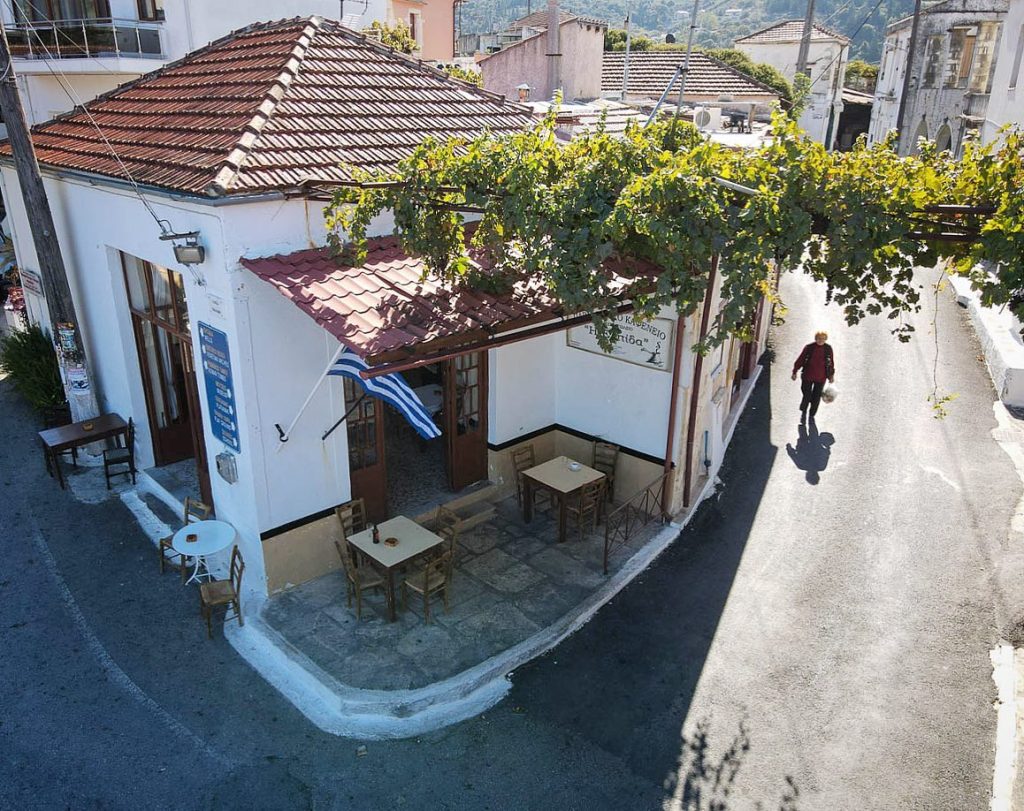
A view from above the Kafeneio, H Ελπίδα, the Gavalohori plateia. Thanks to @gavalohori

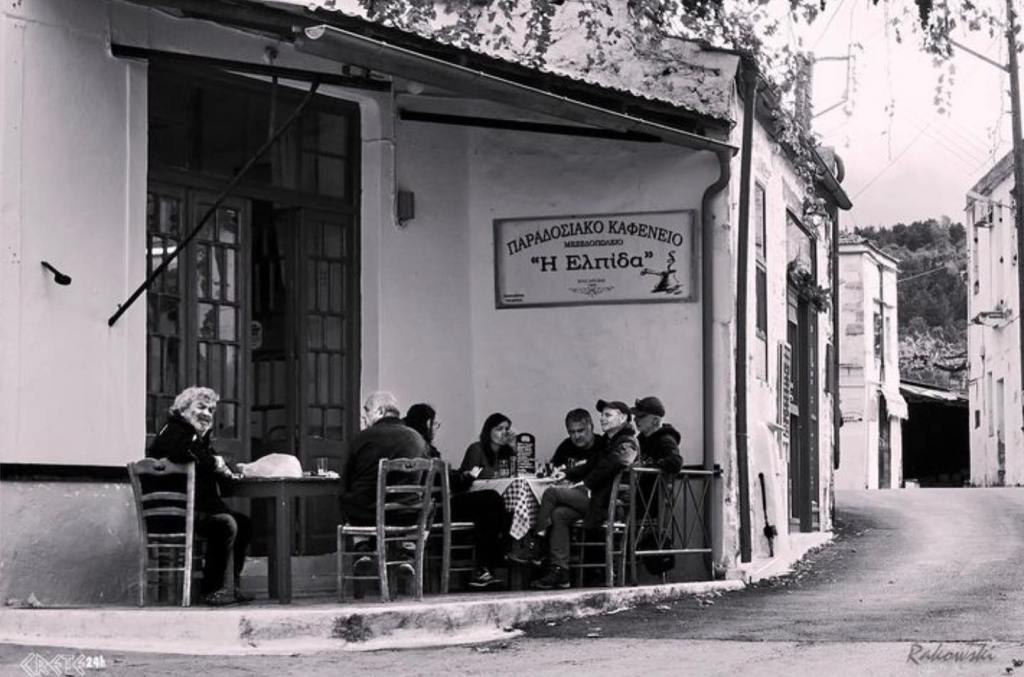
After my musing upon Authoritarianism the other week a number of those present indicated an interest in some sort of monthly discussion group. To this end, I’m proposing that anyone animated by the idea, whether or not they were at the talk itself, meet in the fittingly named kafeneio, ‘H Ελπίδα’ or Hope, situated on the plateia of Gavalohori at 10.30 a.m on Tuesday, March 28.

I’ve no idea who might be able to come and I won’t be offended if I finish up sitting on my own. It’s happened before in more than one English pub. However, if you are able to grace us with your presence I will be chuffed. It would be helpful if you could let me know so I can forewarn Giorgos about the hordes likely to descend on the kafeneio. Contact me at tonymtaylor@gmail.com or ring/text 00447547195092.

As for what we might talk about it feels a good starting point would be to share with one another a little bit about ourselves and what issues we find most interesting and/or pressing. I’ll come with some prepared thoughts in case we’re all struck dumb. To use such an old cliche in itself opens up a discussion about correct/incorrect, sensitive/insensitive language! Chuck in pronouns and that would be a fascinating exchange.

It’s important to stress that our dialogue should seek to be respectful of a diversity of opinion. More than ever we need to listen to each other and guard against labelling arguments as being Left, Right or whatever. Let’s chat with an open mind and question each other with empathy and tolerance. More than ever we need to be conscious of the ways in which we have been manipulated in recent times. The present and the future need critically aware citizens.

Hoping our paths might cross soon,

Tony Taylor

Postscript

My dear friend, comrade and confirmed Graecophile, Malcolm Ball, who died exactly two years ago, would be made up with the idea of a Critically Chatting discussion group on Crete. I can just see him with a cheeky morning ‘Mythos’ in hand, suggesting, after a lengthy, even frustrating exchange of views, that we let our thoughts ‘marinate’ until the next time – a piece of advice well worth absorbing.

International Women’s Day, Clara Zetkin and the Class Struggle

Clara Zetkin, the German delegate at the International Socialist Women’s conference in Copenhagen in 1910, was instrumental in establishing International Women’s Day. ‘The day must be international, she argued, because these sufferings are shared by all the oppressed, regardless of national borders. It is women’s day because, in her words, the inhuman burden of global capitalism weighs with especial heaviness on women.’ It may be that her political stance, her uncompromising opposition to capitalism, is perceived as outdated, even embarrassing to some of today’s sponsors of International Women’s Day.

However, as Dalia Nassar and Kristin Gjesdal argue, concerning 8 March and International Women’s Day, one of the takeaways from Clara Zetkin is that once her work is read within a broader context of women’s philosophical contribution, there is no tension between a radical fight for women’s rights and living conditions and a universalist analysis of oppression in its many shapes and forms. For Zetkin, 8 March could never be a celebration of womanhood. It was, instead, part of a sustained fight for a society under which women, of all colours and walks of life, could lead genuinely human lives. Her mission was radical; her message was universal.

One of the most important and formative moments of my political life was travelling down to London overnight to be on the Grunwick picket line – the year 1977. I did so in the company of a convoy of cars and coaches carrying trade unionists and supporters travelling to the Grunwick film processing plant in Willesden. Twenty thousand strong, we were there in solidarity with the courageous group of Asian women workers led by Jayaben Desai out on strike fighting for trade union recognition. They remain an inspiration today – an expression of Zetkin’s universal message,’ all for one, one for all’.

There are many herstories of the dispute – for example https://www.striking-women.org/module/striking-out/grunwick-dispute

I was moved to scribble this post by the chance appearance of these two posters from the period in question.

POWER TO THE SISTERS

Talking about Authoritarianism in a quiet, idyllic Greek village

A recent painting of a village house by Marilyn

A couple of days ago I gave a talk initially entitled ‘Sleepwalking into Authoritarianism’ in the surreal setting of a sleepy Greek village. As is my wont I had made heavy weather of putting together the presentation. Even the day before the event the floor around my desk was laden with discarded attempts to write something worth hearing.

Amongst the many considerations influencing my weary way – I still handwrite and forever return to my varied beginnings to start afresh – were two in particular.

  1. I felt overwhelmed with information. I didn’t view this mass of opinion as misinformed, disinformed or whatever. It was simply stuff I had to scrutinise to the best of my ability and in the full knowledge of my own ideological disposition. Somehow I had to pull something together that reflected my sense of what’s happening in society without boring folk to tears.
  2. And the folk in question, so it proved, were a motley bunch with no shared background, expertise or experience. Even if a majority were retired immigrants from the UK, others present were younger, alongside those for whom English was a second language.

In the event, it seemed to go well. I was forgiven for my age-old habit of preparing flip chart prompts, only to overlook them completely. There was exquisitely timed melodrama. As I uttered the exclamation, ‘all hell was let loose’ a plastic chair, not for the first or last time on Crete, collapsed under poor Ralph sitting in the front row. He went down with quite a wallop, his coffee flying in all directions. As ever in such circumstances hilarity mixed with concern. However, Ralph quickly regained his composure, aided by the provision of two chairs in one. In accord with the adage, the show went on regardless. I hardly had time to take a breath.

In truth, if I dare use such an abused phrase, this lively moment was probably a blessed relief, given the doom-laden content of much of my offering. Nonetheless, a number of people responded positively to the idea of a monthly discussion group, to the opportunity of meeting regularly to converse critically about what’s going on in the world.

Thus I will write up my notes under the changed title, ‘Authoritarianism: Chains Loosened, Shackles Tightened’. and incorporate some of the telling points made in the Q&A end to the morning. Hopefully, I’ll sort this out in the next fortnight. All being well we will meet in the week beginning Sunday, March 19th. Further details will be circulated soon.

Thanks to all who came, to the committee of the Kalamitsi village for the use of the Old School and to Phil and Fran [Kalamitsi Arts Group] for the arrangements.

The Inextricable Relations of the Struggle around Class, Race, Gender and Sexuality – the example of Lesbians and Gays Support the Miners

When I first discovered left-wing politics or more precisely Trotskyism in the early 1970s there was growing criticism that Marxism in practice prioritised class struggle above all else. The typical class militant was seen as telling women, black people, gays and lesbians that they must wait upon their demands till after the revolution. I was fortunate to join the Marxist Worker Group [MWG], a tiny organisation based in the North-West of England. Therein the question of women’s liberation was central. Within the group, we read and discussed passionately the works of Rosa Luxemburg, Clara Zeitkin and Alexandra Kollontai, along with contemporary figures such as Sheila Rowbotham, whose groundbreaking book, ‘Woman’s Consciousness, Man’s World’ was published in 1974. Over the decades I moved slowly and contrarily away from Marxism’s certitude towards Anarchism’s uncertainty. However, I will remain forever grateful to the members of MWG, such as the formidable Eileen Murphy for an argumentative, challenging beginning to my political life in which class, gender, race and sexuality were inextricably intertwined.

Thus, over the decades, I have sought to argue for this crucial intertwining in both practice and theory. In the Community and Youth Workers Union, along with Roy Ratcliffe himself a leading figure in MWG. we gained majority support in 1981 for a constitution, which placed the right to caucus at the very heart of the union’s democracy, emphasising the interrelatedness of class, gender, race and sexuality.

Ironically, given my opening remarks, as the years passed by, I found myself lamenting the disappearance of a class struggle analysis from both the professional and political spheres. For example, I wrote a piece for Youth & Policy’s History series, ‘Youth Work and Class: The Struggle that dare not Speak Its Name’, which argued at one point:

In focusing on a notion of the Class Struggle and its absence from Youth Work discourse I risk being seen as a geriatric Leftie, trying stubbornly to resurrect the discredited idea that class is primary, relegating the significance of other social relations. This is not at all my desire.  My point is no more and no less than that the political struggle for equality, freedom and justice must have a rounded and interrelated sense of the relations of class, gender, race, sexuality and disabilityNone of them makes proper sense without reference to each other.  If this inextricable knot is recognised, the silence about class within most Youth Work is deeply disturbing.

As best I can see and my glasses may need more than a cursory clean the outlook of the contemporary Left and its base in the professional classes is dominated by a version of ‘identity politics’, within which the inextricable knot is utterly undone. Identities compete rather than cooperate. Over forty years ago Heidi Hartmann worried about the unhappy marriage of Marxism and Feminism. She argued for a more progressive union. Today we witness a clash between trans and feminist politics that seems to defy any idea of reconciliation. In this context to ponder a relationship between trans and class politics seems to be off with the fairies. Whilst I am aware that trans activists have influenced the policies of trade unions, to what extent have they captured the hearts and minds of the memberships? On the ground the going might well be tough I remember the rows between women and men at one of the first 1984 national miners’ demonstrations in Mansfield. The miners were taken to task for chanting, ‘get yer tits out for the lads’. The women, the feminists didn’t write off the blokes. They argued their corner and, to use a trite phrase, good things happened. Perhaps I’m out of touch but as much as ever we need to renew a questioning yet forgiving dialogue across the identities. Such a culture of openness requires time, patience and guts. If we take courage, the rich need take care. For now, the ruling class remains delighted by our divisions, both feeding and feeding off our estrangement from one another. Certainly though, we can all, whoever we are, draw strength from the inspiring intervention in 1984/85 of the group, ‘Lesbians and Gays Support the Miners’. I can vouch for the impact of its courageous intervention upon the consciousness of both the men and women of the mining communities in Leicestershire and Derbyshire, where I was a committed activist.

Grateful thanks to Working Class History for reminding us of the following.

Yesterday, 11 February 1987, Mark Ashton, Irish communist and co-founder of Lesbians and Gays Support the Miners, died aged just 26. LGSM raised huge amounts of money for Welsh miners during the great strike of 1984-5, and both brought the ideas of the workers’ movement to the gay community and brought the idea of gay and sexual liberation to the workers’ movement.

Ashton died of complications related to AIDS, at a time when the UK government had failed to take action to combat HIV.

His friend, LGSM co-founder Mike Jackson, stated at a memorial event: “To this day, Mark’s loss remains deeply felt by so many family members and friends… Driven, principled and charismatic, Mark would have achieved so much more if he had not died so young.”

The group, and Mark, were immortalised in the fantastic 2014 film, Pride.

Learn more about LGSM and Mark, in our podcast episodes 27-29 with participants. Find them on every major podcast app or on our website: https://workingclasshistory.com/…/e23-25-lesbians-gays…/

The Guardian 2014 – It’s not Russia that’s pushed Ukraine to the brink of war

The armaments industry can’t believe its good fortune as its deathly goods pour into the Ukraine. To question any of this is to be derided as a Putin apologist. At the very least it’s worth reflecting on this article by Seamus Milne, which appeared in Comment is Free, well over eight years ago.

‘The reality is that after two decades of Nato expansion, this crisis was triggered by the west’s attempt to pull Ukraine decisively into its orbit … ‘ Illustration: Matt Kenyon

Milne begins:

The threat of war in Ukraine is growing. As the unelected government in Kiev declares itself unable to control the rebellion in the country’s east, John Kerry brands Russia a rogue state. The US and the European Union step up sanctions against the Kremlin, accusing it of destabilising Ukraine. The White House is reported to be set on a new cold war policy with the aim of turning Russia into a “pariah state”

He concludes:

The US and EU have already overplayed their hand in Ukraine. Neither Russia nor the western powers may want to intervene directly, and the Ukrainian prime minister’s conjuring up of a third world war presumably isn’t authorised by his Washington sponsors. But a century after 1914, the risk of unintended consequences should be obvious enough – as the threat of a return of big-power conflict grows. Pressure for a negotiated end to the crisis is essential.

In 2023 it is neither fanciful nor neurotic to fear an escalation into a nuclear conflict.

Today Milne’s analysis would not be offered the time of the day – least of all in the war-mongering Guardian.

Read in full at https://www.theguardian.com/commentisfree/2014/apr/30/russia-ukraine-war-kiev-conflict