
So much going on but wasn’t that always the case? Yet now it is so exaggerated. So much that we know apparently but what do we know in truth? So much that appears new but has been said a thousand times before. In all of this much of a muchness and manic madness I struggle to find a voice worth voicing. No matter, I have little in the way of an audience. I’m conscious that others with a significant following say lots, which I find challenging. That’s how it ought to be. I’ll continue being inevitably discomforted. I’ll be circumspect..
With this in mind I am going to put to bed the self-flagellation, which accompanies failing to put my thoughts on paper; which keeps me awake at night as I compose crafted articles of poetic power, all to be forgotten in the morn.
Doing this means dieting. It means an end to the daily gorge of all things considered worthy of my attention, by whom I am never that sure. It means giving up on even some writers I admire. It’s all too much. My brain hurts or as my son would say, ‘it’s doin’ my head in’.
Even as I mutter this escape clause, I find myself drafting an irritated and frustrated response to the generalised characterisation of ordinary folk, who voted Reform in the UK, as stupid, racist, xenophobic bigots. I am incensed by the arrogant moral superiority of the professional and technocratic managerial class, which insists we adopt its values as we succumb to its influence. I am depressed by the absence of any sense of contradiction and uncertainty in judging both individual and political motivation. Yet, unravelling what I mean makes little sense without some context, some history of where I’ve come from and where I’m up to. Why do I believe what I do now? It may well be garbage, to quote an American President, but it’s been a long time shovelling it all into the bin.
Hence I am going to return seriously to the task of writing an autobiography, which will trace and interrogate my personal, social, professional and political journey from 1958 to the present day, closing on 70 years by 2028. I suspect it may well suggest I have been part of the very problem, which threatens to consume us. I hope the verdict might not be so scathing.

More than a year ago I all but completed the first chapter, ‘The Apolitical Years -1958-1968’. It needs revisiting, revising and refreshing but it’s a decent start. If anything comes of the venture I will publish the reminiscences decade by decade.
As for a title, I am wondering about an old phrase, my mother, faced with a hapless child, used to tell me off, ‘ Tony, yer don’t know yer left from yer right’. Politically, make of that what you will!
Meanwhile I’m continuing to sing, which is a source of joy and a little pride. It is now 65 years since I left the church choir when my voice broke. And it’s about six years since I began singing again in earnest. Two weeks ago I gave a concert in aid of our village museum and, to my delight, my daughter, Megan was in the audience. She’s somewhat biased but thought I did well. It was my usual eclectic mix of parlour and folk songs, spirituals, standards and show tunes, not forgetting a couple of Greek classics. This time, however, I was privileged to be accompanied on the piano for some of the repertoire by Linda Manousaki, mother of the inspirational jazz violinist, Maria Manousaki. Linda and I hope to continue this relationship, provided she can put up with me. My dear friend, Ken Carpenter, who has generously recorded some of my outings, was ill during the concert. Hence there may be no record of our fledgling partnership.
I began my humble offering with the opening from this beautiful piece by Henry Purcell, hoping that our music-making might beguile. Later in the concert I changed key as music should also disturb and sang the moving ‘No Man’s Land’.
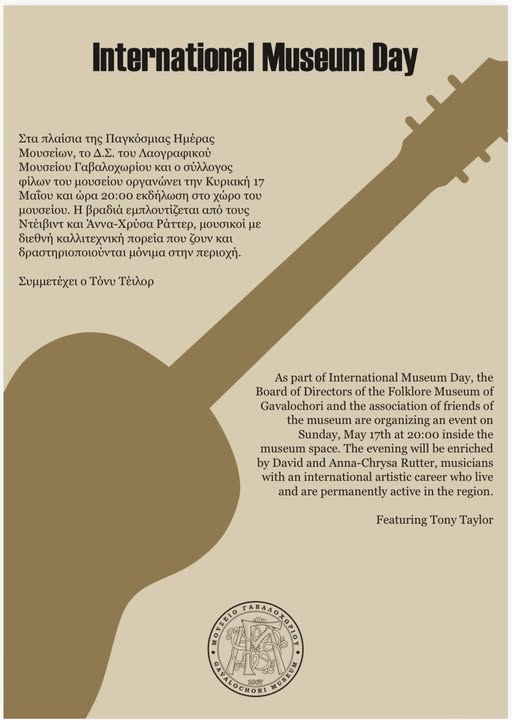
And, I’ll be performing again this coming Sunday, May 17th at an event celebrating International Museum Day.
My spirits are lifted too by the coming Vlatos Jazz Festival organised through Martin Vlatos and curated by Maria Manousaki.

STOP PRESS

WHAT RICHES TO BEHOLD!
To bring this farewell to a close I’ll do one more post identifying the writers I will continue to follow. Then I’ll get my head down.