CRUSHING DISSENT AND RESISTANCE

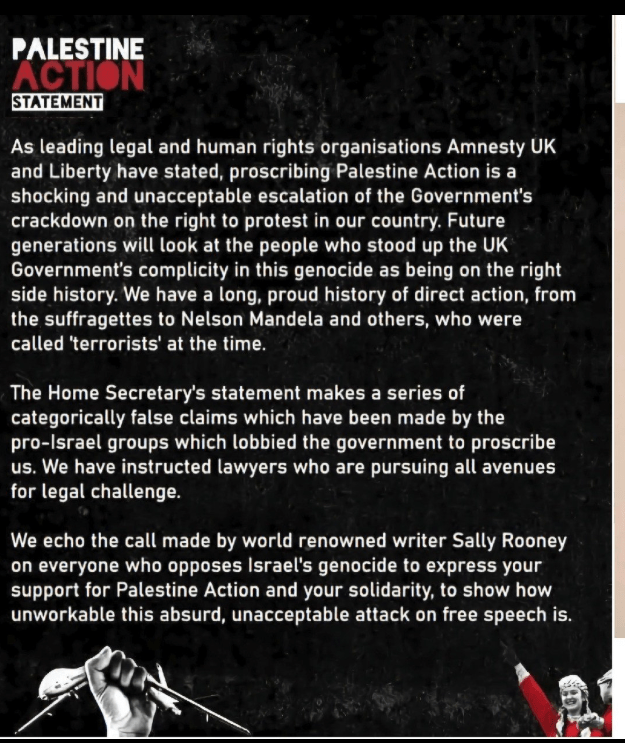
I started to put this hardly controversial post together yesterday morning and it’s already been overtaken by numerous pieces despairing at Labour’s proscription of Palestine Action. A direct action group seeking to raise awareness of the obscene genocide in Gaza, of the war crimes of a terrorist State is without any due process defined as a terrorist organisation. Even the Guardian is forced to descend from the fence in an article, ‘It’s a complete assault on free speech’: how Palestine Action was targeted for proscription as terrorists’

The article notes, if the group is proscribed next week, as is expected, being a member of or inviting support for Palestine Action will carry a maximum penalty of 14 years. Wearing clothing or publishing a logo that arouses reasonable suspicion that someone supports Palestine Action will carry a sentence of up to six months.

In a week’s time we wait to applaud the Guardian’s recovery of its liberal tradition, whereby the paper explicitly backs the right of Palestine Action [PA] to exist and resist.


The arrogant and ignorant authoritarianism at the heart of today’s Labour Party is exemplified by the Home Secretary’s condemnation of PA’s militant tactics. In 2018 she spoke in the House of Commons, expressing her admiration for the suffragette movement, and celebrated its herstory by wearing a rosette in the suffragette colours of purple, white and green.

It seems to have slipped her mind that the suffragettes were not shy when it came to attacking the patriarchal state that denied them even a voice. Thus, at 6.10am on the 19 February 1913, a bomb exploded at the summer house that was being built for Chancellor of the Exchequer, David Lloyd George, at Walton-on-the-Hill, causing damage estimated at £500 (modern equivalent nearly £55,000 in today’s money). On the evening of the incident Emmeline Pankhurst, one of the leaders of the Women’s Social and Political Union (WSPU), claimed responsibility for the bomb at a meeting at Cory Hall, Cardiff, where she admits that they have “blown up the Chancellor of the Exchequer’s house”. Pankhurst was willing to be arrested for the incident saying “I have advised, I have incited, I have conspired”; and that if she is arrested for the incident she shall prove that the “punishment unjustly imposed upon women who have no voice in making the laws cannot be carried out”. We presume the Home Secretary might well retrospectively need to proscribe the WSPU as a terrorist organisation.

See this great piece that elaborates the story, Lloyd George and the Suffragette Bomb Outrage


And, let’s not forget……….

Greenham Common Women’s Peace Camp
1981 – 2000  

On the 5th September 1981, the Welsh group “Women for Life on Earth” arrived on Greenham Common, Berkshire, England. They marched from Cardiff with the intention of challenging, by debate, the decision to site 96 Cruise nuclear missiles there. On arrival they delivered a letter to the Base Commander which among other things stated ‘We fear for the future of all our children and for the future of the living world which is the basis of all life’.

When their request for a debate was ignored they set up a Peace Camp just outside the fence surrounding RAF Greenham Common Airbase. They took the authorities by surprise and set the tone for a most audacious and lengthy protest that lasted 19 years. Within 6 months the camp became known as the Women’s Peace Camp and gained recognition both nationally and internationally by drawing attention to the base with well publicised imaginative gatherings.This unique initiative threw a spotlight on ‘Cruise’ making it a national and international political issue throughout the 80s and early 90s.

The presence of women living outside an operational nuclear base 24 hours a day, brought a new perspective to the peace movement – giving it leadership and a continuous focus. At a time when the USA and the USSR were competing for nuclear superiority in Europe, the Women’s Peace Camp on Greenham Common was seen as an edifying influence. The commitment to non-violence and non-alignment gave the protest an authority that was difficult to dismiss – journalists from almost every corner of the globe found their way to the camp and reported on the happenings and events taking place there.

Living conditions were primitive. Living outside in all kinds of weather especially in the winter and rainy seasons was testing. Without electricity, telephone, running water etc, frequent evictions and vigilante attacks, life was difficult. In spite of the conditions women, from many parts of the UK and abroad, came to spend time at the camp to be part of the resistance to nuclear weapons. It was a case of giving up comfort for commitment.

The protest, committed to disrupting the exercises of the USAF, was highly effective. Nuclear convoys leaving the base to practice nuclear war, were blockaded, tracked to their practice area and disrupted.Taking non-violent direct action meant that women were arrested, taken to court and sent to prison.

The conduct and integrity of the protest mounted by the Women’s Peace Camp was instrumental in the decision to remove the Cruise Missiles from Greenham Common. Under the Intermediate Nuclear Forces (INF) Treaty, the missiles were flown back to the USA along with the USAF personnel in 91/92. The Treaty signed by the USA and the USSR in 1987, is in accord with the stated position held by women, in defence of their actions on arrest, when it states :

“Conscious that nuclear weapons would have devastating consequences for all mankind”

A number of initiatives were made by women in Court testing the legality of nuclear weapons. Also, challenges to the conduct and stewardship of the Ministry of Defence as landlords of Greenham Common. In 1992 Lord Taylor, Lord Chief Justice, delivering the Richard Dimbleby Lecture for the BBC, referring to the Bylaws case ( won by Greenham women in the House of Lords in 1990) said ‘…it would be difficult to suggest a group whose cause and lifestyle were less likely to excite the sympathies and approval of five elderly judges. Yet it was five Law Lords who allowed the Appeal and held that the Minister had exceeded his powers in framing the byelaws so as to prevent access to common land’.

The Camp was brought to a close in 2000 to make way for the Commemorative and Historic Site on the land that housed the original Women’s Peace Camp at Yellow Gate Greenham Common between the years 1981 – 2000.

Sarah Hipperson

This remarkable book tells how the women of the Yellow Gate peace camp at Greenham Common took on the law – and in some instances won.

They challenged the laws under which they were arrested and as Judge Hague said said in the County Court “…they are no strangers to litigation, both criminal and civil. In the courts they have sometimes had a considerable measure of success, and indeed they are immortalised in the Law Reports in connection with two of their successes in the higher courts.”

This book offers inspiration and encouragement to all who take part in non-violent direct action or want to challenge the powers of the state or large institutions. In its detailed descriptions of each case, it suggests how this can be done successfully.

The last chapter tells the story of the Commemorative and Historic Site, a garden of peace where once the women of Yellow Gate camp lived and confronted the Cruise Missiles – and the powers of the state.

To buy a copy of this book, send a cheque for £9.98 (+ £1.00 p & p) payable to ‘Greenham Publications’ to 15 Sydney Road, London E11 2JW or order one from your bookseller (ISBN 0-9550122-0-1)


AND AS OF NOW

https://www.theguardian.com/politics/2025/jun/25/mass-protests-uk-nuclear-deterrent-expansion

The biggest expansion of the UK’s nuclear deterrent in a generation will put the nation on the “nuclear frontline” and mobilise a new generation of anti-nuclear weapons protesters, campaign groups have warned.

Anti-nuclear and anti-arms campaign groups are planning mass protests against nuclear weapons – of a kind not seen since the days of the Greenham Common peace camp in the 80s – in response to government plans to significantly expand its nuclear deterrent by buying a squadron of American fighter jets capable of carrying nuclear weapons.

The Campaign for Nuclear Disarmament (CND) protested on Saturday, June 28th at RAF Marham in Norfolk, which is used by the US air force.

Campaign groups said the decision to buy 12 F-35A jets, which are capable of carrying conventional arms, and also the US B61-12 gravity bomb, a variant of which has more than three times the explosive power of the weapon dropped on Hiroshima, had been taken without parliamentary debate and undermined democracy.


Returning to Iran, Siya Vash, reports that within the convulsions inside the country suppression of dissent deepens.

The paranoid and humiliated Revolutionary Guards in Iran have been sending the following text messages to people’s mobile numbers:

Warning
Following or joining pages affiliated with the Zionist regime constitutes a criminal act and is subject to legal prosecution. Therefore, given the recorded activity of this number on virtual pages of the Zionist regime, you are hereby warned to immediately remove supportive comments and likes, and exit these pages without delay. Failure to do so will result in legal action in accordance with Article 8 of the Law on Confronting Hostile Actions of the Zionist Regime.
Deputy for Social Affairs and Crime Prevention, Judiciary of the Islamic Republic of Iran
Honourable People of Iran


In recent days, your exemplary cooperation and solidarity with your servants in the IRGC Intelligence Organisation—through public reporting—has not only altered the enemy’s calculations but has also led to their defeat on the battlefield. Therefore, we kindly ask you to continue this valuable approach and report any suspicious activity by contacting 110, 113, or 114, or through available channels on domestic messaging platforms.
IRGC Intelligence Organisation


In a philosophical atmosphere, all of the above would be open to criticism, agreement and disagreement. However the creeping authoritarianism I have sought to address since the ascent of neoliberalism in the 1980’s, its fetish of individualism and its hatred of autonomous collectivity has gathered pace across the decades, not least during the manufactured COVID pandemic. Central to the shift into an era of technocratic capitalism is the Expert, who takes different forms and cannot be questioned. To do so is to be beyond the pale. This demand for conformity and obedience is profoundly anti-democratic. And its prophets and disciples come from both the traditional Left and Right. If I get my act together I will try to put flesh on these bare bones.

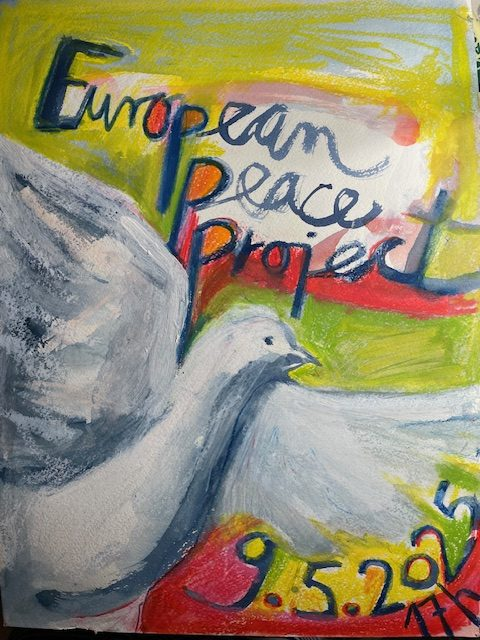
European Peace Project – 05/09/2025@5pm

“On May 9 at 5 pm – it’s time to set an example
for the peaceful future of Europe!”

The Manifesto – European Peace Project

Today, on May 9, 2025 – exactly 80 years after the end of the Second World War, which cost the lives of 60 million people, including 27 million Soviet citizens – we, the citizens of Europe, raise our voices! We are ashamed of our governments and the EU, which have not learned the lessons of the 20th century. The EU, once conceived as a peace project, has been perverted and has thus betrayed the essence of Europe! We, the citizens of Europe, are therefore taking our destiny and our history into our own hands today, on May 9. We declare the EU a failure. We start with citizen diplomacy and refuse the planned war against Russia! We recognize the co-responsibility of the “West”, the European governments and the EU in this conflict.

We, the citizens of Europe, together with the European Peace Project, oppose the shameless hypocrisy and lies that are being spread today – on Europe Day – at official ceremonies and on public broadcasters.

We are reaching out to the citizens of Ukraine and Russia. You are part of the European family and we are convinced that together we can organize peaceful coexistence on our continent.

We have the images of the military cemeteries before our eyes – from Volgograd to Riga to Lorraine. We see the fresh graves left behind by this senseless war in Ukraine and Russia. While most EU governments and those responsible for the war are rushing and suppressing what war means for the population, we have learned the lesson of the last century: Europe means “Never again war!”

We remember the European reconstruction achievements of the last century and the promises made in 1989 after the peaceful revolution. We call for a European-Russian Youth Exchange, modelled alike the French-German Youth Office of 1963, which ended the “hereditary enmity” between Germany and France. We demand an end to sanctions and the reconstruction of the Nord Stream II pipeline. We refuse to waste our tax money on armaments and militarization at the expense of social standards and infrastructure. Within the framework of an OSCE peace conference, we call for the creation of a European security architecture with and not against Russia, as laid down in the 1990 Charter of Paris. We call for a neutral Europe, emancipated from the USA, which takes on a mediating role in a multipolar world. Our Europe is post-colonial and post-imperial.

We, the citizens of Europe, hereby declare this war to be over! We will not take part in the war games. We will not turn our men and sons into soldiers, our daughters into nurses in military hospitals and our countries into battlefields.

We offer to immediately send a delegation of European citizens to Kiev and Moscow to start a dialog. We will no longer stand by and watch our future and that of our children being sacrificed on the altar of power politics.

Long live Europe, long live peace, long live freedom

GO TO https://europeanpeaceproject.eu/en/ to support and donate.

SUFFOCATING, NOT GOING UNDER AND TAKING A BREATH

When I was about 8 years old my primary school teacher, frustrated by my reluctance to enter, pushed me into the pool at the town’s Baths.  I thought I was going to drown but my fellow pupils came to the rescue.  How could she have done this?  What callousness!  Or so the story goes.  In truth I’m not sure the incident ever happened.  However, I’ve told the tale so many times, often embellished, that I’ve come to believe it.  Why the need for this dubious childhood anecdote?  Certainly it has served to excuse my genuine fear of putting my head under water.  Friends who have sought to teach me to swim can attest to my frenzied splashing in protest.  Indeed it appears to explain my life-long struggle to stifle frightening dreams, within which I experience being suffocated, physically with a pillow, or psychologically by guilt, having betrayed my beliefs or people dear to me.  I awake dramatically, fighting for my breath.  By and large I deal with this, park the neurosis in its place.  And then again, perhaps not.

For over the last four years, in particular, I have felt suffocated, drowning in an unrelenting deluge of information, opinion, analysis and gossip.  I experience being in a state of alternative asphyxia.  It is not that I am starved of the oxygen of ideas, rather I gorge, I binge compulsively on their 24/7 availability. Some sort of diet beckons.

This self-indulgent, breathless cry for relief from the day-to-day assault on my senses inflicted by the media of whatever ilk is very much personal.  It is not to be taken in any way as an argument against the widest possible array of views being out there and accessible.  I oppose censorship, the suppression of opinion, most of all when I disagree even vehemently with such speculation.  I stand against authoritarianism, whether dressed in the cloak of the Left, Centre or Right.  Obviously I have no time for the manufactured categories of mis and disinformation through which the powerful seek to silence criticism and opposition.  Plainly the charge of misinformation is directed principally at those who question the dominant narrative.  It is applied to those who desire to make public what the ruling class wishes to remain private. According to the ever suave Barack Obama, I’m severely mistaken. I’m sinking into the ‘raw sewage’ pumped into the public square by the alternative media. Thus, misled, he opines it’s no wonder I’ve lost faith in society’s politicians, institutions and media and in doing so I represent a disturbing threat – let’s not mince his words –  to the future of humankind. Given this apocalyptic charge, it’s no surprise that the 2024 World Economic Forum in Davos is deeply bothered about my dissidence.

In his opening remarks to the conference of the great and good, Klaus Schwab, its founder and chair expressed his concern – “We must rebuild trust – trust in the future, trust in our capacity to overcome challenges and, most importantly, trust in each other.” In order to win back my undying support the elite will continue to encourage the creation of an armoury of so-called ‘independent’ disinformation agencies, funded by a mix of  private and public sources. For example the European Union has “a network of  anti-disinformation hubs that are part of the European Digital Media Observatory (EDMO), the independent platform for fact-checkers, academic researchers and other relevant stakeholders contributing to addressing disinformation in Europe”. Forgive the obvious but there is not the faintest scent of humility in these manoeuvrings, the slightest nod of recognition that their arrogant and authoritarian programme of propaganda and restriction might have something to do with our mistrust of their motives.

In the UK’s recently passed ‘Online Safety Bill’ you can see how the government intends to win back our trust. Section 179 section makes it illegal to publish false information with intent to cause harm…..

…..but Section 180 exempts all Mainstream Media outlets from this new law!

Of course I might not be seeing the wall for the bricks but this suggests strongly that the MSM are explicitly permitted to “knowingly publish false information with intent to cause non-trivial harm”. Yet you or I can be imprisoned for a year for committing a criminal act in drawing attention to their conscious deceit. A touch topsy-turvy!

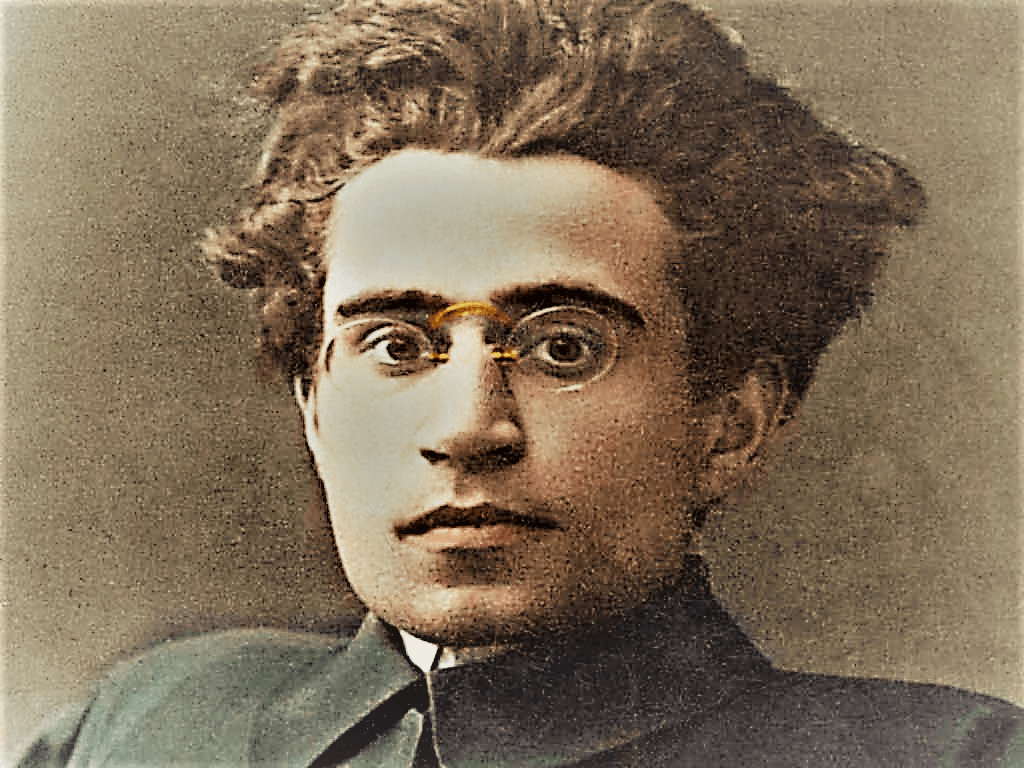
Hence, for my part, I will not be intimidated into accepting the powerful’s rule over what I think or believe. Perhaps you might think me simple but, on a day-to-day basis, I will proceed on the basis of receiving, reading and thinking about information. It will be whatever it is, a product of those who put it together, informed by their expertise or lack of it, their integrity, their prejudices, their beliefs and so on.  It is my job as the aspiring, thoughtful citizen of Aristotle’s imagination to interpret and judge what I am told to the best of my faculties. Certainly such an ability, as far as it goes in my case, is born of a splicing of political activism with professional education and a measure of involvement in academia. At my most pretentious I fancied myself as one of Gramsci’s organic intellectuals.

Thanks to avanti.it

In this context, summed up in the world of youth and community work [YCW]  work, within which I laboured, as the desire to be a critically reflective practitioner, I didn’t expect to be so isolated as the COVID manufactured melodrama unfolded. I remain perplexed at the extent to which the professional class, including its YCW members, embraced and colluded uncritically with an unevidenced and unethical regime of societal restriction. An emergency was asserted but never proven. Fear provided its justification. Naively, I thought such authoritarianism would spark resistance. In retrospect, I failed to recognise how deeply behaviourism, its apparatus of preordained scripts, prescribed targets and imposed outcomes, was embedded in the professional psyche – not least in work with young people.This acceptance of a discourse of certainty about the correctness of our data-driven, objective models, the righteousness of our impact, the benificence of our worthy goals,  spilled over into life as a whole. And, as far as I can see, practitioners remain in denial as to what they were up to. No more than fleeting research confirms that masking, social distancing [made up on the back of a cigarette packet], the closure of children’s and young people’s provision were harmful and unnecessary. I await the National Youth Agency even shyly allowing it was a touch over the top, even as it bemoans a deterioration in young people’s mental health. Evidently it was the virus ‘wot dun it’ not the conscious application by practitioners of draconian social policy. Perhaps, though I’m too harsh, even the much revered Noam Chomsky, ‘an intellectual superstar’, according to the Guardian, succumbed utterly to the smear that the unvaccinated were dangerous and irresponsible, arguing that they should be ‘isolated’.

Ironically and thankfully, Chomsky along with much of the Left recovered his balance as the seemingly endless tragedy of Gaza erupted, as genocide stared us in the face. Almost overnight we rediscovered our ‘instinctive mistrust of the state’, of careerist and opportunist politicians, of undemocratic, unelected bodies of experts. In particular, perhaps, having swallowed whole the COVID propaganda spewing from the mass media, we remembered belatedly our relentless and scathing critique of the bourgeois press, which goes back at least in academic and activist circles to 1974 and the creation of the Glasgow Media Group. 

Enough is enough. I’ve peddled this perspective before without reaction, which is fair enough. Who on earth am I? My insignificance acknowledged, it does mean therefore that I must take a deep breath about my suffocating immersion in the currents of available opinion. It is extraordinary but I’m ‘sut on mi bum’ to use a Lancashire expression more than ever in my whole life.  True, I still drag myself out more or less every day to indulge the narcotic of my lingering athletic obsession.  I persuade myself I feel better for having done it.  Yet, outside this hour or so of exertion, I’m sometimes spending up to eight hours hunched over the laptop in a pompous search for the Holy Grail containing ‘the Truth’! Inevitably it’s always just out of reach. I need a break from this self-inflicted imprisonment.

To cut my usual ramble short I’m determined to work out a fresh approach in my declining days. I need to get out more as the saying goes.

  1. I won’t abandon Chatting Critically but, in addition to my occasional originals, I want to use it more as a conduit to challenging thinkers and activists who you might not trip over. In doing so I’ve already culled the number of people I’ve been following because I can’t keep up. A future post  will single out blogs and websites, which continue to stimulate me. You might well shake your head at my choices. On the ground I remain committed to our local Chatting Critically group.
  2. I shall spend more time on a project to record the history of the Lancashire Walking Club , of which I am a life member. It gives me pleasure, believe it or not, to do so.
  3. I am close to giving up on even being the In Defence of Youth Work [IDYW] archivist, the initiative of which I was once coordinator. Few seem interested. To all appearances its open-ended philosophy has been defeated – see the inanities of its supposed Facebook page, which ought to be closed out of respect to IDYW’s corpse.
  4. I’m going to ramble and cycle as I wish without feeling the need to rush back home.
  5. I’m going to spend more time singing and becoming musically literate.
  6. I’m going to  spend more time musing for the sake of musing in our village kafeneion.
  7. I cannot promise but I ought to improve my Greek.

On reading this afresh it ends up looking like a belated set of New Year’s resolutions. Given my past track record in keeping to such sensible proposals as cutting down on the village wine, the omens are not promising. We will see.

Tony Taylor


To end positively, let me introduce you to the writings of W.D. James, who teaches philosophy in Kentucky, USA and his substack Philosopher’s Holler

He explains:

Egalitarian Anti-Modernist philosophical ruminations on our contemporary conundrums. In my native dialect, a ‘holler’ can refer to a hollow (empty space), a yell, or a work song.

I’m thinking my way through our current times and I tend to do that by digging into the ‘classics’ of Westen political philosophy to see what light they can shine on the contemporary moment.

My basic stance is characterized by:

  • Anti-Modernism
  • Anti-Globalism
  • Deep respect for pre-modern wisdom traditions, including religious traditions
  • Liberty
  • Defense of the opportunity for a good life for everyone
  • A critique of the modern state
  • Grounding in nature/reality, intellectually, morally, and existentially

For my part, TT speaking, I would recommend you download and dip into the free pdf, Egalitarian Anti-Modernism

CONTENTS
Foreword by Paul Cudenec
Part 1: Was Jerusalem Builded Here?
Part 2: Jean-Jacques Against the Pathologies
of Civilization
Part 3: Rousseau and the Evils of Inequality
Part 4: Rousseau’s Revival
Part 5: William Morris and the Political
Economy of Beauty
Part 6: William Morris – Dreaming of Justice
and of Home
Part 7: What is Wrong With the World?
Part 8: Chesterton Against Servility
Part 9: Catastrophe
Part 10: Egalitarian Anti-Modernism and the
Contemporary Political Landscape

I enjoyed and was challenged by its content and argument, given that for a long time in my political life I believed in the inexorable relationship between progress and the continual development of the productive forces. I’m less confident nowadays.

“OUR DREAMS ON THIS EARTH HAVE NOT FINISHED BLOOMING…”

Tomorrow. all being well. there’ll be a belated report from the first Cretan Chatting Critically meeting held in Gavalohori in March, together with notice of the next meeting to take place on Tuesday, April 25 in the same venue, H Ελπίδα.

Given our first discussion touched both on Freedom and Hope, here’s a song from HK (& Les Saltimbanks), Toi et moi, ma liberté – with translation.

You and me, my freedom
This is where it all begins
Time may well stop
For a new dance
You and me, my freedom

Tonight the city is asleep
Humans have their minds elsewhere
Do you know that for you my friend
I will sing for hours

I will open the windows wide
To contemplate the joys of the sky
And I will see you appear
Like a flash, a spark

This is where it all begins

Time may well stop
For a new dance
You and me, my freedom

This is where it all begins
Time may well stop
For a new dance
You and me, my freedom

Last the walls and the facades
And the speeches of circumstance
A few imprudent people escape
Freeing themselves from proprieties

And here they are joining us
Like in a big popular ball
Do you feel our sorrows slipping away
Tomorrow will be more beautiful than yesterday

This is where it all begins
Time may well stop
For a new dance
You and me, my freedom

This is where it all begins
Time may well stop
For a new dance
You and me, my freedom

Friends, trees are in bloom
And here we are again
Like brothers, like sisters
And the soldiers are disarmed

We dance barefoot on the Earth
We pitch on the roof of the world

HK et Les Saltimbanks is a French popular music group from the Lille metropolis.

HK, son of an immigrant and Roubaisien, develops ideas of nomadic utopias and tells the stories of the homeless, Tuaregs and revolutionaries in the first album entitled Citoyen du monde’. They are known for their committed texts dealing with social struggles…

International Women’s Day, Clara Zetkin and the Class Struggle

Clara Zetkin, the German delegate at the International Socialist Women’s conference in Copenhagen in 1910, was instrumental in establishing International Women’s Day. ‘The day must be international, she argued, because these sufferings are shared by all the oppressed, regardless of national borders. It is women’s day because, in her words, the inhuman burden of global capitalism weighs with especial heaviness on women.’ It may be that her political stance, her uncompromising opposition to capitalism, is perceived as outdated, even embarrassing to some of today’s sponsors of International Women’s Day.

However, as Dalia Nassar and Kristin Gjesdal argue, concerning 8 March and International Women’s Day, one of the takeaways from Clara Zetkin is that once her work is read within a broader context of women’s philosophical contribution, there is no tension between a radical fight for women’s rights and living conditions and a universalist analysis of oppression in its many shapes and forms. For Zetkin, 8 March could never be a celebration of womanhood. It was, instead, part of a sustained fight for a society under which women, of all colours and walks of life, could lead genuinely human lives. Her mission was radical; her message was universal.

One of the most important and formative moments of my political life was travelling down to London overnight to be on the Grunwick picket line – the year 1977. I did so in the company of a convoy of cars and coaches carrying trade unionists and supporters travelling to the Grunwick film processing plant in Willesden. Twenty thousand strong, we were there in solidarity with the courageous group of Asian women workers led by Jayaben Desai out on strike fighting for trade union recognition. They remain an inspiration today – an expression of Zetkin’s universal message,’ all for one, one for all’.

There are many herstories of the dispute – for example https://www.striking-women.org/module/striking-out/grunwick-dispute

I was moved to scribble this post by the chance appearance of these two posters from the period in question.

POWER TO THE SISTERS

Reflections on the Meaning of Existence whilst Leaning on a Lamp-Post

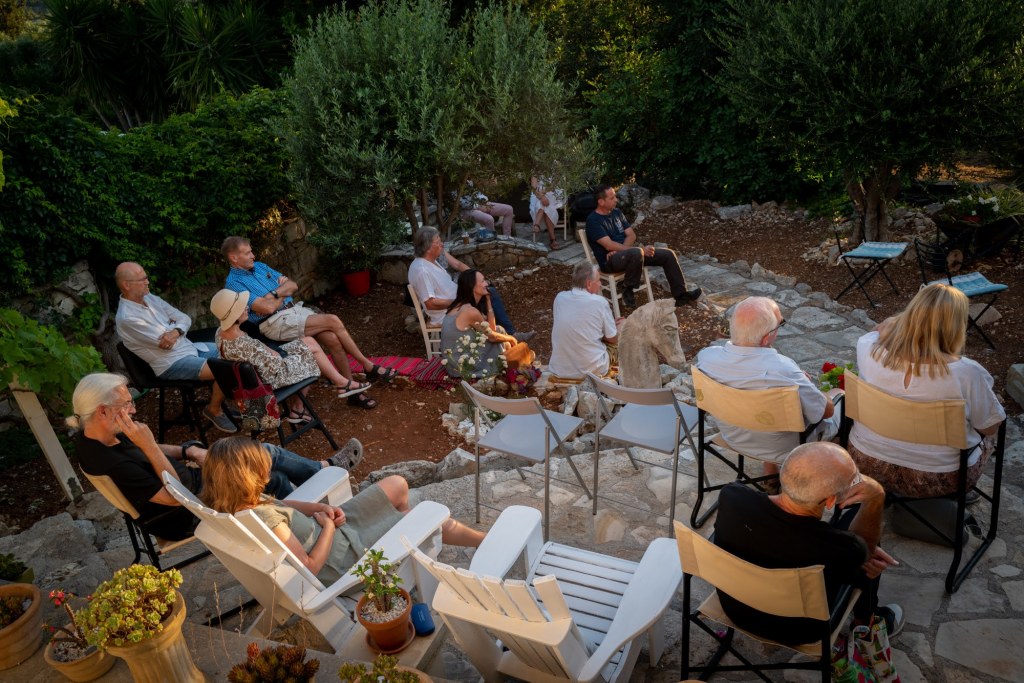
The audience starts to assemble. Ta to Xavier

Further to my self-centred announcement of my 75th birthday, the following seeks to offer an insight into the tribulations plus a number of images of the celebratory event held at our house. I’m hoping that doing so might kick-start me into renewing the momentum of this blog. We will see. Perhaps predictably I’ve found myself in the past few days, as befits my three scores and fifteen, dwelling upon the question of what I’ve been up to in my life. Living in the birthplace of Western philosophy demands such reflection. For now, though this musing remains hazy in keeping with me being dazy for the past week or so.

My dazed condition dates back to an alarming moment when, on a longish journey home, the brakes on our stalwart Suzuki car failed. One tortuous way and another we limped to the garage where the dear girl, 22 years old was declared beyond repair. With the birthday bash only two days away, without transport, our predilection to be anxious reared its nagging head. Fortunately, neighbours and friends came to our aid as we remembered, yet again, something else we had forgotten, notably, παγάκιa, the essential ice cubes. The temperature was forecast to be 32 degrees.

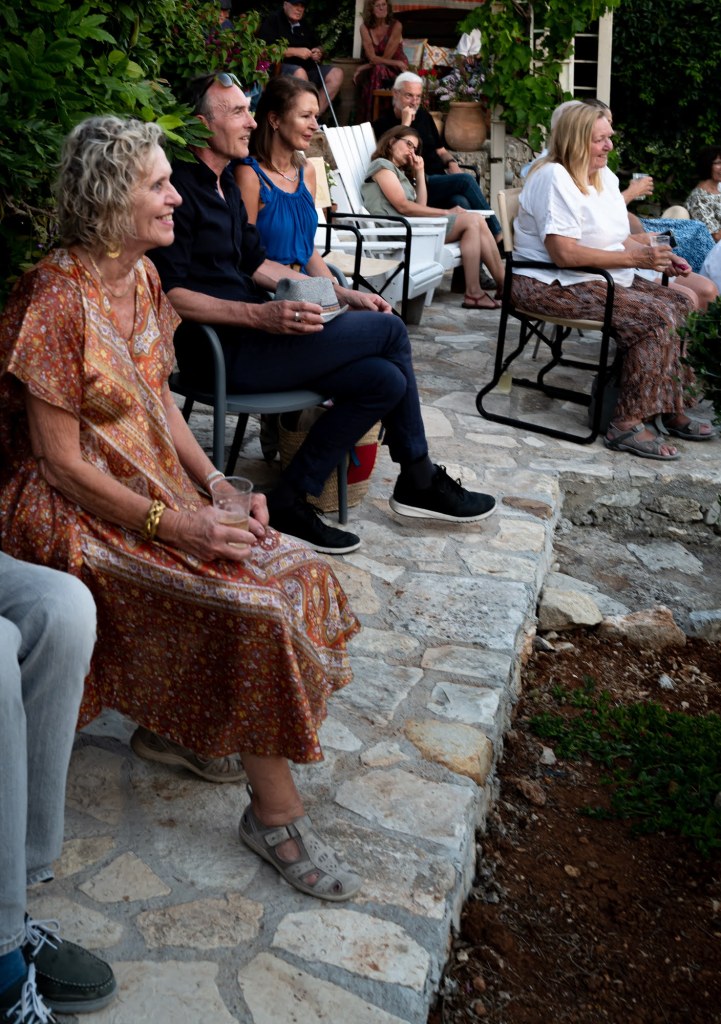
A glimpse of our eclectic assortment of chairs/kαρέκλες and indeed friends. Ta to Xavier

Not a single eddy disturbed the tranquil opening to Sunday itself. Not a wisp of a breeze could be discerned. Only the animated birdsong and a cock crowing pierced the silence. It was going to be bloody hot. The start of the evening’s delights would have to be delayed. Nevertheless, the first task if we were to be ahead of ourselves was arranging the seating. Over 40 chairs had been begged and borrowed. Being diverse and inclusive by nature rather than being in thrall to some Johnny-come-lately Human Relations influencers, we refused none on the grounds of shape, size or colour. Thus, when completed, the eclectic composition of kαρέκλες fitted perfectly the natural amphitheatre provided by our back garden. We were pleased with ourselves which was to be our undoing.

Despite the resplendent garden defying our horticultural ignorance, Marilyn ventured that a couple more bursts of colour wouldn’t come amiss. All the more so as our neighbourhood pine marten seemed to take great pleasure in digging up and destroying the prettiest of our flowers. Despite it being the day of repose Mark and I volunteered to go in search. Intuitively perhaps we knew. The charming little florist in the next village, Vamos, was indeed closed. However, opposite was situated the seductive sight of the Mosaico cafe. It seemed irreverent on a hot Holy Day not to seek refreshment. Two pale ales and toast later we realised we best return at speed except we were empty-handed. In a last throw of the dice, we dashed to nearby Kalives where alas the florist was also closed. Yet two rows of plants had been left outside on the narrow pavement and this was Crete. Thus I chose two colourful offerings, nipped into the next-door craft shop where I left the money owed in the helpful hands of the unphased, artistic owner. Σε ευχαριστώ πολύ.

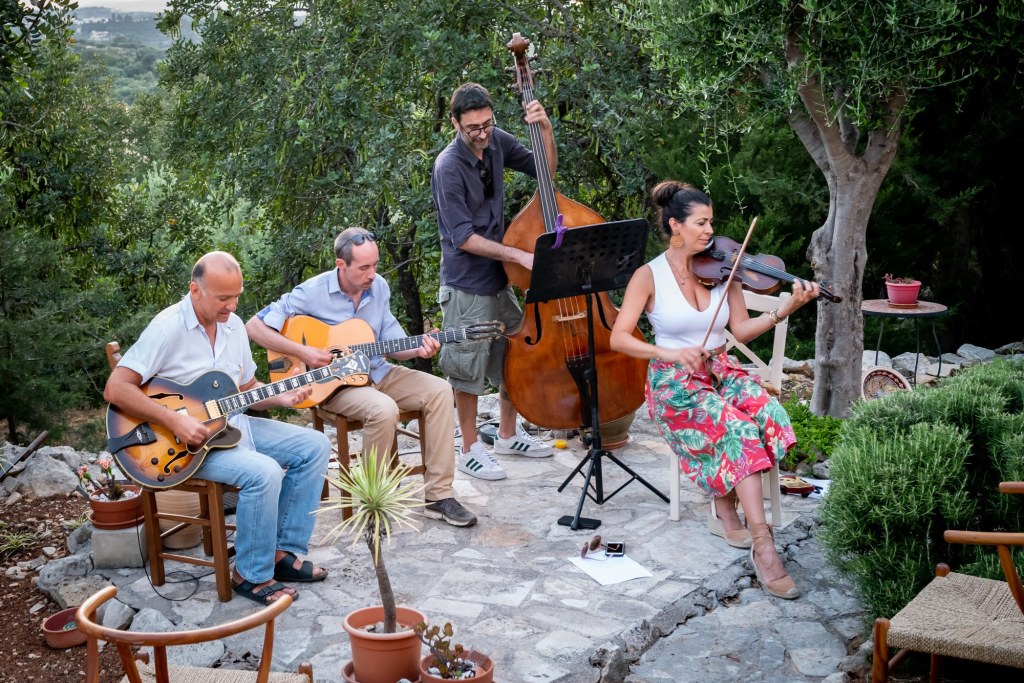
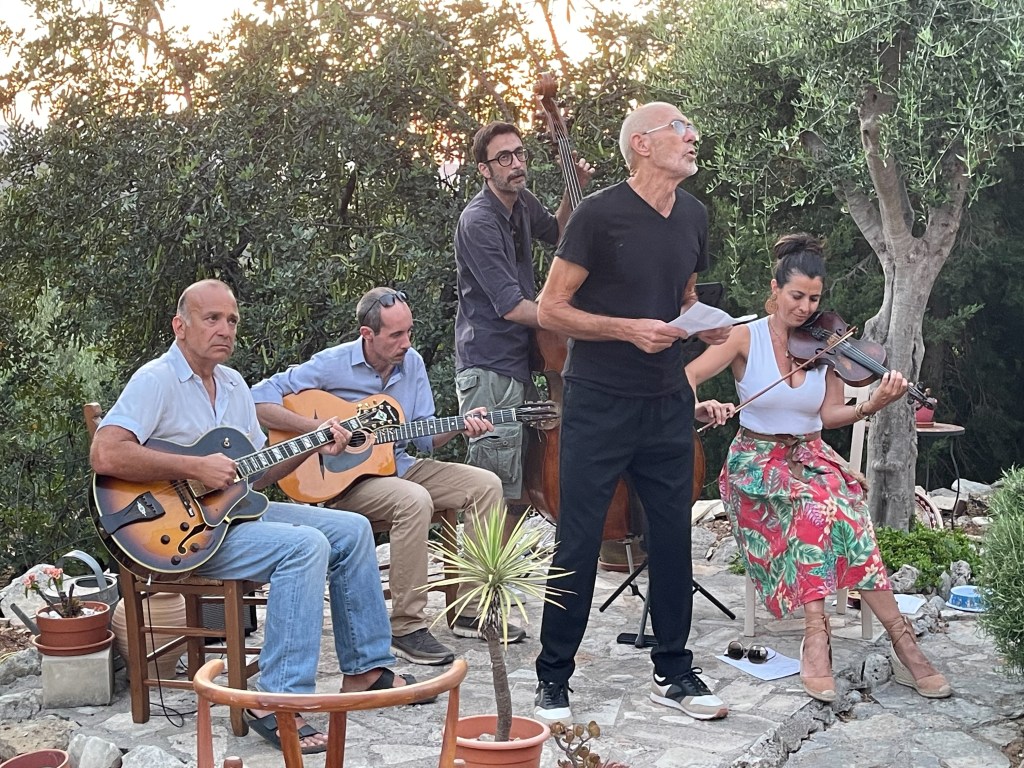
Mutterings aside and acknowledging the flowers in hand, Marilyn and Sara forgave our boyish antics but nonetheless, the preparations had been concertinaed. Before we knew where we were, folk were arriving, not least Maria Manousaki and the band, Hot Club de Grece. In fact, these brilliant musicians were no trouble, escaping into the shade to practise together.

Yiannis inseparable from his guitar even during a break. Ta to Xavier

As for ourselves, our brains fled to the mountains. We forgot all sorts – the aforesaid ice, the bread, the prosecco, the beers and much more. If we’d ordered pies, them too, for sure. Meanwhile Francesca, in charge of the canapes, was serenity itself. Whilst Linda, Lizzie and Marie recognising our plight mucked in on plying guests with drinks and nibbles.

Marilyn arrives with Rosemary’s glorious orange drizzle cake. Ta to Sara

As for Marilyn and I being by default master and mistress of ceremonies we sought to pull ourselves together, to stop being mard-arsed. Marilyn floated amongst our guests, exuding welcoming warmth. I ventured to the front of proceedings with an eye on a retreating, still blazing sun, ready to capture the audience’s attention. In doing so I set aside half a century of experience. It was my wont never to speak publicly without rehearsing, indeed almost memorising the script I had written in long hand. Thus armed, I scarcely ever looked down at my scribbling. I strutted the lecture and conference hall with confidence.

Dazed but not drunk, forgetting my lines. Dimitris, our dear neighbour, who climbed up our back wall from his olive grove below, looks concerned. Ta to Sara

Yet there I was without a note in my hand. The rest is an embarrassing blur. I said something about being fortunate to grow up at a time when, under proletarian pressure, Capitalism had made a number of profound concessions to the working class, notably free education from cradle to grave. I muttered something about education being to do with the creation of questioning, active citizens, not the indoctrination of obedient, passive consumers. I declared that we were at a crossroads in a clash between the struggle for authentic democracy and the imposition of technocratic authoritarianism. All of which needed much explanation. It was neither the time nor place but whenever is? Time for a ditty though?

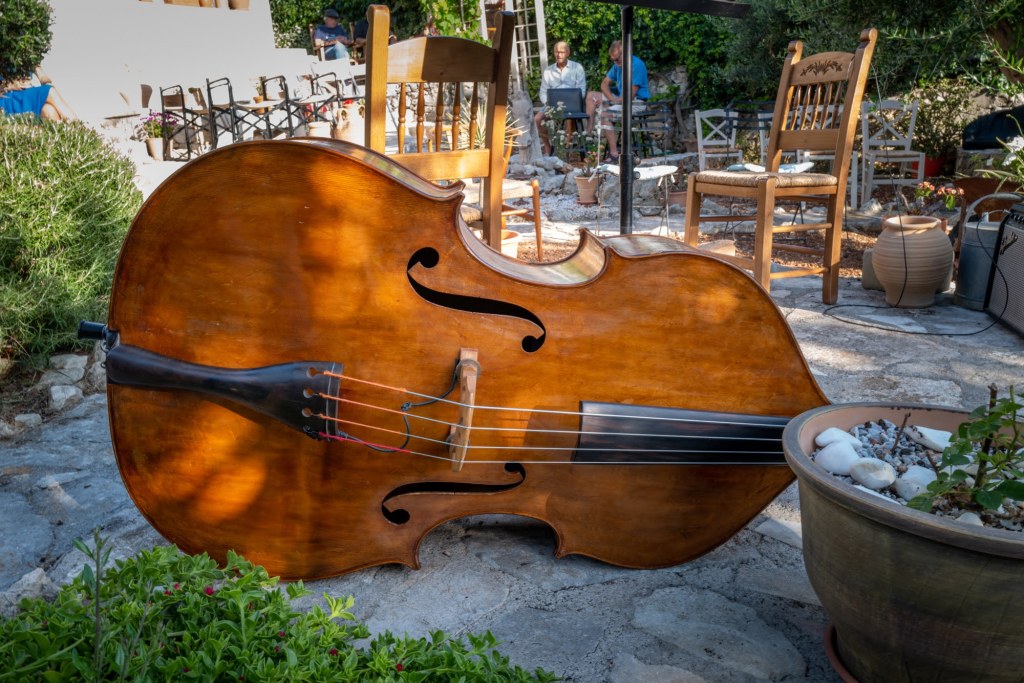
Thus I sang ‘Ol’ Man River’, a song of age, conformity and resistance with a falter before intoning Paul Robeson’s rewriting of the closing lines – ‘I’ll keep laughin’ instead of cryin’, I must keep fightin’ till I’m dyin’. At the end of which I departed dizzily stage left without even introducing Maria, Yiannis, Antonis and Georgos, the Hot Club. Fortunately, there was no need for such niceties. From the first strum, la pompe, the voices of violin, guitars and double-bass intertwined seemingly effortlessly in a tour de force of jazz manouche. We swung and were captivated.

Maria swinging with the Hot Club. Ta to Xavier

At the break Marilyn and I had decided, given our advancing years, to allow ourselves a nostalgic glance back to growing up in Lancashire, sitting in front of the telly watching the comic films of Gracie Fields and George Formby.

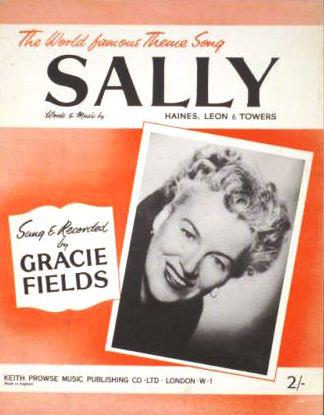
Hence I began by singing our Gracie’s signature tune, ‘Sally in our Alley’. It is now claimed there wasn’t a dry eye in the garden. Tears of emotion or laughter, we shall never know.

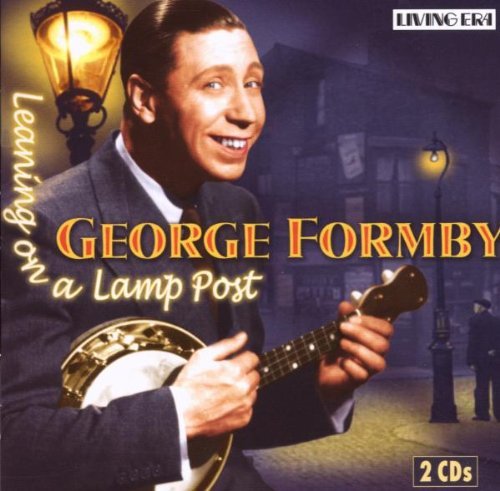
After which I was joined by the Backyard Boys, Phil on ukulele, John banjo and Ian washboard to deliver George’s greatest giggle of a hit, ‘Leaning on a Lamp-post’. Their consummate backing was much admired. As was Phil’s account of a touching poem penned by Linda Manousaki.

Begging Sally to marry me. Ta to Sara
Leaning on a lamp-post waiting for a lass called Marilyn to pass by. Ta to Xavier
Phil reads Linda’s generous tribute to my scribbling. Ta to Xavier

Maria and the Hot Club opened the second set by generously accompanying my effort to do justice to a popular Greek number, ‘Τι είναι αυτό που λένε αγάπη;’ translated as ‘What is this thing called love?’. I will take solace in the fact that Anastasia was impressed with my performance. Once I was out of the way Maria and the Hot Club returned us to the joys of their musicianship.

Honoured to be singing ‘Τι είναι αυτό’ with these wonderful musicians. Ta to Rod
Anastasia evidently pleased with my rendition of ‘Τι είναι αυτό’ . Carsten can’t quite believe what he is hearing. Ta to Xavier

It was at this point that Marilyn and I cast off our cloak of anxiety, tried to stop stressing and sought to bask in the atmosphere of shared pleasure created in our idyllic back garden. To add to our delight the band played her special request, ‘Misty’. At the end, rapturous applause rang down our lane and folk went their separate ways.

It’s tempting to think Marilyn is listening to the ageless melody of ‘Misty’. Ta to Xavier

At a pivotal moment when the ruling class would like to divide us and consign us to a virtual world of their making, a collective experience created by improvisatory live music cocks a snook at the powerful. It belongs to us and no one else. Our gratitude is due to everyone for being involved in all manner of supportive and helpful ways. On the Sunday itself, we vowed ‘never again’ but with each passing day our affection for the occasion grows. Whatever transpires in the future as the old song goes, ‘Thanks for the memories’. The struggle ever continues but between whom?

Well, Linda and Maria seem to have enjoyed the occasion. Ta to Sara
Thanks all round. Ta to Sara
The party’s over. Ta to Xavier

Many thanks to Xavier Rouchaud, Sara Gilding and Rod Waters for the atmospheric photos.

Our bucket collection raised 325 Euros towards Medical Aid for Palestinians. Much appreciated.

Postscript.

Thanks to Rod or not as the case might be – Leaning on a Lamp-post live from Gavalohori with the Backyard Boys! Eat your heart out, George.

Keep on Trucking against Authoritarianism

In the last few days, I’ve been trying to finish one last piece [for now?] on the ‘pandemic’ – a list of questions I’ve asked myself over these painful two years. I’ve set these thoughts aside. It is surreal to scribble in the abstract when resistance becomes real. A massive convoy of trucks and heavy goods vehicles has arrived and is arriving across borders and states in Canada’s capital city, Ottawa. The truckers, applauded and joined by thousands of Canadians in the teeth of the elements. are on the one hand protesting against vaccine mandates. On the other, they are heading a wider movement of opposition to the undemocratic imposition of enforced restrictions on society as a whole.

Outside of Canada the silence hanging over this remarkable surge of collective action is shattering. We ought to be shocked yet it is no surprise. Even as the mainstream COVID narrative unravels the media remains in denial – best not to cover this remarkable story at all. Inside Canada, the Prime Minister and former World Economic Forum Young Leader, Trudeau, aided by the press and television, sneers at the truckers, no more than a fringe irritant and smears them as misogynist and racist. In his eyes, they are backward, prejudiced and, heaven help us, disobedient.

As best I can tell at this moment the Left [whatever that quite means today?] is yet again nowhere to be seen. Some time ago, a long time ago, you might have expected the Left to welcome the spontaneous rise of struggle from below, even if it then desired to become its leadership. Today all bets are off. In truth I’m not sure what the Left would see as an authentic expression of the resistance of the ‘demos’. In the truckers’ case, they may be persona non grata as their union bureaucracy condemns them. Perhaps the Left, abandoning the notion of contradiction, paints remarkably the blunt truckers as self-centred individualists and sophisticated Trudeau as the voice of the collective, the greater good.

For what it’s worth I salute the truckers, expelled from Facebook as I write. I salute the thousands of their supporters. From what I can gather their occupation of Ottawa seems overwhelmingly cooperative and communal, even joyous. If I dare quote Lenin in a rare, romantic moment, it is ‘a festival of the oppressed’. I want to believe that if I was in Canada I would move heaven and high snow to be in Ottawa tomorrow, answering the call for a multitude on the streets. The more who are there, the less chance of violent reprisal. I remain anxious as to how tomorrow might play out.

I accept utterly you might be wary of my rose-tinted version of events. Who am I listening to? Well, for one, I’m listening to this Ottawa resident, a data scientist called David Maybury – see his blog, The Reformed Physicist. I’m copying in full his post yesterday in the hope you will read it.

A night with the untouchables

I live in downtown Ottawa, right in the middle of the trucker convoy protest. They are literally camped out below my bedroom window. My new neighbours moved in on Friday and they seem determined to stay. I have read a lot about what my new neighbours are supposedly like, mostly from reporters and columnists who write from distant vantage points somewhere in the media heartland of Canada. Apparently the people who inhabit the patch of asphalt next to my bedroom are white supremacists, racists, hatemongers, pseudo-Trumpian grifters, and even QAnon-style nutters. I have a perfect view down Kent Street – the absolute ground zero of the convoy. In the morning, I see some protesters emerge from their trucks to stretch their legs, but mostly throughout the day they remain in their cabs honking their horns. At night I see small groups huddled in quiet conversations in their new found companionship. There is no honking at night. What I haven’t noticed, not even once, are reporters from any of Canada’s news agencies walking among the trucks to find out who these people are. So last night, I decided to do just that – I introduced myself to my new neighbours.

The Convoy on Kent Street. February 2, 2022.

At 10pm I started my walk along – and in – Kent Street. I felt nervous. Would these people shout at me? My clothes, my demeanour, even the way I walk screamed that I’m an outsider. All the trucks were aglow in the late evening mist, idling to maintain warmth, but all with ominously dark interiors. Standing in the middle of the convoy, I felt completely alone as though these giant monsters weren’t piloted by people but were instead autonomous transformer robots from some science fiction universe that had gone into recharging mode for the night. As I moved along I started to notice smatterings of people grouped together between the cabs sharing cigarettes or enjoying light laughs. I kept quiet and moved on. Nearby, I spotted a heavy duty pickup truck, and seeing the silhouette of a person in the driver’s seat, I waved. A young man, probably in his mid 20s, rolled down the window, said hello and I introduced myself. His girlfriend was reclined against the passenger side door with a pillow to prop her up as she watched a movie on her phone. I could easily tell it’s been an uncomfortable few nights. I asked how they felt and I told them I lived across the street. Immediate surprise washed over the young man’s face. He said, “You must hate us. But no one honks past 6pm!” That’s true. As someone who lives right on top of the convoy, there is no noise at night. I said, “No, I don’t hate anyone, but I wanted to find out about you.” The two were from Sudbury Ontario, having arrived on Friday with the bulk of the truckers. I ask what they hoped to achieve, and what they wanted. The young woman in the passenger seat moved forward, excited to share. They said that they didn’t want a country that forced people to get medical treatments such as vaccines. There was no hint of conspiracy theories in their conversation with me, not a hint of racist overtones or hateful demagoguery. I didn’t ask them if they had taken the vaccine, but they were adamant that they were not anti-vaxers.

The next man I ran into was standing in front of the big trucks at the head of the intersection. Past middle age and slightly rotund, he had a face that suggests a lifetime of working outdoors. I introduced myself and he told me he was from Cochrane, Ontario. He also proudly pointed out that he was the block captain who helped maintain order. I thought, oh no, he might be the one person keeping a lid on things; is it all that precarious? I delicately asked how hard his job was to keep the peace but I quickly learned that’s not really what he did. He organized the garbage collection among the cabs, put together snow removal crews to shovel the sidewalks and clear the snow that accumulates on the road. He even has a salting crew for the sidewalks. He proudly bellowed in an irrepressible laugh “We’re taking care of the roads and sidewalks better than the city.” I waved goodbye and continued to the next block.

My next encounter was with a man dressed in dark blue shop-floor coveralls. A wiry man of upper middle age, he seemed taciturn and stood a bit separated from the small crowd that formed behind his cab for a late night smoke. He hailed from the Annapolis Valley, Nova Scotia. He owned his own rig, but he only drove truck occasionally, his main job being a self-employed heavy duty mechanic. He closed his shop to drive to Ottawa, because he said, “I don’t want my new granddaughter to live in a country that would strip the livelihood from someone for not getting vaccinated.” He introduced me to the group beside us. A younger crowd, I can remember their bearded faces, from Athabasca, Alberta, and Swift Current Saskatchewan. The weather had warmed, and it began to rain slightly, but they too were excited to tell me why they came to Ottawa. They felt that they needed to stand up to a government that doesn’t understand what their lives are like. To be honest, I don’t know what their lives are like either – a group of young men who work outside all day with tools that they don’t even own. Vaccine mandates are a bridge too far for them. But again, not a hint of anti-vax conspiracy theories or deranged ideology.

I made my way back through the trucks, my next stop leading me to a man of East Indian descent in conversation with a young man from Sylvan Lake, Alberta. They told me how they were following the news of O’Toole’s departure from the Conservative leadership and that they didn’t like how in government so much power has pooled into so few hands.

The rain began to get harder; I moved quickly through the intersection to the next block. This time I waved at a driver in one of the big rigs. Through the rain it was hard to see him, but he introduced himself, an older man, he had driven up from New Brunswick to lend his support. Just behind him some young men from Gaspésie, Quebec introduced themselves to me in their best English. At that time people started to notice me – this man from Ottawa who lives across the street – just having honest conversations with the convoy. Many felt a deep sense of abuse by a powerful government and that no one thinks they matter.

Behind the crowd from Gaspésie sat a stretch van, the kind you often see associated with industrial cleaners. I could see the shadow of a man leaning out from the back as he placed a small charcoal BBQ on the sidewalk next to his vehicle. He introduced himself and told me he was from one of the reservations on Manitoulin Island. Here I was in conversation with an Indigenous man who was fiercely proud to be part of the convoy. He showed me his medicine wheel and he pointed to its colours, red, black, white, and yellow. He said there is a message of healing in there for all the human races, that we can come together because we are all human. He said, “If you ever find yourself on Manitoulin Island, come to my reserve, I would love to show you my community.” I realized that I was witnessing something profound; I don’t know how to fully express it.

As the night wore on and the rain turned to snow, those conversations repeated themselves. The man from Newfoundland with his bullmastiff, a young couple from British Columbia, the group from Winnipeg that together form what they call “Manitoba Corner ” all of them with similar stories. At Manitoba Corner a boisterous heavily tattooed man spoke to me from the cab of his dually pickup truck – a man who had a look that would have fit right in on the set of some motorcycle movie – pointed out that there are no symbols of hate in the convoy. He said, “Yes there was some clown with a Nazi flag on the weekend, and we don’t know where he’s from, but I’ll tell you what, if we see anyone with a Nazi flag or a Confederate flag, we’ll kick his fucking teeth in. No one’s a Nazi here.” Manitoba Corner all gave a shout out to that.

As I finally made my way back home, after talking to dozens of truckers into the night, I realized I met someone from every province except PEI. They all have a deep love for this country. They believe in it. They believe in Canadians. These are the people that Canada relies on to build its infrastructure, deliver its goods, and fill the ranks of its military in times of war. The overwhelming concern they have is that the vaccine mandates are creating an untouchable class of Canadians. They didn’t make high-falutin arguments from Plato’s Republic, Locke’s treatises, or Bagehot’s interpretation of Westminster parliamentary systems. Instead, they see their government willing to push a class of people outside the boundaries of society, deny them a livelihood, and deny them full membership in the most welcoming country in the world; and they said enough. Last night I learned my new neighbours are not a monstrous faceless occupying mob. They are our moral conscience reminding us – with every blow of their horns – what we should have never forgotten: We are not a country that makes an untouchable class out of our citizens.

David Maynard

Thanks to Julius Ruechel at https://www.juliusruechel.com/ for the photos.

As the New Year dawns – being bullied into COVID compliance

New Year’s Day 2022 – an azure and windless sky beckons, promises and resolutions hang not yet tested in the still air. New Year’s Days I’ve had too many to mention but this one is different. It’s surreal, sinister and disconcerting.

I’m now into my 75th year on this god-forsaken earth. For more than half a century I’ve spouted forth about the evils of capitalism, even advocated revolution but my stance has not cost me dear. A tapped phone here, a night on a police station floor there, a few bruises on the picket line. Nothing to write home about. Indeed, it might well be argued that I’ve made something of a career out of being the useful ‘token ‘radical, not ‘in and against’ rather ‘in and compromised’ by the State. I’m of a post-war generation, whose lives were improved to different degrees by the struggles of our forefathers and mothers. With all its warts, and I railed against its shortcomings, the social-democratic society was a step forward. Neoliberalism has been closing down its gains for over forty years. I’ve sought to criticise this assault, arguing against the insidious influence of behaviourist psychology and worrying about the danger of us sleepwalking into an authoritarian and intolerant society. Again I have not been taken to task by the powerful for this dissension. As far as being troubled goes, it’s been wrought by my own self-doubt and anxiety. As a dear friend whispered gently, ‘being a couch revolutionary isn’t exactly uncomfortable’.

Two years ago I would have shaken my bald pate in disbelief at the predicament I face this New Year’s Day. The Greek government has determined that all the citizens and residents of the country, who are over 60 years of age will be vaccinated with the ‘booster’. Refusing to comply will lead to the following State punishments.

  • Each person resisting will be fined 100 euros each successive month until they give in. Over 25% of Greek pensioners, around 700,00 persons, receive less tha 500 Euros a month and even the average pension amounts to only 869 euros before deductions. In my case it seems that if I resist the 100 Euros will be procured for the government by my accountant.
  • Each person resisting will not possess therefore a valid vaccine passport. This means they will only be allowed access to supermarkets, grocery stores and chemists, to food and medicine. They will be barred from all public indoor spaces – tavernas, kafeneion, the beating heart of Greek life, even, I’m not sure, the Church – and public events. If this is enforced they will be excluded from the majority of what we might call civil society.

I want you to be shocked and angry in the face of such a draconian scenario, imposed by a government without an ethical leg to stand on. I worry that the propaganda machine churning out numbers, numbers, numbers will continue to cloud the issue. Mass testing alongside the emergence of a milder but more infectious variant will inevitably mean an upsurge in infections, leave aside the fact that the USA Centre for Disease Control has just disowned the PCR test, admitting its unreliability. A touch late, methinks.

In essence, the Mitsotakis government’s authoritarianism, whilst running deep in its historical blood, is inseparable from the influence of the corporate and pharmaceutical giants of our era. It is about power and profit. It is about politics. It is not about health. At this point, some readers may sigh. Am I in Covid denial? For now, I will only say that I believe that the COVID threat to society as a whole has been exaggerated enormously; that from a health point of view things could have been managed so very differently.

AgePeak Case Fatality Rate in winter 2020Case Fatality rate in June 2021
<204 in 100,0004 in 100,000
20-2914 in 100,00020 in 100,000
30-398 in 10,000 5 in 10,000 
40-492 in 1000 1 in 1000
50-598 in 10003 in 1000
60-693.3%1.4%
70-7914%3.8%
80 or above33%15%

Table 1: Proportion of people catching covid who die with it by age in England official gov.uk figures

The data presented above for June 2021 does not take into account booster vaccinations, early treatments and Omicron being less dangerous than earlier variants. These figures are calculated based on every ‘covid death’ including those where covid may well have been a bystander infection as often occurs with respiratory viruses. [Taken from ‘The Six Miracles of COVID’ Health Advice Recovery Team]

Thus, walking Glyka this morning, I felt my back was against the stone wall running down our lane, never mind that it was crumbling with the passing years. What to do? If I decline to be boosted I don’t think I am a health hazard. I don’t think I am being irresponsible. The growing evidence, given the vaccine has not lived up to the hype, is that the unvaccinated and the vaccinated are no more dangerous in terms of transmission to each other than each other. The mandatory vaccination of the over 60s here in Greece owes nothing to its democratic tradition, harking back much more to the dark days of the junta. As with all authoritarianism, it is industrial in its practice. The idea that treatment ought to be tailored to the particular history and circumstances of the individual is an anathema; that the principle of bodily autonomy, ‘our body, our choice’, is fundamental regarded as passe; that a healthy older person with no underlying comorbidities with legitimate concerns about the safety of an experimental drug has every right to demur is seen as utterly unacceptable; and as for the once cherished notion of informed consent that’s consigned to the historical bin.

Obviously, given my analysis of the situation, I should refuse the jab. Yet I prevaricate. I’m perplexed and angry. There’s nothing unique about the corner I’m in. Insofar as it’s special it’s to do with relationships, most intimately with my family. Becoming a ‘refusenik’ would curtail all sorts of simple social acts, just having a morning coffee down in the village. It would prevent me from travelling to see my children and grandchildren. Perhaps, if I was made of sterner stuff I would hold out. As things stand, in the absence of visible collective resistance, I suspect, I will shame-facedly comply. I have until the 16th of January to decide. Rather than be true to the active intent of the slogan, ‘educate, agitate, organise’ I’ll retreat passively into being agitated. I will persuade myself that I will live to fight another day. Will that be when the fourth jab is demanded? History will be the judge.

Searching for Understanding in the face of Power and Propaganda – Part Two : ‘It’s the economy, stupid!’

In looking at the pandemic from an economic and political perspective I will proceed from what might be seen as the ABC of a critical analysis.

  • It is necessary to ground what we are looking at in the specific circumstances of the time.
  • In doing so we should be mindful also of the historical context if this seems pertinent and we might allow ourselves a speculation about the future if appropriate.
  • Additionally we must situate the phenomenon being scrutinised in the power relations of society. Cui bono? Whose interests are served by the way in which the object of our concern is characterized; by the way in which governments respond; by the way in which the people respond and so on?

My starting point is both simple and profound. The COVID-19 pandemic expresses first and foremost a crisis of capitalism’s health, much less so a crisis of our individual and collective physical health.  I shall seek to give substance to this assertion which if true has enormous consequences both for our day-to-day existence and the ongoing struggle to create an autonomous and democratic society.

As for weighing up what’s going on in 2021, I’ll go back no further historically than the Second World War. I acknowledge the following sketch is rough and ready but it’s no more than a starter for a critical exchange of views.I wonder if such a proposal to be argumentative makes any sense in these dualist and censorious times.

The Social-Democratic Consensus

Aneurin Bevan – a chief architect of the NHS

As the war came to an end the capitalist class was afeard. Talk of radical and revolutionary change hung in the acrid air. To retain their overall control they conceded the following:

  • An acceptance of the mixed economy, public and private cooperation, the nationalisation of basic utilities – water, electricity and so on.
  • An agreement that the leaders of the working class should have a seat at the table,
  • A recognition of the value of universal free education, social and health care.
  • However grudging, an allowance that the individual, the social and the political are inextricably intertwined.

The Neoliberal Fightback

Margaret Thatcher – the enemy within

Thirty years later influential sections of the ruling class were increasingly unhappy about the post-war social contract. Certainly, they were concerned to restore their share of the profits but were also deeply troubled by the growing pressure exerted by working-class militancy and the rise of the social movements demanding equality and justice. To retain their control they set in motion a counter-offensive. Its cornerstones were:

  • A rejection of the mixed economy and an explicit commitment to the primacy of the ‘free’ market as being the ultimate expression of what is good for everyone, rich or poor.
  • The utter necessity to undermine the autonomous organisation of the working class and the social movements, exemplified by the 1984/85  violent assault on the National Union of Mineworkers and the softer seduction of leaders and activists from the women’s, black and gay movements into managerial roles serving the neoliberal project.
  • The launch of an extraordinarily ambitious social engineering project designed to alter our very personalities; to privatise our existence, turning us in on ourselves as individuals and away from collective understandings of our situations; to see ourselves as passive consumers rather than active citizens.

Neoliberalism in crisis

The 2008 banking collapse served notice that the neoliberal economic model was broken. An opportunity of resistance beckoned. In the marginal world of youth work, I argued that we should reassert youth work as open, volatile and voluntary in opposition to the increasingly taken-for-granted closed, imposed, scripted version – youth work as intuition rather than youth work by numbers.

On the broader front, significant protest raged across the world but it was fragmented and largely contained. Nevertheless, the ruling class was shaken and stirred. Across the next decade, it was forced to act pragmatically, bailing out the banks with a massive infusion of ‘public’ money, whilst trying to work out a longer-term strategy that served its interests and maintained its power. The sticking plaster of quantitative easing hid the reality of unsustainable debt, the austerity-imposed immiseration of millions and the obscenity of the rich getting ever richer.

The United Nations poverty adviser, Philp Alston compared contemporary Tory policy to that which had created the workhouses of the nineteenth century. Research undertaken at the University of Bristol led by David Gordon illustrated that in the UK [population 69 million] 18 million people could not afford adequate housing; 12 million were too poor to engage in many forms of social activity; whilst 4 million children and adults were not fed properly. However, austerity was not too austere for the richest 1,000 in the UK, who increased their wealth by 60 billion pounds in a single year, 2017/18.

My guess is that from a ruling class perspective these themes have dominated their many extravagant meetings in snowy Swiss or sunny Mediterranean resorts.

Why Davos?
  • A compelling shift to believing that some form of global governance had to be achieved. The vision would require ‘scientific’ regulation, a central role for experts and the obedience of the senior management representing compliant states.
  • Hindering such a sweeping move would be nation-states with notions of autonomy and democracy itself, even in its limited representative guise, along with dissident collectives and dangerous maverick individuals.
  • How might an alienated population, exhausted from work, deprived of work, retired from work be persuaded to go along with a major restructuring of social relations in favour of the powerful at the expense of the powerless?

Towards a global-led technocratic and surveillance capitalism

The reference group for grasping the strategic thinking of the powerful in a period of profound social, political and economic crisis is the World Economic Forum [WEF], which in its own words is “the global platform for public-private cooperation, of partnerships between businessmen, politicians, intellectuals and other leaders of society to define, discuss and advance key issues on the global agenda.” On board amongst many are Amazon, Google, Facebook, Barclays, Deutsche Bank, Morgan Chase, AstraZeneca, Pfizer, the Gates and Rockefeller Foundations – all powerhouses on the international scene – not to mention the World Health Organisation and International Monetary Fund.

Our experts and leaders

Somewhat in passing I find it intriguing that to comment on the intimate social connections between these corporations is often now dismissed as a sign of that neurotic condition, ‘conspiritatis’. Similarly it is seen almost as a cheap trick to pursue the money, to scrutinise the financial chicanery of these shakers and movers. When, to my mind, these avenues of inquiry are the basis of investigative journalism and social research, of speaking truth to power, if you will forgive such a hackneyed phrase.

To return to the question of the elite’s thinking, sections within its ranks have long felt that some sort of global overview of the social, political and economic order was necessary. To take but one example, Zbigniew Brzezinski, later Jimmy Carter’s Security Advisor, in his 1970 book ‘Between Two Ages: America’s Role in the Technetronic Era’. wrote:

The technetronic era involves the gradual appearance of a more controlled society. Such a society would be dominated by an elite, unrestrained by traditional values. Soon it will be possible to assert almost continuous surveillance over every citizen and maintain up-to-date complete files containing even the most personal information about the citizen. These files will be subject to instantaneous retrieval by the authorities.”

“The nation-state as a fundamental unit of man’s organized life has ceased to be the principal creative force: International banks and multinational corporations are acting and planning in terms that are far in advance of the political concepts of the nation-state”


This globalising technology-led tendency has gathered pace in the last decade with the WEF at the forefront of proceedings. The following are but a few quotes from Klaus Schwab, the founder and executive chairman of the World Economic Forum contained in his 2016 book, The Fourth Industrial Revolution.

Klaus Schwab

“Fourth Industrial Revolution technologies are truly disruptive—they upend existing ways of sensing, calculating, organizing, acting and delivering. They represent entirely new ways of creating value for organizations and citizens”.

“Sooner than most anticipate, the work of professions as different as lawyers, financial analysts, doctors, journalists, accountants, insurance underwriters or librarians may be partly or completely automated…”

“Drones represent a new type of cost-cutting employee working among us and performing jobs that once involved real people” 

“Already, advances in neurotechnologies and biotechnologies are forcing us to question what it means to be human”

We are at the threshold of a radical systemic change that requires human beings to adapt continuously. As a result, we may witness an increasing degree of polarization in the world, marked by those who embrace change versus those who resist it.

Enter the Pandemic

Whether the consequence of zoonotic transfer or laboratory leak, the COVID-19 virus has failed to live up to the catastrophic expectations of half a million deaths in the UK based on Neil Ferguson’s discredited computer modelling. It was never the 21st century version of the Black Death. Indeed WEF’s Kurt Schwab and Thierry Malleret in a book, The Great Reset, published in July 2020, allow that COVID-19 is “one of the least deadly pandemics the world has experienced over the last 2000 years”, adding that “the consequences of COVID-19 in terms of health and mortality will be mild compared to previous pandemics”. 

Nevertheless they cannot contain their delight at the opportunities opened up by its emergence.

“It is our defining moment”, “Many things will change forever”. “A new world will emerge”. “The societal upheaval unleashed by COVID-19 will last for years, and possibly generations”. “Many of us are pondering when things will return to normal. The short response is: never”.

“The pandemic is clearly exacerbating and accelerating geopolitical trends that were already apparent before the crisis erupted”.

Amongst the themes running dizzily through their excitement are:

  • The crucial need for the financial sector, together with the corporate, technological and pharmaceutical giants, to be the enlightened leadership of the way forward in tackling the world’s problems. “The combined market value of the leading tech companies hit record after record during the lockdowns, even rising back above levels before the outbreak started… this phenomenon is unlikely to abate any time soon, quite the opposite”.
  • The necessity of digitally transforming our private and public existence, whether through shopping, via a shift to on-line banking; on-line education, tele-medicine or even e-sport “Online banking interactions have risen to 90 percent during the crisis, from 10 percent, with no drop-off in quality and an increase in compliance.”;“In the summer of 2020, the direction of the trend seems clear: the world of education, like for so many other industries, will become partly virtual”; “The necessity to address the pandemic with any means available (plus, during the outbreak, the need to protect health workers by allowing them to work remotely) removed some of the regulatory and legislative impediments related to the adoption of telemedicine”;“For a while, social distancing may constrain the practice of certain sports, which will in turn benefit the ever-more powerful expansion of e-sports. Tech and digital are never far away!”
  • The requirement that our physical and psychological presence on earth is subject to the policing and surveillance of what we do and what we think – see also Shoshanna Zuboff’s ‘The Age of Surveillance Capitalism’. In the wake of the lockdowns, vaccine passports, physical muzzling and ideological censorship, I’ll visit the biosecurity state and freedom of thought and movement in Part Three.
  • The demand that we speed up becoming identifiable, immunised, traceable, card-carrying, cash-less consumers.“The current imperative to propel, no matter what, the ‘contactless economy’ and the subsequent willingness of regulators to speed it up means that there are no holds barred

These developments are revealing but leave unanswered a nagging question, why would the ruling class, hardly noted for its humanity, close down society in the name of our common good? Back in the twentieth century Castoriadis warned against the illusion of ‘perpetual production and ceaseless consumption’, which as it is shattered will invite the rise of authoritarianism. More immediately, in the midst of the pandemic itself, Fabio Vighi ponders “why the usually unscrupulous ruling elites decide to freeze the global profit-making machine in the face of a pathogen that targets almost exclusively the unproductive, the over 80s?”

Age Infection Survival Rate of COVID [STANFORD STUDY ON COVID INFECTION MORTALITY RATES – A study by Cathrine Axfors and John P.A. Ioannidis from the Departments of Medicine, of Epidemiology and Population Health, of Biomedical Data Science, and of Statistics, Stanford University, July 2021

0-19 99.9973%

20-29 99.986%

30-39 99.969%

40-49 99.918%

50-59 99.73%

60-69 99.41%

70+ 97.6% (non-inst.)

70+ 94.5% (all)

Given there is precious little evidence that lockdowns have been the compelling riposte to the virus, it is intriguing to follow Vighi’s line of thought.

  • Above all lockdowns were imposed because the financial markets were yet again collapsing. In order to rescue the markets with another massive injection of cash the real economy had to be halted, everyday business transactions and the need for credit postponed. In this way capitalism buys time as it seeks to revive itself. Such a holding tactic is likely to be played again – see the constant references to new variants, unexpected emergencies. In this stuttering scenario one winner is without doubt Big Pharma. The sickly pharmaceutical giants, whose profits were waning, have been given a new lease of life via the oxygen of public funds provided to develop and then purchase the vaccines.
  • Reinventing itself is an utter necessity for capitalism as the old certainties disappear. Workers are thrown out of the workforce as automation takes over and increasingly they cannot find a way back into the fold of employment. In general the mass of the population will slide into relative debt and poverty. A chilling question surfaces, to what extent is a significant part of the working and middle classes surplus to requirements?

When push comes to shove the measures taken to counter the pandemic are part of necessary paradigm shift if capitalism is to survive. The taken-for-granted model of endless production and consumption, of inexorable economic progress is heading for compulsory redundancy. Vighi comments that as of now, “ capitalism is increasingly dependent on public debt, low wages, centralisation of wealth and power, a permanent state of emergency and financial acrobatics.”

George Orwell

As for the future it smells dystopian. The WEF’s  economic and political programme, the nightmare of stakeholder capitalism or more aptly technocratic neo-feudal capitalism, is a regime of rule by experts. It disdains democracy. It spurns the active, critical citizen. It prefers we settle for being contemporary serfs, obedient and grateful. If you think I exaggerate, look around at the compliance of so many, not least amongst the professional classes, during a manufactured pandemic.

In part Three I will visit the State of Fear created by a toxic mix of company-bound scientists and stenographers disguised as journalists – ‘the’ Science and the supine mass media.