Musings on the politics of youth work, community work and society at large – dedicated to the memory of Steve Waterhouse, Malcolm Ball and Sue Atkins, great youth workers, comrades and human beings
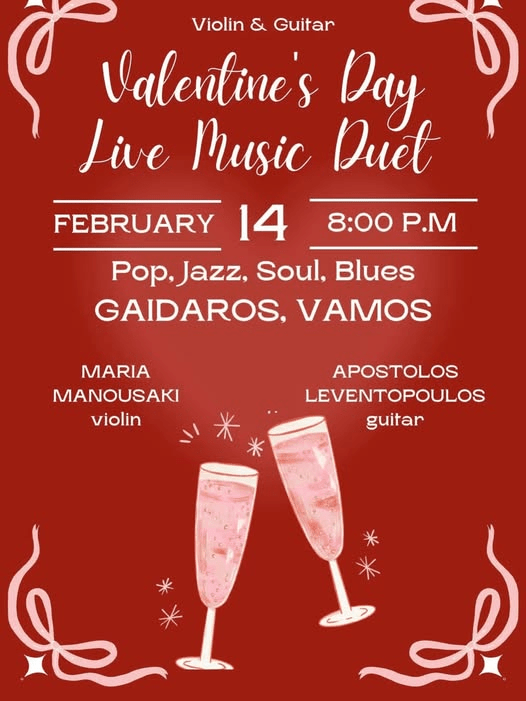
Across the years I have somewhat pompously but with good reason ignored Valentine’s Day. “I will decide when to celebrate my love for Marilyn; when to offer her a present or flowers” was my precious stance. Perhaps I’m softening in my dotage. Tonight we will go to hear Maria Manousaki and Apostolos Leventopoulos weave their improvisatory magic in a programme of jazz and soul. And, before setting off, I will sing ‘My Funny Valentine’ on our terrace accompanied by the migrating love birds from Africa.
Love as Resistance: The Radical History of Valentine’s Day The oligarchy does not want you to know the true history of Valentine’s Day.
I did not know this story and its alternative reading of the accepted narrative.
One of my very favourite singers, Thomas Quasthoff in lieder and now jazz.
Essay: Trump’s Triumph Or Tragedy
Might, overreach and war make work for idle hands
A powerful piece from a commentator it is difficult to pigeon-hole. Sometimes I am at odds. He disturbs the old Leftie in me, for whom old habits, ways of thinking die hard and are not lightly set aside. I’m grateful for his unsettling perspective.
The headlines should be full of contrition for the abuse of children. Instead the establishment media is doing its best to distract. It is a trans-Atlantic scandal that has exposed politicians and corporate leaders, under growing pressure to resign. The issue is not only abuse of children. It is the corruption of public morals that is a sign of societal decline, itself a symptom of the fall of the Western system built upon the exploitation of humans through empire.
AsTime Goes By – a song to be added to my repertoire. Time slips by so quickly too. I’m conscious of losing touch with friends and comrades. Not only physically, inevitable though it is, given my presence on Crete but also via all the other means of communication [for better or worse] available to us. I’m conscious of finding it evermore difficult to write anything worthwhile or indeed to write in the absence of a culture of give and take, in a vacuum wherein speculative thoughts are treated as one’s final indelible word; within which forgiveness is forbidden.
However I am reading voraciously – as usual, to my detriment and to the disbelief of Marilyn, not fiction but article after limitless article of all manner of ideological persuasion. It might well be suggested that this promiscuity is at the heart of my political impotence, my failure to articulate much about anything. I don’t think so. It’s hardly insightful but we live in an increasingly explicit authoritarian world, where the compulsion to censor any expression of opposition to the imposition of varied forms of ideological certitude is rampant. Perchance I exaggerate. Yet, in my lifetime. I do not feel I have experienced such a level of intolerance to dissent or disagreement. And this hostility to heresy infects both the Left and Right with honorable exceptions on both sides of this increasingly redundant binary.
There are contemporary issues I ought to address, simply to share and check out my thinking, whatever its insights, whatever its flaws. I feel anxious, not such a parlous state, given the unbearable fear running through the lives of the people of Palestine, Iran and many places beyond. And, to be contrary, I would be granted permission by the Left to voice my solidarity in this regard, especially as my own political history of support, for example, for the Palestine Liberation Organisation [PLO] goes back to the 1970s. Yet, on other matters, I am advised to be silent. To voice any concern about transgender ideology or the climate change agenda is evidently beyond the pale. To do so is to ask for trouble, to risk excommunication from the ranks of the political righteous. In this instance my past political activism in support of the Gay and Lesbian Movement or my scathing critique of the capitalist imperative, ‘perpetual production, ceaseless consumption’ is irrelevant, not worth a sideways glance.
I am likely to be found guilty by association. After all, isn’t the Trump regime hostile to trans women and men, not to mention enthusiastic about fossil fuels? Case closed, contradictions seemingly not allowed as evidence. Utterances are never placed in context, grounded in the circumstances of their uttering. Biographies, histories are not a source of memories to be both treasured and measured, respected and scrutinised for their past, present and future significance or otherwise. They are to be interrogated for unpardonable sins as defined by today’s Thought Police.
Musing about all of this messy reality is accompanied by a feeling of oft-times hopelessness, which never quite admits defeat. I will continue, even if I fail to say anything useful myself, to point people to commentators I find stimulating from across the ideological spectrum. More than ever I endeavour to read and hear what is actually being said rather than assume to know what is being said on the basis of knee-jerk prejudice, bias and stereotype. I start from the content, not the source. I favour not just freedom of speech but what the Athenians called parrhesia, frank and fearless speech. Foucault revived the concept in his later work – https://foucault.info/parrhesia/
To begin with, what is the general meaning of the word ” parrhesia”? Etymologically, “parrhesiazesthai” means ” to say everything –from ” pan” πάυ and ” rhema” [δήμα] (that which is said). The one who uses parrhesia, the parrhesiastes, is someone who says everything he has in mind : he does not hide anything, but opens his heart and mind completely to other people through his discourse. In parrhesia, the speaker is supposed to give a complete and exact account of what he has in mind so that the audience is able to comprehend exactly what the speaker thinks. The word ” parrhesia” then, refers to a type of relationship between the speaker and what he says. For in parrhesia, the speaker makes it manifestly clear and obvious that what he says is his own opinion. And he does this by avoiding any kind of rhetorical form which would veil what he thinks. Instead, the parrhesiastes uses the most direct words and forms of expression he can find. Whereas rhetoric provides the speaker with technical devices to help him prevail upon the minds of his audience (regardless of the rhetorician’s own opinion concerning what he says), in parrhesia, the parrhesiastes acts on other people’s mind by showing them as directly as possible what he actually believes.
Whether any of this comes to pass, hardly matters, and depends on 2026 being less turbulent personally than this past year. For the first time in my life I’ve been dogged by a variety of health problems, culminating in being rushed into hospital for fear of a stroke. Thankfully a series of scans and tests revealed no visible problems, apart from hinting that I am possessed by a hidden, troubled mind! Given my age, continuing problems with my sight and what Les Dawson with a knowing glance downwards to the prostate would dub a ‘man’s problem’ are hardly unique.
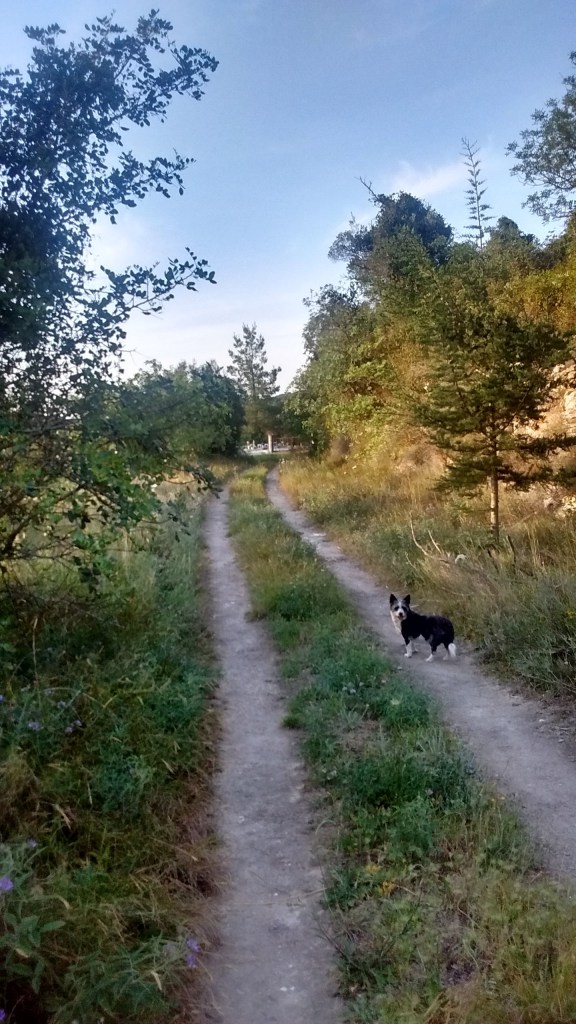
It’s tempting to seek refuge in my beautiful surroundings, walking and cycling as best I can. Sadly I am no longer accompanied on my rambles by dearest, sweetest Glyka, our 17 year old dog and loving companion , who died before Christmas. I was distraught as was Marilyn. Over the years Glyka taught me to appreciate herself, her fellow creatures and indeed Nature itself. She taught me to take my time and take in my surroundings; to acknowledge the cats, which she never chased, the dogs, towards whom she was a bit stand-offish, to chat to the sheep and goats, who sometimes replied imploringly, to be quiet so as to catch the birdsong and to gaze across the olive groves to the splendour of the towering White Mountains. As for herself she watched and listened, ever by my side, but never barked. We were free spirits or so we believed.
My dearest companion, Glyka
From my contact since the beginning of the COVID melodrama with dissidents of all colours I have been struck by how many are of a religious persuasion. Those to whom I’ve warmed have not been of an evangelical bent. However the conversations have often taken a spiritual turn. Over the years I’ve been quietly frustrated by what I see as religion’s appropriation of spirituality as its own. I’ve tried to be true to a spirit of human creativity, of cooperation, of justice and love. These past years closer to Nature, guided by Glyka, Leo, our aristocratic rescue horse, by the playful bin cats I feed, by Stelios’s adventurous goats, amazed by the way our brick-strewn barren garden has blossomed, I have sensed another level of spiritual awareness. Nevertheless I remain an atheist. I feel no need for a deity to give purpose to my existence. I remain a revolutionary humanist, a steadfast universalist, who has come to cherish the Earth in all its glory.
I do not know what I would do without music to soothe my spirits. Last week I sang ‘a capella’ in our village hall. I began with Dowland’s desire, ‘Music, music for a while, shall all your cares beguile’- somewhat truncated and hardly as beautiful as the wonderful Alfred Deller.
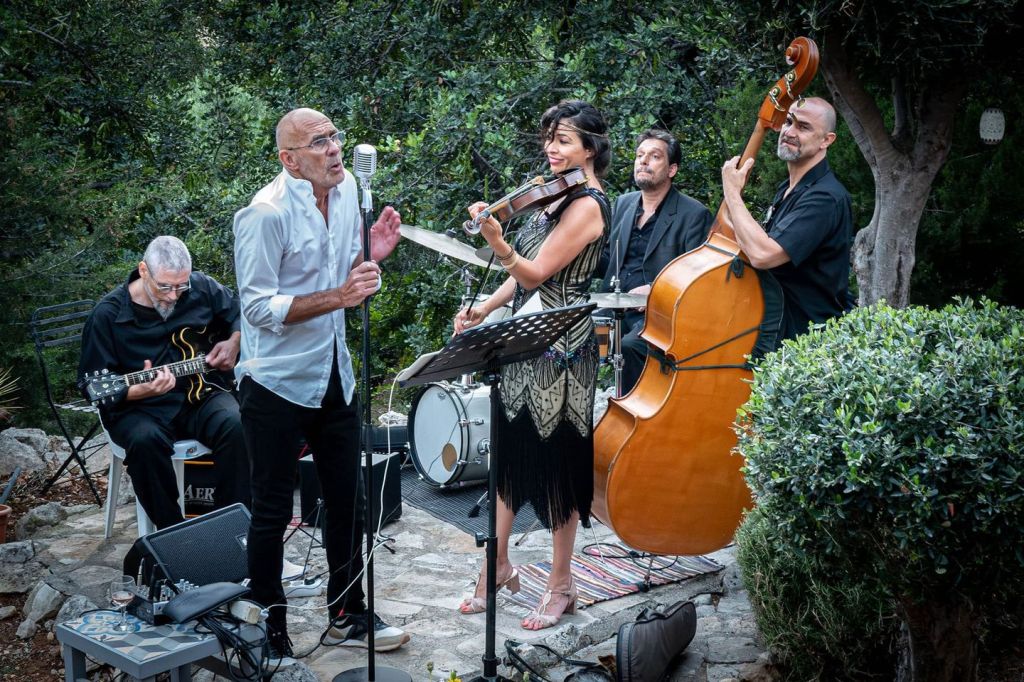
My generous neighbour, Ken Carpenter filmed some of the concert I gave to a small audience in our village hall. If I have the courage I will post a link to these videos soon. Listening and encouraging my effort, even entranced [!] were my very dearest friends, Maria and Linda Manousaki. Maria is an inspiration, not only as violin virtuoso but also as the driving force behind the diverse groupings of musicians she brings together here on Crete – for example, two very different string quartets, the Melos Ensemble play arrangements from the classical and jazz repertoires, whilst Tetracho improvise upon the indigenous Cretan tradition . In the next few weeks Linda at the piano and I will be rehearsing songs from American musicals. She will engage with my musical myopia, symbolised by the worried, ‘what key are we in?’ Who knows I might even sing accompanied sometime in the future!? We will see.
Privileged to be singing with Maria and the Swinging Strings
This piece is silent on the impact of Artificial Intelligence on our lives. It does not speak directly to the killings on the streets of Gaza, Teheran and Minneapolis. The silence is not by chance. I will break it but doing so is haunted by the knowledge that increasingly words, sounds and images tease, alarm as to their authenticity. It has always been necessary to be critical of what we read, hear and see. Today it is an unceasing and tiring obligation. And through the fog enveloping the truth I am inspired by the sight of ordinary people acting courageously in unison, striving against the odds to be agents of their own destinies. I refuse the concerted attempts across the ideological divide to deny them their autonomy, to cast them as mere pawns in the clutches of the oligarchs, the intelligence agencies, the corporations, the technocrats, the media, right or left-wing agitators or whomever.
Solidarity from an armchair radical, who needs to get on his bike.
Love & struggle,
Tony
On reading afresh this New Year’s ramble I’m afraid to say it’s more of the same navel-gazing as previous years – the same doubts and the same themes. Somewhat wearying, I fear. At the same time it indicates that the social and political situation isn’t getting better. Indeed it’s getting worse.
In an interview on Bad Faith, Gabor Mate suggests he has never experienced such darkness.
I grew up in a working class household where music was the means of escape from the ordinariness of life. My father sang and played the drums. He adored Al Jolson and Gene Krupka. My mother loved opera. She had heard Beniamino Gigli live. She adored Renata Tebaldi, hated Maria Callas. My dad and I sang in the church choir, where I, being blessed with a pleasant treble voice, did my best with solos from Mozart and Mendelssohn. I loved to sing.
And in 1964, quite by chance, I discovered the amazing voice of Cleo Laine, sensual and acrobatic, covering, it was said, four octaves. At that very moment I was involved in a perhaps foolhardy initiative led by our gentle and inspiring English teacher, Mr Harrison to perform the Seven Ages of Man, a Shakespearean medley created by the legendary actor. John Gielgud. There were four of us Grammar School boys covering the various speeches and sonnets. One of my contributions was the heart-rending piece from Act Four of the bizarre play, Cymbeline, ”Fear no more the heat of the sun’. I tried again to do my declamatory best, earning the praise of one of the school’s cleaners at a particular rehearsal in our impressive assembly hall. Clapping politely as I finished, she declared I had a lovely chocolate voice. A compliment I’ve treasured over the years.
At about that time I had started a record collection of almost entirely classical music. Being romantically inclined, Brahms and Dvorak were favourites. I could only afford the budget labels, Ace of Clubs and Golden Guinea and had to travel on the number 26 bus into Manchester to find a classical-minded store. The hour’s journey through the suburbs, some even leafy, was well worth it. The joy of rifling through the stacked LPs in alphabetical order under the brotherly eye of an enthusiast, only too willing to discuss the ins and outs of interpretations of great masterpieces. I didn’t always understand what he was going on about but he showered sophistication upon me. And, then, one day there in my clutches was the stereo Fontana LP, ‘Shakespeare and all that Jazz’ featuring Cleo Laine and Johnny Dankworth and one track leapt off the cover, ‘Fear No More’. Thanks to the kindly owner I bought the record on instalments. I played it to death. She did possess the most wondrous of voices from contralto to coloratura. To me, she was to jazz what Callas was to opera. I lent the LP never to see it again. As best I know it was never released on CD.
Moving forward half a century and more, I renewed my desire to sing under the guidance of Ian Brothwood. Through our love for English art song we found Gerald Finzi’s moving setting of ‘Fear No More’. I did my best to do its beauty justice at a number of private soirees. To my shame I’d forgotten Dankworth’s version and Cleo’s interpretation. Such is age.
Thus sadly I have rediscovered Cleo with her death. I hope she will have ‘quiet consummation’ and know that ‘renowned will be her grave’. Much joy and sorrow awaits me as I journey afresh through her amazing career.
Fear no more the heat o’ the sun; Nor the furious winter’s rages, Thou thy worldly task hast done, Home art gone, and ta’en thy wages; Golden lads and girls all must, As chimney sweepers come to dust.
Fear no more the frown of the great, Thou art past the tyrant’s stroke: Care no more to clothe and eat; To thee the reed is as the oak: The sceptre, learning, physic, must All follow this, and come to dust.
Fear no more the lightning-flash, Nor the all-dread thunder-stone; Fear not slander, censure rash; Thou hast finished joy and moan; All lovers young, all lovers must Consign to thee, and come to dust.
No exorciser harm thee! Nor no witchcraft charm thee! Ghost unlaid forbear thee! Nothing ill come near thee! Quiet consummation have; And renowned be thy grave!
And isn’t this a wonderful rendition of ‘Killing Me Softly’
The powerful, the ruling class of any historical period has spread fear as an essential element in the maintenance of its social and political control. Hence I’m stretching a point to suggest that we are living through an unprecedented era of Anxiety. And yet, even today, I’ve been warned to beware a possible proliferation of epidemic-catalysing viruses, all given the COVID script being existential threats, and instructed to fill the larder with supplies sufficient to last 72 hours in case of war.
We imagine the world as unsafe, and then we dream the world as unsafe, and then feel in our bodies that the world is unsafe. And this is an inverted order of things, the opposite of how our bodies come to knowledge. Rhyd Wildermuth
Sometime, perhaps never, I will seek to explore the contemporary phenomenon of algorithmic- created anxiety. For now, in the past few weeks I’ve sought to escape being suffocated inside the virtual by way of being scared of reality, namely giving another solo concert in my Cretan village. The nerves did indeed jangle. If you are kind enough to watch the two videos below you might well discern my tension. In terms of the songs themselves, it’s most obvious in my rushing through the Schubert composition, ‘Der Leiermann’, losing on the way much of its ambiguous mystery. Next time…….
A couple of people have asked for details of the latest programme. If I wasn’t so nervous about singing in the correct key I would relax and say more about the songs at the concert itself.
1. 0 Waly, Waly
Somerset folk song
2. Somewhere a Voice’s Calling and Smilin’ Through
American Parlour-Songs recorded in 1914 and 1919 by John McCormack, the famous Irish lyric tenor and sung by me as a boy soprano in 1957!!
3. Unbelievable, The Nearness of You and Bewitched, Bothered and Bewildered
American classics and often jazz standards – Livingstone, Carmichael and Rodgers
4, Hands, Eyes, Heart and Tired – Vaughan Williams and Now Sleeps the Petal – Quilter.
English Art Song
5. I am a Poor Wayfaring Stranger
North American folk song and spiritual
6. Ti eínai aftó pou to léne agápi from the Boy on a Dolphin, If I Loved You from Carousel and Summertime from Porgy and Bess
Songs from film and musicals – Morakis, Rodgers and Gershwin
Interval.
7. Im Wunderschönen Monat Mai – Schumann, Das Wandern and Der Leiermann – Schubert
German Lieder
8. Danny Boy
Irish folk song
9. My Funny Valentine, When I Fall in Love and The First Time Ever I Saw Your Face
Classic Love songs – Rodgers, Young and MacColl
10. Whither do I wander – Vaughan Williams, Sea Fever – Ireland and Come Again – Dowland
English and Elizabethan song
11. One Little Quarrel and Guilty
Tribute to Al Bowly and 1930s dance bands
12. Πάμε μια βόλτα στο φεγγάρι or Let’s take a walk to the moon
Greek classic – Hadjidakis
———————————————————————————————————————————————
Our villagekafeneio, H Elpida, the cafe of Hope
There seems little doubt, in my mind, that preparing for and giving this little concert, despite the blemishes, kept me out of what Anthony Rella calls the ‘psychic pollution’ infecting our relation to the internet and social media. OK, I admit, the warbling kept me away only for some of the time. Certainly I would suggest that prioritising time away from the screen in all its forms is a necessary form of resistance to the Machine. Lately I’ve gone back to printing off copies of stuff I’d like to read and taking them to peruse in the village kafeneio. A precious bonus is that Georgos brews a fine cappuccino and I get to pass the time of day with our village’s motley characters.
I must close by thanking Ken Carpenter for filming and editing the videos – all out of the goodness of his heart.
It’s mid-day and I’m sitting pensively in the corner of the village kafeneio, ‘Ελπίδα’, the Greek word for Hope – something on which to cling. It’s unusually cold for Crete, barely ten degrees even now. The sky is, a monochrome, ominous grey, so dull and dead that even Marilyn’s delicate paintbrush, would fail to bring it to life. It is raining off and on but the downpour is sufficient to turn the steep descent from our house into a bubbling stream. My feet are soaking cold – note to myself to purchase some ‘wellies’. Fortunately Giorgos has lit the wood burner, attracting into the kafeneio’s intimate confines a mix of the regular ‘lads’, a sprinkling of ‘lasses’, not to mention a quartet of spoilt and photogenic cats, seeking the comfort of my lap. In the kitchen, given it’s the weekend, the speciality of boiled goat and pilaffi is being prepared. The tasty concoction will be ready by this evening. For our part, Marilyn and I will debate whether to resist its delight and wait until Monday when a goat stifado or stew might make a magical appearance. That’s if there is sufficient goat left over from the Sunday. Should we take the risk?
Enough distracted thoughts. I’m making as usual hard work of composing a couple of things Firstly, I’m striving to engage with the tsunami of opinion in which we’re drowning and why, in the thrashing about to survive, many, it seems ‘stick to what they know’. Secondly, more pressing, in a couple of weeks, I’m giving a talk, “Free Speech In Authoritarian Times’ as a contribution to a winter series held in the old school hall of the nearby village of Kalamitsi. These exchanges are organised by Phil and Francesca Harrison, both key people across the years in stimulating the growth of a diverse cultural life in our area. For example, the two previous talks were on ‘Artificial Intelligence’ and ‘James Joyce’ respectively.
Singing in 1958
Ahead of talking freely in a fortnight I gave a concert of songs ‘a capella’ in the Gavalochori Cultural Centre a week ago. The blurb on a few home-made posters in English and Greek went as follows:
A Voice of Nostalgia: Μια Φωνή Νοσταλγία
Tony Taylor will sing without accompaniment, ‘a capella’, on Saturday, February 1st in the Cultural Centre, Gavalochori. The concert will start at 11.30 a.m. He will draw upon folk and popular music, American musical theatre and the English Renaissance.
I made a few blunders. Setting off in the wrong key has its strangulated and embarrassing results.. Whatever the audience was both supportive and participative, if, at times, a trifle out of sympathy with my tempo and interpretation. Indeed there is talk of a future nostalgic happening. Although some have suggested somewhat sarcastically that perhaps I could venture for my material into more recent decades.
By chance, Ken Carpenter, unbeknown to me, was kind enough to video and edit a number of the opening numbers. Gritting my teeth here it is.
Thinking now about the content of the recital and given my politics, I’m conscious that, apart from a brief change of verse in my tribute to the great Paul Robeson, there were no moments of rebellion. Even my one Greek number was romantic. For next time I’ve got a couple up my sleeve.
However I did find myself musing that here on Crete there is a rich, overflowing tradition of musical resistance, about which I need to understand more. Back in the kafeneio two nights ago, there erupted an impromptu evening, sustained by that wondrous instrument the lyra, where so many of those present knew the local folk songs backwards. By chance, only yesterday I tripped over this apposite piece by my favourite Appalachian philosopher, W.D.James, on the power of people’s music. It’s well worth a read.
As a break from my usual ramblings on the state of the world but not at all at odds with its philosophy, enjoy this brief extract of the quartet, ‘ΤΕΤΡΑΗΧΟ”, playing in the picturesque village of Pollirinia on Crete back in July 2023. I’ve been privileged to hear them breaking boundaries with this unusual combination of instruments and styles. My dear friend, Maria, an outstanding jazz violinist brought together two great figures from the Cretan violin tradition in Michalis and Markos, together with the outstanding lute player, Kiriakos to explore and improvise without any guarantees of whether it would work. The outcome was a joyous, anarchic celebration of intimate music-making founded on listening, always listening to one another. You should have heard their exuberant version of a Brahms Hungarian Dance! It exuded a love of humanity, a mutual affection, which more than ever we need to defend. I’m still trying to ascertain who won the children’s running race taking place in the background! Kids!
Thanks to Autonomies, where I found this ‘powerful’ testimonial.
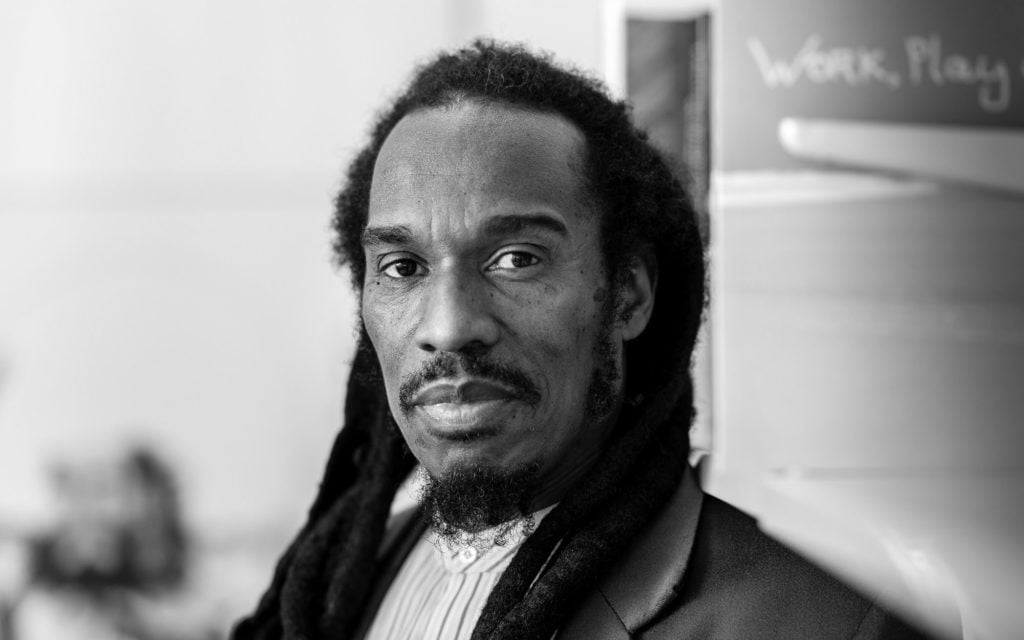
A testimonial by poet and writer Benjamin Zephaniah
I got political after I suffered my first racist attack at the age of seven. I didn’t understand any political theory, I just knew that I had been wronged, and I knew there was another way. A few years later, when I was fifteen a marked police car pulled up to me as I walked in Birmingham in the early hours of the morning, three cops got out of the car, they pushed me into a shop doorway, then they beat me up. They got back into their car, and drove off as if nothing had happened. I had read nothing about policing policy, or anything on so-called law and order, I just knew I had been wronged. When I got my first job as a painter, I had read nothing on the theory of working class struggles or how the rich exploited the poor, but when my boss turned up every other day in a different supercar, and we were risking our lives up ladders and breathing in toxic fumes, I just knew I had been wronged.
I grew up (like most people around me) believing Anarchism meant everyone just going crazy, and the end of everything. I am very dyslexic so I often have to use a spellchecker or a dictionary to make sure I’ve written words correctly. I was hearing words like Socialism and Communism all the time, but even the Socialists and Communists that I came across tended to dismiss Anarchists as either a fringe group, who they always blamed if there was trouble on demonstrations, or dreamers. Even now, I just checked a spellchecker and it describes Anarchism as chaos, lawlessness, mayhem, and disorder. I like the disorder thing, but for the ‘average’ person, disorder does mean chaos, lawlessness, and mayhem. The very things they’re told to fear the most.
The greatest thing I’ve ever done for myself is to learn how to think for myself. I began to do that at an early age, but it’s really difficult to do that when there are things around you all the time telling you how to think. Capitalism is seductive. It limits your imagination, and then tells you that you should feel free because you have choices, but your choices are limited to the products they put before you, or the limits of your now limited imagination. I remember visiting São Paulo many years ago when it introduced its Clean City Law. The mayor didn’t suddenly become an Anarchist, but he did realise that the continuous and ubiquitous marketing people were subjected to was not just ugly, but distracting people from themselves. So more than 15,000 marketing billboards were taken down. Buses, taxis, neon and paper poster advertisements were all banned. At first it looked a little odd, but instead of either looking at, or trying not to look at advertising broads, I walked, and as I walked I looked around me. I found that I only purchased what I really needed, not what I was told I needed, and what was most noticeable was that I met and talked to new people every day. These conversations tended to be relevant, political, and meaningful. Capitalism keeps us in competition with each other, and the people who run Capitalism don’t really want us to talk to each other, not in a meaningful way.
I’m not going to go on about Capitalism, Socialism, or Communism, but it is clear that one thing they all have in common is their need for power. Then to back up their drive for power they all have theories, theories about taking power and what they want to do with power, but therein lies the problem. Theories and power. I became an Anarchist when I decided to drop the theories and stop seeking power. When I stopped concerning myself with those things I realised that true Anarchy is my nature. It is our nature. It is what we were doing before the theories arrived, it is what we were doing before we were encouraged to be in competition with each other. There have been some great things written about Anarchism, and I guess that’s Anarchist theory, but when I try to get my friends to read these things (I’m talking about big books with big words), they get headaches and turn away. So, then I turn off the advertising (the TV etc.) and sit with them, and remind them of what they can do for themselves. I give them examples of people who live without governments, people who organise themselves, people who have taken back their own spiritual identity – and then it all makes sense.
If we keep talking about theories then we can only talk to people who are aware of those theories, or have theories of their own, and if we keep talking in the round about theories we exclude a lot of people. The very people we need to reach, the very people who need to rid themselves of the shackles of modern, Capitalistic slavery. The story of Carne Ross is inspiring, not because he wrote something, but because he lived it. I love the work of Noam Chomsky and I love the way that Stuart Christie’s granny made him an Anarchist, but I’m here because I understand that the racist police who beat me have the state behind them, and the state itself is racist. I’m here because I now understand that the boss-man who exploited me to make himself rich didn’t care about me. I’m here because I know how the Marrons in Jamaica freed themselves and took to the hills and proved to all enslaved people that they (the Marrons), could manage themselves. Don’t get me wrong, I love books (I’m a writer, by the way), and I know we need people who think deeply – we should all think deeply. But my biggest inspirations come from everyday people who stop seeking power for themselves, or seeking the powerful to rescue them, and they do life for themselves. I have met people who live Anarchism in India, Kenya, Jamaica, Ethiopia, and in Papua New Guinea, but when I tell them they are Anarchists most will tell me they have not heard of such a word, and what they are doing is natural and uncomplicated. I’m an Anarchist because I’ve been wronged, and I’ve seen everything else fail.
I spent the late seventies and the eighties living in London with many exiled ANC activists – after a long struggle Nelson Mandela was freed and the exiles returned home. I remember looking at a photo of the first democratically elected government in South Africa and realising that I knew two thirds of them. I also remember seeing a photo of the newly elected Blair (New Labour) government and realising that I knew a quarter of them, and on both occasions I remember how I was filled with hope. But in both cases it didn’t take long to see how power corrupted so many members of those governments. These were people I would call and say, “Hey, what are you doing?”, and the reply was always something along the lines of, “Benjamin, you don’t understand how having power works”. Well I do. Fuck power, and lets just take care of each other.
Most people know that politics is failing. That’s not a theory or my point of view. They can see it, they can feel it. The problem is they just can’t imagine an alternative. They lack confidence. I simply blanked out all the advertising, I turned off the ‘tell-lie-vision’, and I started to think for myself. Then I really started to meet people – and, trust me, there is nothing as great as meeting people who are getting on with their lives, running farms, schools, shops, and even economies, in communities where no one has power.
An antidote to the despair induced by the combined ferocity of Zionism (“Christian,” “Jewish”) and Judaeophobia
At this nightmarish moment of pandemic hate, we badly need to be reminded of the possibility that we can come together, and thereby defeat the forces dedicated to dividing us, by keeping both sides in a genocidal rage—which, if it doesn’t kill you outright, will only make you that much easier to kill, through other means.
To put it differently, we can and must resist the atavistic call to join the sort of “holy war” that drenched the Middle East, and so much of Europe, and Byzantium, in blood throughout the centuries of the Crusades, with oceans more spilled during the Reformation, then the Counter-Reformation. We need, in short, to rediscover the great prior time of Convivencia, in Spain, when Muslims, Jews and Christians lived in harmony, and flourished culturally, for some three centuries of the (so-called) “Dark Ages.”
The glory of that possibility resounds from this exhilarating mass performance of “One Day,” sung in English, Arabic and Hebrew, in Haifa, just five years ago.
Please watch and listen, and then share it if you like, because its spirit is enough to help us overcome the hate that has now been so deftly engineered to have us at each other’s throats, so that we fail to see what’s coming down on all of us, and has been for some four years.
From M. Hall:
“Matthew Paul Miller – known by his Hebrew name Matisyahu is a Jewish reggae singer.
In 2018 he asked 3,000 Muslims and Jews in Haifa (none of whom had ever met before) to come together and learn the song “One Day” with him in less than an hour. Not only that, they also learned to sing and harmonize the song in threedifferent languages. The concert that resulted from this brings the spirit of the new era into the world.
There is an incomprehensible power inherent in the spirit of UNITY, LOVE and CONNECTION.
Carrying this power TOGETHER into the world is the new WE ❤️ “
On the possibility of Convivencia—a possibility that was once realized in the “Dark Ages,” which evidently were less “dark” than the later centuries of Christian (or “Christian”) primacy.
Tomorrow. all being well. there’ll be a belated report from the first Cretan Chatting Critically meeting held in Gavalohori in March, together with notice of the next meeting to take place on Tuesday, April 25 in the same venue, H Ελπίδα.
Given our first discussion touched both on Freedom and Hope, here’s a song from HK (& Les Saltimbanks), Toi et moi, ma liberté – with translation.
You and me, my freedom This is where it all begins Time may well stop For a new dance You and me, my freedom
Tonight the city is asleep Humans have their minds elsewhere Do you know that for you my friend I will sing for hours
I will open the windows wide To contemplate the joys of the sky And I will see you appear Like a flash, a spark
This is where it all begins
Time may well stop For a new dance You and me, my freedom
This is where it all begins Time may well stop For a new dance You and me, my freedom
Last the walls and the facades And the speeches of circumstance A few imprudent people escape Freeing themselves from proprieties
And here they are joining us Like in a big popular ball Do you feel our sorrows slipping away Tomorrow will be more beautiful than yesterday
This is where it all begins Time may well stop For a new dance You and me, my freedom
This is where it all begins Time may well stop For a new dance You and me, my freedom
Friends, trees are in bloom And here we are again Like brothers, like sisters And the soldiers are disarmed
We dance barefoot on the Earth We pitch on the roof of the world
HK et Les Saltimbanks is a French popular music group from the Lille metropolis.
HK, son of an immigrant and Roubaisien, develops ideas of nomadic utopias and tells the stories of the homeless, Tuaregs and revolutionaries in the first album entitled‘‘Citoyen du monde’. They are known for their committed texts dealing with social struggles…
The ruling class, the elite, the powerful [call them, what you will] wish to render us perpetually anxious. In the last few years energised by the ‘pandemic’, their propaganda has sought to leave us in a suspended state of fear. The next existential crisis, the latest emergency is always imminent, staring us in our oft-masked faces or lying suspiciously in wait just around the next corner. We are witnessing disaster capitalism in full flight from the consequence of its wilful, almost mindless exploitation of humanity and the earth.
Aided by their behavioural lackeys and the supine mainstream media, they use the time-honoured and still profoundly effective tactic of ‘divide and rule’. To this end, politicians, bureaucrats, psychologists and journalists [or rather stenographers] lie and deceive. In particular the unvaccinated were identified, chastised and depicted as a death-inducing threat to young and old, whilst children were told they could kill their grandparents. Medical practitioners, great and small, questioning the absurdity of governments’ claim to be following the Science had their reputations and prospects trashed.
As for ourselves how do we explain our embrace of or our resistance to this calculated conspiracy of contempt? On what I suppose is my side of the fence many took to Mattias Desmet’s theory of mass formation psychosis, in which a majority of society is said to have been captured and mesmerised by the dominant narrative. I am not so taken. Such a generalised view of human practice offends my decades-long, faltering attempt to comprehend the unique, yet always social individual. For my part I prefer to call on the idea of ‘uneven consciousness’ to express the differing degrees of consistency and contradiction in our thought and practice. I am loathe to accept that people are hypnotised into compliance with authoritarianism. I am loathe to see those, who have disobeyed the orders from above, as enlightenment incarnate. In the main, we are neither sinners nor saints.
Tellingly none of the draconian restrictions upon our existence suffered during the ‘pandemic’ were even subject to the illusions of representative democracy. Parliaments were utterly ignored. The demos was conspicuous by its absence. For now, the constraints have been largely lifted but continue to be available as the powerful see fit.
It seems to me, to borrow Malcolm Ball’s favourite opening caveat, that the dehumanising grip of technocratic authoritarianism can only be loosened by the emergence of diverse forms of direct democracy at local regional, national and international levels. To imagine such a revolutionary development demands humility on all fronts. It will demand being in critical dialogue across ideologies and faiths, which have seen themselves as in opposition to one another. It will require listening to one another, setting aside prejudices, refusing to jump to immediate judgements. It will necessitate cooperating in the service of a shared sense of purpose despite significant disagreements. For what it’s worth, back in the 1980s I was mortified by the refusal of feminists, whom I knew well, to support the 84/85 Strike on the grounds of the miners’ sexism. Yet, across ensuing years we worked together across a range of political issues. Today, given the emphasis on identity politics. is it possible to envisage relating to someone, who joins the public service picket lines, is involved in ‘Kick Racism Out ‘ yet continues to believe that biological sex matters? Is this person to be excluded from the oppositional alliances we need to create? We need beware the imposition within our own ranks of correct lines, which cannot be criticised, lest excommunication follows.
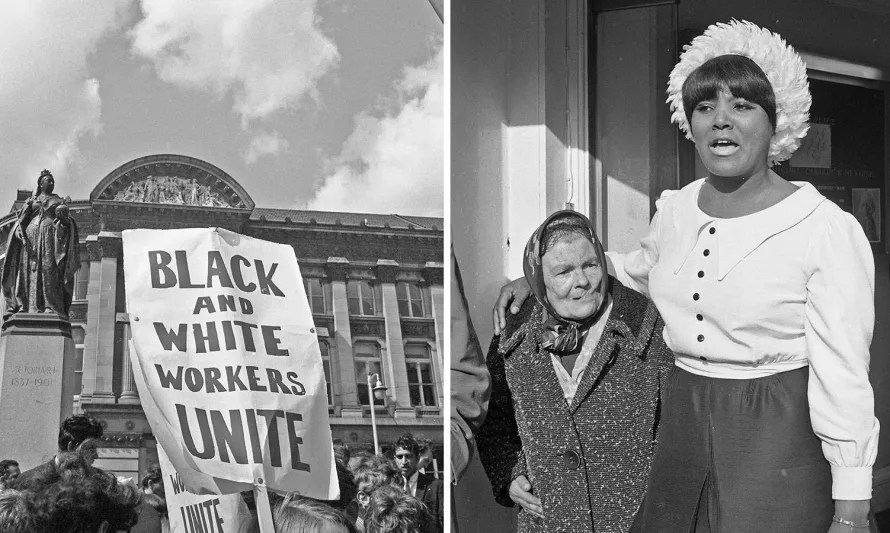
Images from the 1970s in Birmingham, I think – trying to find out more. Ta to the flatpackfestival.org.uk
Who you are is what you do
The politics of identity which led individuals to use an innate aspect (their gender, colour etc) as ipso facto a right from which to judge others, could itself become a way of setting up a hierarchy of oppressions. Siva criticised all forms of identity politics which did not reach out to try to transform society, for, not just the self, but for all. The transformation of the individual would take place in the process of a larger collective struggle but a politics based in the self would not open out in that way. Identity would not be confirmed in isolation. ‘Who you are is what you do’ [A. Sivanandan writing in the 1980s]
To paraphrase something I wrote long before I came across the idea of intersectionality. ‘My point is no more and no less than that the political struggle for individual and social autonomy, against technocratic authoritarian capitalism, must have a rounded and interrelated understanding of the oppressive and exploitative relations of class, gender, race, sexuality, disability and faith. None of them makes emancipatory sense without constant reference to each other’.
Time to take a breath I set off scribbling without knowing where I was going. Obviously, this erratic ensemble of assertions begs more questions than it answers. If only for my own sanity I’ll pursue these in future posts in 2023. We will see.
A Day in the Life of…….
One of Marilyn’s latest paintings, ‘A Village at Dusk’
Of course these perhaps pretentious and pompous pronouncements are the backdrop to ordinary folk getting on with their ordinary, sometimes weary, sometimes invigorating lives. On the ground, my somewhat pessimistic outlook is countered by people simply getting on with things. As for ourselves on the morning of New Year’s Eve, I walked our Glyka, disobeying my music teacher’s instructions not to warble a particular song because in doing so I compounded my mistaken entry – the piece being John Ireland’s setting of ‘Sally Gardens’. If this sounds stuffy I also tried ‘Georgia on my mind’.
After carefully cooked bowls of porridge dripping with honey poured over our very own oranges, managed expertly with cats on her knee, Marilyn fled the house, cash in hand, eager to exchange greetings in our local shops, where everyone knows everyone. Essentials purchased, word had it that some new horses and donkeys had appeared in a nearby village so Marilyn went off in search. To her joy she found them. To her frustration she couldn’t get near enough to inhale their seductive smell. Next time?
In the afternoon we joined hands, electric saw and axe at the ready, in cutting and chopping wood for our two stoves, our primary source of heating – a fall from environmental grace to be rectified, cost allowing, who knows when? After which Marilyn started a new water-colour and I amused as ever the blokes seated outside the village kafeneio by my ageing effort to race walk. To be fair their generous shouts of ‘Bravo’ spurred me on. As dusk fell I accompanied a sciatica-stricken friend’s dogs, Filos and Toula on their evening traipse. I’ve grown to love dogs and there’s something about the three of us having a roadside piss together that cheers me up no end.
Back home preparations for the evening were in full swing. As is only proper Marilyn was making a Hot-Pot with a suet crust, decorated with homemade red cabbage. It was beltin’. There being no real ale available it was washed down with a mix of sparkling plonk and the local village red. Thus fortified we watched an old black and white Agatha Christie film with Charles Laughton and Marlene Dietrich, compellingly all dialogue and no action. Not a car chase in sight. Fortunately, perchance the alcohol, we’d both forgotten the last-minute twist in the courtroom drama wherein Marlene executes her faithless lover. He had it coming. Thence to the highlight of any New Year’s Eve, at least in Germany, the comedy sketch, ‘Dinner for One’, featuring the wonderful Freddie Frinton as the drunken butler, a role he had honed on stage in Britain’s music halls. Evidently, first shown in 1962 on German television, it has acquired cult status in the country.
By this time midnight was still two hours away and the writing was on the wall. Not for the first time, we wouldn’t be welcoming in the New Year. After all nobody was likely to turn up as the first foot through the door with a piece of coal in hand. Hence Marilyn, head buried in her latest book, was in bed by 10ish with a cup of hot chocolate and the ever-faithful, Glyka. She was fast asleep by 11. Basking in the glow of the dying embers I watched a bit of football before putting on some soothing Satie. I was so soothed I fell asleep and wasn’t disturbed even by the rattle of gunfire and blast of explosions echoing across our valley. I crept to bed in the New Year to dream of revolution and the overthrow of capitalism. It’s getting to be something of a tradition.
Time’s running out for me but the fight continues on the streets of Iran, in the fields of Holland and India, on picket lines across the globe and in a plethora of places out of sight, out of mind as far as our ‘betters and experts’ are concerned.
Here’s to a New Year, in which we stop bickering amongst ourselves and renew our shared sense of solidarity in the face of a would-be tyranny, within which our existence will be increasingly policed ‘for our own good’.







 CHATTING CRITICALLY