Musings on the politics of youth work, community work and society at large – dedicated to the memory of Steve Waterhouse, Malcolm Ball and Sue Atkins, great youth workers, comrades and human beings
Across the years I have somewhat pompously but with good reason ignored Valentine’s Day. “I will decide when to celebrate my love for Marilyn; when to offer her a present or flowers” was my precious stance. Perhaps I’m softening in my dotage. Tonight we will go to hear Maria Manousaki and Apostolos Leventopoulos weave their improvisatory magic in a programme of jazz and soul. And, before setting off, I will sing ‘My Funny Valentine’ on our terrace accompanied by the migrating love birds from Africa.
Love as Resistance: The Radical History of Valentine’s Day The oligarchy does not want you to know the true history of Valentine’s Day.
I did not know this story and its alternative reading of the accepted narrative.
One of my very favourite singers, Thomas Quasthoff in lieder and now jazz.
Essay: Trump’s Triumph Or Tragedy
Might, overreach and war make work for idle hands
A powerful piece from a commentator it is difficult to pigeon-hole. Sometimes I am at odds. He disturbs the old Leftie in me, for whom old habits, ways of thinking die hard and are not lightly set aside. I’m grateful for his unsettling perspective.
The headlines should be full of contrition for the abuse of children. Instead the establishment media is doing its best to distract. It is a trans-Atlantic scandal that has exposed politicians and corporate leaders, under growing pressure to resign. The issue is not only abuse of children. It is the corruption of public morals that is a sign of societal decline, itself a symptom of the fall of the Western system built upon the exploitation of humans through empire.
AsTime Goes By – a song to be added to my repertoire. Time slips by so quickly too. I’m conscious of losing touch with friends and comrades. Not only physically, inevitable though it is, given my presence on Crete but also via all the other means of communication [for better or worse] available to us. I’m conscious of finding it evermore difficult to write anything worthwhile or indeed to write in the absence of a culture of give and take, in a vacuum wherein speculative thoughts are treated as one’s final indelible word; within which forgiveness is forbidden.
However I am reading voraciously – as usual, to my detriment and to the disbelief of Marilyn, not fiction but article after limitless article of all manner of ideological persuasion. It might well be suggested that this promiscuity is at the heart of my political impotence, my failure to articulate much about anything. I don’t think so. It’s hardly insightful but we live in an increasingly explicit authoritarian world, where the compulsion to censor any expression of opposition to the imposition of varied forms of ideological certitude is rampant. Perchance I exaggerate. Yet, in my lifetime. I do not feel I have experienced such a level of intolerance to dissent or disagreement. And this hostility to heresy infects both the Left and Right with honorable exceptions on both sides of this increasingly redundant binary.
There are contemporary issues I ought to address, simply to share and check out my thinking, whatever its insights, whatever its flaws. I feel anxious, not such a parlous state, given the unbearable fear running through the lives of the people of Palestine, Iran and many places beyond. And, to be contrary, I would be granted permission by the Left to voice my solidarity in this regard, especially as my own political history of support, for example, for the Palestine Liberation Organisation [PLO] goes back to the 1970s. Yet, on other matters, I am advised to be silent. To voice any concern about transgender ideology or the climate change agenda is evidently beyond the pale. To do so is to ask for trouble, to risk excommunication from the ranks of the political righteous. In this instance my past political activism in support of the Gay and Lesbian Movement or my scathing critique of the capitalist imperative, ‘perpetual production, ceaseless consumption’ is irrelevant, not worth a sideways glance.
I am likely to be found guilty by association. After all, isn’t the Trump regime hostile to trans women and men, not to mention enthusiastic about fossil fuels? Case closed, contradictions seemingly not allowed as evidence. Utterances are never placed in context, grounded in the circumstances of their uttering. Biographies, histories are not a source of memories to be both treasured and measured, respected and scrutinised for their past, present and future significance or otherwise. They are to be interrogated for unpardonable sins as defined by today’s Thought Police.
Musing about all of this messy reality is accompanied by a feeling of oft-times hopelessness, which never quite admits defeat. I will continue, even if I fail to say anything useful myself, to point people to commentators I find stimulating from across the ideological spectrum. More than ever I endeavour to read and hear what is actually being said rather than assume to know what is being said on the basis of knee-jerk prejudice, bias and stereotype. I start from the content, not the source. I favour not just freedom of speech but what the Athenians called parrhesia, frank and fearless speech. Foucault revived the concept in his later work – https://foucault.info/parrhesia/
To begin with, what is the general meaning of the word ” parrhesia”? Etymologically, “parrhesiazesthai” means ” to say everything –from ” pan” πάυ and ” rhema” [δήμα] (that which is said). The one who uses parrhesia, the parrhesiastes, is someone who says everything he has in mind : he does not hide anything, but opens his heart and mind completely to other people through his discourse. In parrhesia, the speaker is supposed to give a complete and exact account of what he has in mind so that the audience is able to comprehend exactly what the speaker thinks. The word ” parrhesia” then, refers to a type of relationship between the speaker and what he says. For in parrhesia, the speaker makes it manifestly clear and obvious that what he says is his own opinion. And he does this by avoiding any kind of rhetorical form which would veil what he thinks. Instead, the parrhesiastes uses the most direct words and forms of expression he can find. Whereas rhetoric provides the speaker with technical devices to help him prevail upon the minds of his audience (regardless of the rhetorician’s own opinion concerning what he says), in parrhesia, the parrhesiastes acts on other people’s mind by showing them as directly as possible what he actually believes.
Whether any of this comes to pass, hardly matters, and depends on 2026 being less turbulent personally than this past year. For the first time in my life I’ve been dogged by a variety of health problems, culminating in being rushed into hospital for fear of a stroke. Thankfully a series of scans and tests revealed no visible problems, apart from hinting that I am possessed by a hidden, troubled mind! Given my age, continuing problems with my sight and what Les Dawson with a knowing glance downwards to the prostate would dub a ‘man’s problem’ are hardly unique.
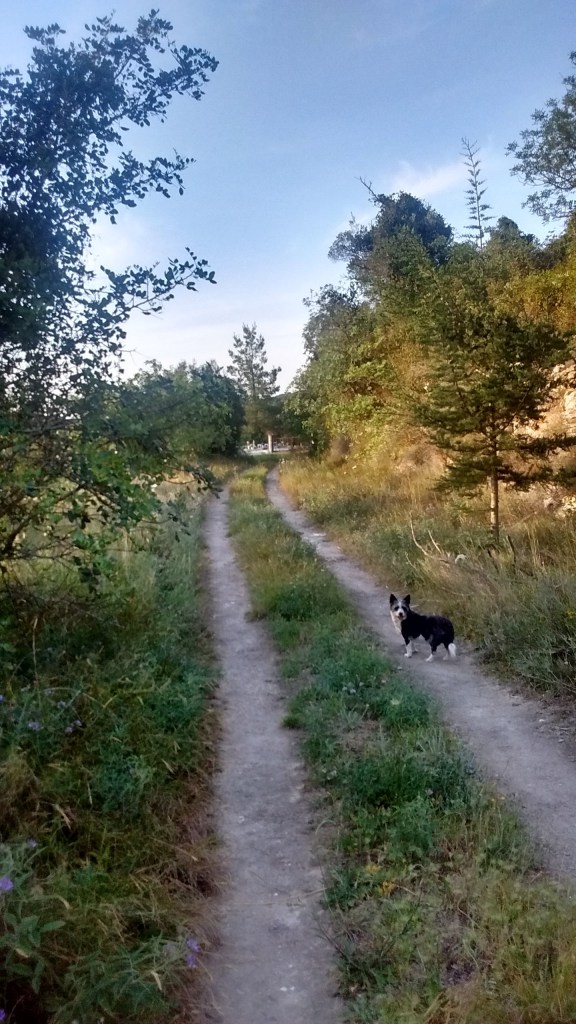
It’s tempting to seek refuge in my beautiful surroundings, walking and cycling as best I can. Sadly I am no longer accompanied on my rambles by dearest, sweetest Glyka, our 17 year old dog and loving companion , who died before Christmas. I was distraught as was Marilyn. Over the years Glyka taught me to appreciate herself, her fellow creatures and indeed Nature itself. She taught me to take my time and take in my surroundings; to acknowledge the cats, which she never chased, the dogs, towards whom she was a bit stand-offish, to chat to the sheep and goats, who sometimes replied imploringly, to be quiet so as to catch the birdsong and to gaze across the olive groves to the splendour of the towering White Mountains. As for herself she watched and listened, ever by my side, but never barked. We were free spirits or so we believed.
My dearest companion, Glyka
From my contact since the beginning of the COVID melodrama with dissidents of all colours I have been struck by how many are of a religious persuasion. Those to whom I’ve warmed have not been of an evangelical bent. However the conversations have often taken a spiritual turn. Over the years I’ve been quietly frustrated by what I see as religion’s appropriation of spirituality as its own. I’ve tried to be true to a spirit of human creativity, of cooperation, of justice and love. These past years closer to Nature, guided by Glyka, Leo, our aristocratic rescue horse, by the playful bin cats I feed, by Stelios’s adventurous goats, amazed by the way our brick-strewn barren garden has blossomed, I have sensed another level of spiritual awareness. Nevertheless I remain an atheist. I feel no need for a deity to give purpose to my existence. I remain a revolutionary humanist, a steadfast universalist, who has come to cherish the Earth in all its glory.
I do not know what I would do without music to soothe my spirits. Last week I sang ‘a capella’ in our village hall. I began with Dowland’s desire, ‘Music, music for a while, shall all your cares beguile’- somewhat truncated and hardly as beautiful as the wonderful Alfred Deller.
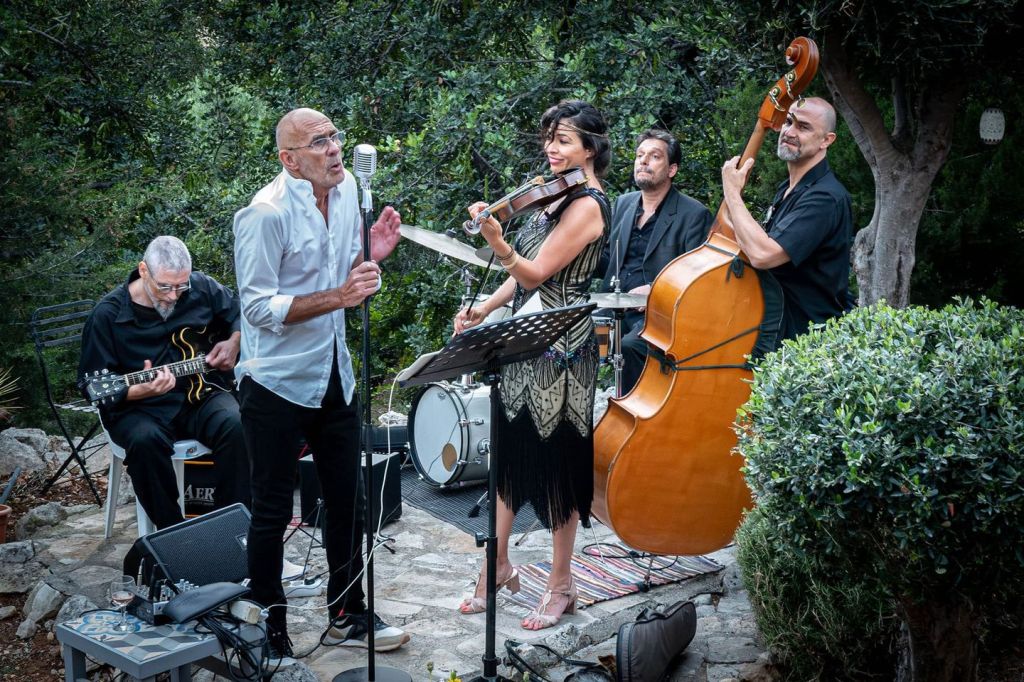
My generous neighbour, Ken Carpenter filmed some of the concert I gave to a small audience in our village hall. If I have the courage I will post a link to these videos soon. Listening and encouraging my effort, even entranced [!] were my very dearest friends, Maria and Linda Manousaki. Maria is an inspiration, not only as violin virtuoso but also as the driving force behind the diverse groupings of musicians she brings together here on Crete – for example, two very different string quartets, the Melos Ensemble play arrangements from the classical and jazz repertoires, whilst Tetracho improvise upon the indigenous Cretan tradition . In the next few weeks Linda at the piano and I will be rehearsing songs from American musicals. She will engage with my musical myopia, symbolised by the worried, ‘what key are we in?’ Who knows I might even sing accompanied sometime in the future!? We will see.
Privileged to be singing with Maria and the Swinging Strings
This piece is silent on the impact of Artificial Intelligence on our lives. It does not speak directly to the killings on the streets of Gaza, Teheran and Minneapolis. The silence is not by chance. I will break it but doing so is haunted by the knowledge that increasingly words, sounds and images tease, alarm as to their authenticity. It has always been necessary to be critical of what we read, hear and see. Today it is an unceasing and tiring obligation. And through the fog enveloping the truth I am inspired by the sight of ordinary people acting courageously in unison, striving against the odds to be agents of their own destinies. I refuse the concerted attempts across the ideological divide to deny them their autonomy, to cast them as mere pawns in the clutches of the oligarchs, the intelligence agencies, the corporations, the technocrats, the media, right or left-wing agitators or whomever.
Solidarity from an armchair radical, who needs to get on his bike.
Love & struggle,
Tony
On reading afresh this New Year’s ramble I’m afraid to say it’s more of the same navel-gazing as previous years – the same doubts and the same themes. Somewhat wearying, I fear. At the same time it indicates that the social and political situation isn’t getting better. Indeed it’s getting worse.
In an interview on Bad Faith, Gabor Mate suggests he has never experienced such darkness.
Leave aside I’m a miserable old git I felt only the fleeting sliver of satisfaction at the defeat of a narcissistic, opportunist maverick. Celebratory was not my mood. Biden, corrupt and cynical, played his Democrat part in the conditions that allowed Trumpism to prosper. At least 67 million Americans still voted for Trump and/or against the Democrats, who under the self-regarding Obama bailed out the bankers and abandoned the working class in all its diversity.
Ta new republic.com
This shot across the bows from Yannis Varoufakis is utterly necessary.
So yes, Joe Biden has won. And thank goodness for that. But let’s understand that he did so despite, not because of, his social graces or promise to restore normality to the White House. The confluence of discontent that powered Trump to power in 2016 has not gone away. To pretend like it has is only to invite future disaster – for America and the rest of the world.
[ I posted this piece a few hours ago on the In Defence of Youth Work web site. It felt worthwhile to repost here. It’s rushed and the dilemmas deserve more attention but for the moment my sinuses are exploding on account of a Saharan dust storm.]
Department for Education (DfE) guidance issued on Thursday for school leaders and teachers involved in setting the relationship, sex and health curriculum categorised anti-capitalism as an “extreme political stance” and equated it with opposition to freedom of speech, antisemitism and endorsement of illegal activity.
Put aside for a moment the issue of the impact of this fait accompli upon youth workers in schools I wonder where this leaves an open-ended youth work practice, which seeks to encourage a critical dialogue as to the roots and contemporary manifestations of oppression and exploitation?
Where does it leave In Defence of Youth Work itself, which in its founding letter argues that Capitalism is revealed yet again as a system of crisis: ‘all that is solid melts into air’; which in its cornerstones argues the continuing necessity of recognising that young people are not a homogeneous group and that issues of class, gender, race, sexuality and disability remain central?
In this chapter we argue that the present state of English youth work exemplifies the corrosive influence exerted by neoliberal capitalism upon its character and purpose. In doing so we hope to contribute to a collective understanding of how youth workers might criticise and resist on a national and international level neoliberalism’s arrogant contention that there is no alternative.
and which closes:
Our starting point is not youth work per se. It is a radical educational praxis, often described as critical pedagogy, which does not belong to any particular profession or institution. At heart it is about the struggle for authentic democracy, about the continued questioning of received assumptions. It is obliged to oppose neoliberal capitalism. Educators committed to this radical praxis do so in a diversity of settings, under differing constraints and across the board.
Is it mere coincidence that in the same month the Tories invoke the threat of ‘extreme political stances’, the American President has launched a scathing assault on the liberal New York Times 1619 Project? It sets out its stall as follows:
Out of slavery — and the anti-black racism it required — grew nearly everything that has truly made America exceptional: its economic might, its industrial power, its electoral system, its diet and popular music, the inequities of its public health and education, its astonishing penchant for violence, its income inequality, the example it sets for the world as a land of freedom and equality, its slang, its legal system and the endemic racial fears and hatreds that continue to plague it to this day. The seeds of all that were planted long before our official birth date, in 1776, when the men known as our founders formally declared independence from Britain.
In an article by Michael Desmond, ‘Capitalism’, well worth reading, he asserts, in order to understand the brutality of American capitalism, you have to start on the plantation.
In response Trump rails against decades of Leftist indoctrination in schools, which have defiled the American Story.
I fear that we are not taking the insidious global slide to authoritarianism seriously enough. To be in conversation with young people about prejudice and injustice, sexism, racism and transphobia, precarious work and trade unions, the environment and climate change, anarchism, social democracy and socialism, all these talking points necessitate grappling with Capitalism’s past, present and future. Doing so is to play a part in the emergence of the critical young citizen, who will, whatever their political leanings, resist being told what they have to think.




 CHATTING CRITICALLY