
Bah Humbug! Get thee behind me, Scrooge

In the last few months during my rambles through the undergrowth of the alternative media, I discovered a writer, W.D. James, who teaches philosophy in Kentucky, USA. He tells us that:

 I’m thinking my way through our current times and I tend to do that by digging into the ‘classics’ of Westen political philosophy to see what light they can shine on the contemporary moment.

My basic stance is characterized by:

  • Anti-Modernism
  • Anti-Globalism
  • Deep respect for pre-modern wisdom traditions, including religious traditions
  • Liberty
  • Defense of the opportunity for a good life for everyone
  • A critique of the modern state
  • Grounding in nature/reality, intellectually, morally, and existentially

I find him accessible, challenging and entertaining. From time to time I will draw your attention to stuff of his that touches one of my fragile nerves. He can be found at https://wdjames.substack.com/

Anyway, he’s just produced a post in praise of Christmas, which caused me to scribble this comment. ‘As a curmudgeon and miserablist, I’m in shock! I loved the piece and I might well be having a Scrooge-like conversion. I might well go out and buy a Christmas Tree.’

CHARLIE BROWN: CHRISTMAS AS SOCIAL PRACTICE -the link

W.D begins:
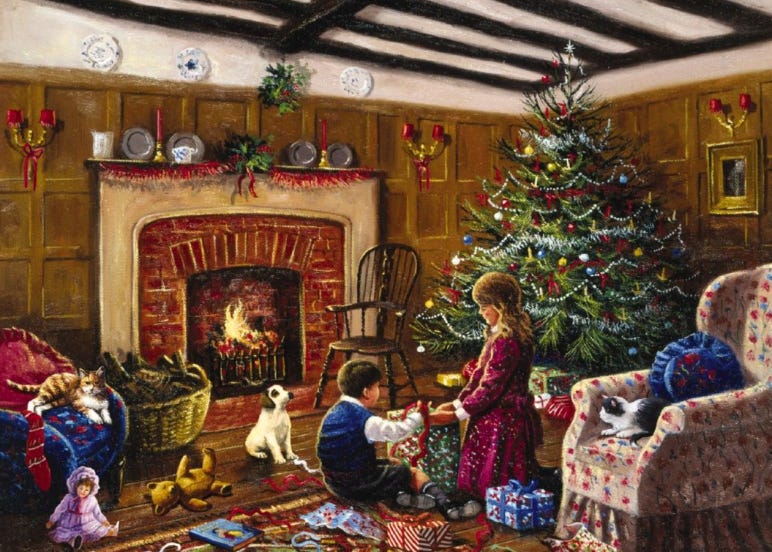
There’ll be parties for hosting
Marshmallows for toasting
And caroling out in the snow
There’ll be scary ghost stories
And tales of the glories of Christmases long, long ago

It’s the most wonderful time of the year
There’ll be much mistletoeing
And hearts will be glowing when loved ones are near
It’s the most wonderful time of the year
i

I believe that Christmas is a magical time. It is my favorite time of the year. I love the lights, the songs, the foods, the presents, mistletoe, holly (which remains green and oddly bears fruit in the winter), Santa, reindeer, snow, elves, holiday films, and the bringing of trees indoors. I am aware that from a cynical post-everything perspective, I would be seen as a sappy sucker for my naïve appreciation of the holiday. I can only plead guilty to being sappy and to loving Christmas. I agree that it is commercialized and that capitalism perverts everything it touches. But I also believe Christmas is too resilient and in tune with the human spirit to be completely subverted.

So, below all the accoutrements listed above, what do I think Christmas is really all about? I believe it is about the promise of new life. Further, I believe it is a holiday. A Holy Day. I take it that the ‘holy’ represents an aspect of our experience where we feel the transcendent breaks into our ordinary world, shining light upon its ultimate meaning and purpose. In that sense, Christmas might just be the holy day. In what follows, I will attempt to look a little more deeply at what is holy about Christmas and also look at Christmas as a thing we do (an old expression speaks of ‘keeping Christmas’, i.e., celebrating it) which means that it is a social practice that has the power to shape us in various ways.

and closes:

Therefore, perhaps we should keep Christmas. Or, we can call it the Solstice, or Saturnalia, or Hanukkah, or Yalda, or Kwanzaa, or whatever we might term it. However that turns out, may you experience a goodly measure of peace and cooperatively bring about some goodwill this season. The main thing is that it involves a tree; the old-fashioned kind made of wood.


Sadly the links to the Charlie Brown movie don’t work but as nostalgic and heartwarming compensation, what about the 1951 version of Christmas Carol with the wonderful Alistair Sim as Scrooge?
The Spectre Haunting Christmas…

One of the joys, amidst the stifling years of the ‘pandemic’, has been discovering stimulating voices, which I’d never have come across in the ordinary course of events. Prominent among these is that of the gay, pagan Marxist, Rhyd Wildermuth, who writes at From the Forests of Arduinna. I’d recommend the blog’s catholic content and dissenting discourse to anyone with an open mind. By chance, Rhyd has just posted a piece from 2019, The Chthonic King of Christmas, which begins with an anecdote about the Dublin tradition of getting ‘piss-drunk’ on Christmas Eve – news to me. at least! It’s the opening to a fascinating reflection on gods before Gods and in particular Saturn. The following is an excerpt, which might whet your appetite.

Saturn has a spectral quality in magical discourse, a haunting truth one cannot ever outrun, so it’s no wonder that Saturnalia itself long haunted European Christianity as just such a spectre. The Church’s war against its continued celebrations was long fought and never fully won. As Rome did for gods, the Christians eventually let in the parts of Saturn’s celebrations that they could not fully eradicate. A truce, as it were: the candles could continue, and also the gift-giving, and in some places even the most curious and dangerous of Saturnalia’s rites.

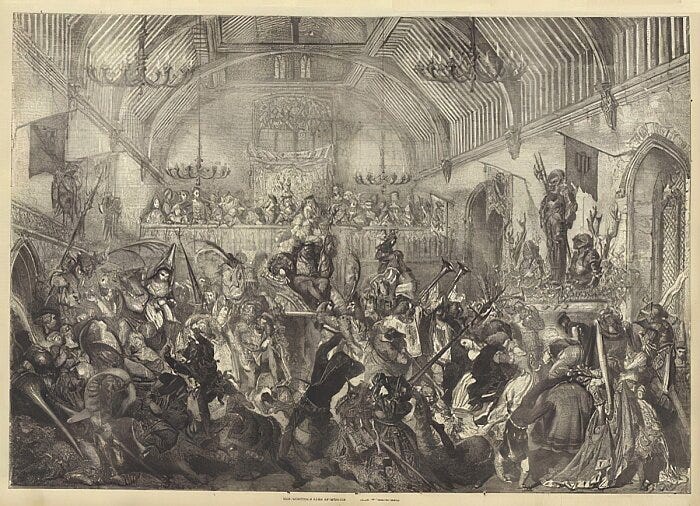
“The Christmas Lord of Misrule,” by Gustave Dore

There’s something I should now make very clear about Saturn, a thing I’ve saved until now. But rather than tell you directly, I’ll let a 2nd-century Roman historian do it:

“The first inhabitants of Italy were the Aborigines, whose king Saturnus is said to have been a man of such extraordinary justice that no one was a slave in his reign, or had any private property, but all things were common to all and undivided as one estate for the use of everyone. In memory of this way of life, it has been ordered that at Saturnalia slaves should everywhere sit down with their masters, the rank of all being made equal.”

The historian Justinius, then, ascribed Saturn to an indigenous people who lived in conditions we could quite easily call autonomous communism. No private property, no rank, no division of class, and no restricted access to the land and its wealth. Other Roman writers claimed Saturn the ruler of the “Golden Age,” a time before recorded history during which the land always provided food for people, labour was unnecessary, and humans were closer to the gods. Depicted sometimes with a scythe in hand, Saturn was the bringer of abundance from the land, sometimes named the father of agriculture (though more likely that of horticulture, rather than mass-scale farming). And most of all, he was the god of a time before slaves and masters, a propertied class and the landless, king of a time before kings themselves.

As such we can guess why Saturnalia’s most fascinating tradition was the most dangerous to the later Christians.

‘Saturnalia’ by Ernesto Bioni

It was not only customary during the Roman rites of Saturnalia for slaves to be treated as equals, but also often enough for lords and masters to become temporarily their servants. During Saturnalia, slaves ate at the tables of their masters (and were often served by them), and were given the right to wear clothing only the free-born and patricians could wear, thus annihilating the public distinction between the two classes.

We see this part of Saturnalia continued throughout Christianized Europe in a raucous aspect of Christmas that involved the selection of a “Lord of Misrule” or a “child bishop.” During these rituals, a peasant was named king—or in France and Germany a child named bishop—and given powers to overturn the normal order of things. These “world turned upside down” celebrations involved profane marriages between donkeys and priests, crossdressing, mischievous social disorder, carnivalistic riots, and the pillaging of the food stores of nobles and lords.

Closer to the present, these celebrations continued into Britain and Ireland for much longer than the Church or ruling classes were ever comfortable with. A particular ritual was greatly distressing to the powerful: carolling. As with modern carolling, groups of people would wander the streets singing songs. But the similarities end there: rather than singing hackneyed versions of “Oh Silent Night” in gaudy sweaters, carolers would chant bawdy, profane, and rather raucous songs at the doors of nobles who in return were expected to give the rioters at their gates cakes and brandy. Failure to do so meant the carolers had the “right” to break into the manses and take what they wanted.

This part of Saturnalia continued even into the 19th century in the United States, so much so that laws were passed in New England against carolling and being publicly drunk on Christmas Eve, laws which the Church in Europe had never fully succeeded in enforcing. By this time, however, the new order of capitalism had taken enough hold that the Calvinist-Bourgeois values of commerce, the nuclear family, and the sanctity of individual wealth were able to supplant survivals of Saturnalian revelry in most places.

One thing that’s always interested me about this transition is a particular story we all know too well, but whose meaning we tend to forget, that of Charles Dickens’ “A Christmas Carol.” As we moderns have lost the original meaning of carolling, the story seems merely a morality play, an admonition that greed will leave you lonely. But remembering that carolling was a continuation of the rites of Saturnalia, Dickens’ point becomes clearer. Scrooge was an industrialist, part of the new bourgeois order of capitalists who, as Marx noted, had freed themselves from the aristocratic code of noblesse oblige. Re-distributing wealth to the riotous poor during Christmas was an unwritten part of that code in England and elsewhere, but Scrooge and the rest of the new capitalist class refused to recognize their duty.

Rhyd ends the piece, Happy Yule. Merry Christmas. Good Solstice to you. And most of all, Io Saturnalia!

To which I can only add the words of the great Irish comedian Dave Allen, ‘May your God go with you’