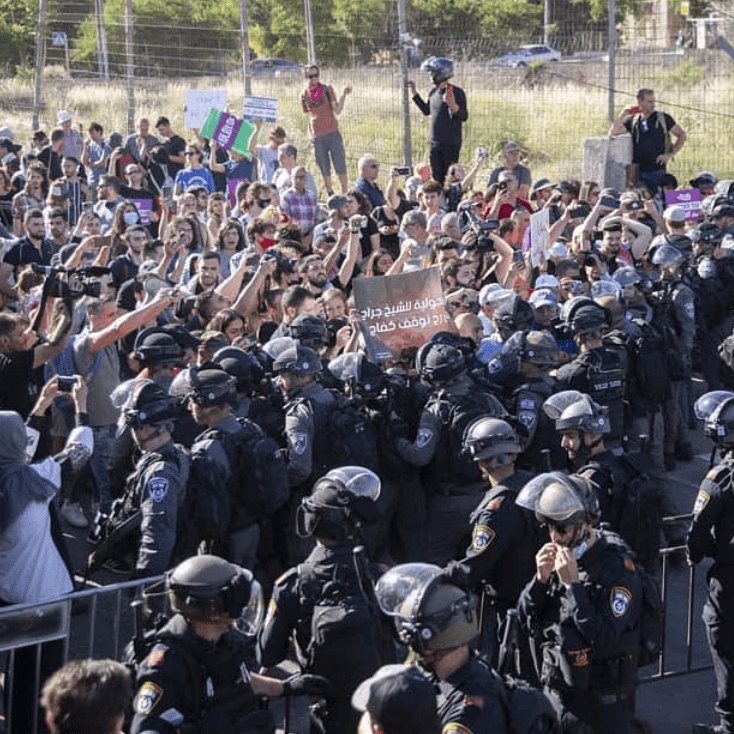
CRUSHING DISSENT AND RESISTANCE

I started to put this hardly controversial post together yesterday morning and it’s already been overtaken by numerous pieces despairing at Labour’s proscription of Palestine Action. A direct action group seeking to raise awareness of the obscene genocide in Gaza, of the war crimes of a terrorist State is without any due process defined as a terrorist organisation. Even the Guardian is forced to descend from the fence in an article, ‘It’s a complete assault on free speech’: how Palestine Action was targeted for proscription as terrorists’

The article notes, if the group is proscribed next week, as is expected, being a member of or inviting support for Palestine Action will carry a maximum penalty of 14 years. Wearing clothing or publishing a logo that arouses reasonable suspicion that someone supports Palestine Action will carry a sentence of up to six months.

In a week’s time we wait to applaud the Guardian’s recovery of its liberal tradition, whereby the paper explicitly backs the right of Palestine Action [PA] to exist and resist.

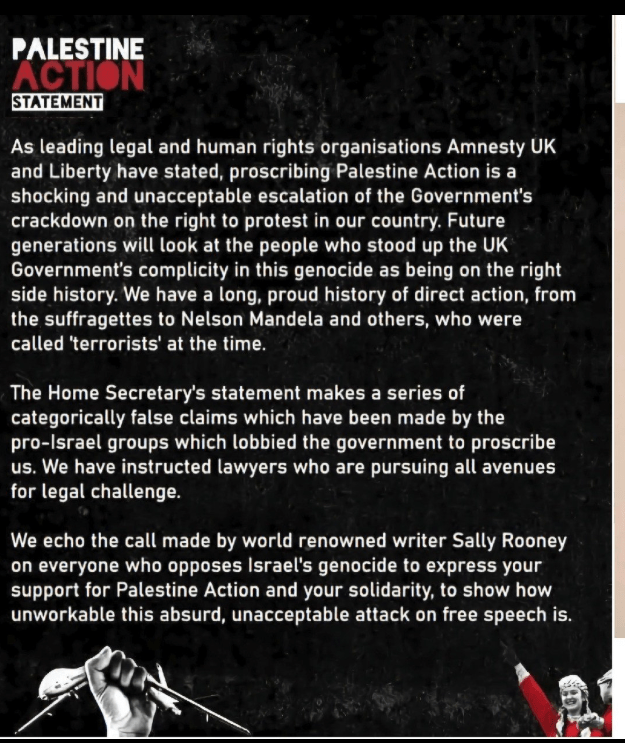
The arrogant and ignorant authoritarianism at the heart of today’s Labour Party is exemplified by the Home Secretary’s condemnation of PA’s militant tactics. In 2018 she spoke in the House of Commons, expressing her admiration for the suffragette movement, and celebrated its herstory by wearing a rosette in the suffragette colours of purple, white and green.

It seems to have slipped her mind that the suffragettes were not shy when it came to attacking the patriarchal state that denied them even a voice. Thus, at 6.10am on the 19 February 1913, a bomb exploded at the summer house that was being built for Chancellor of the Exchequer, David Lloyd George, at Walton-on-the-Hill, causing damage estimated at £500 (modern equivalent nearly £55,000 in today’s money). On the evening of the incident Emmeline Pankhurst, one of the leaders of the Women’s Social and Political Union (WSPU), claimed responsibility for the bomb at a meeting at Cory Hall, Cardiff, where she admits that they have “blown up the Chancellor of the Exchequer’s house”. Pankhurst was willing to be arrested for the incident saying “I have advised, I have incited, I have conspired”; and that if she is arrested for the incident she shall prove that the “punishment unjustly imposed upon women who have no voice in making the laws cannot be carried out”. We presume the Home Secretary might well retrospectively need to proscribe the WSPU as a terrorist organisation.

See this great piece that elaborates the story, Lloyd George and the Suffragette Bomb Outrage


And, let’s not forget……….

Greenham Common Women’s Peace Camp
1981 – 2000  

On the 5th September 1981, the Welsh group “Women for Life on Earth” arrived on Greenham Common, Berkshire, England. They marched from Cardiff with the intention of challenging, by debate, the decision to site 96 Cruise nuclear missiles there. On arrival they delivered a letter to the Base Commander which among other things stated ‘We fear for the future of all our children and for the future of the living world which is the basis of all life’.

When their request for a debate was ignored they set up a Peace Camp just outside the fence surrounding RAF Greenham Common Airbase. They took the authorities by surprise and set the tone for a most audacious and lengthy protest that lasted 19 years. Within 6 months the camp became known as the Women’s Peace Camp and gained recognition both nationally and internationally by drawing attention to the base with well publicised imaginative gatherings.This unique initiative threw a spotlight on ‘Cruise’ making it a national and international political issue throughout the 80s and early 90s.

The presence of women living outside an operational nuclear base 24 hours a day, brought a new perspective to the peace movement – giving it leadership and a continuous focus. At a time when the USA and the USSR were competing for nuclear superiority in Europe, the Women’s Peace Camp on Greenham Common was seen as an edifying influence. The commitment to non-violence and non-alignment gave the protest an authority that was difficult to dismiss – journalists from almost every corner of the globe found their way to the camp and reported on the happenings and events taking place there.

Living conditions were primitive. Living outside in all kinds of weather especially in the winter and rainy seasons was testing. Without electricity, telephone, running water etc, frequent evictions and vigilante attacks, life was difficult. In spite of the conditions women, from many parts of the UK and abroad, came to spend time at the camp to be part of the resistance to nuclear weapons. It was a case of giving up comfort for commitment.

The protest, committed to disrupting the exercises of the USAF, was highly effective. Nuclear convoys leaving the base to practice nuclear war, were blockaded, tracked to their practice area and disrupted.Taking non-violent direct action meant that women were arrested, taken to court and sent to prison.

The conduct and integrity of the protest mounted by the Women’s Peace Camp was instrumental in the decision to remove the Cruise Missiles from Greenham Common. Under the Intermediate Nuclear Forces (INF) Treaty, the missiles were flown back to the USA along with the USAF personnel in 91/92. The Treaty signed by the USA and the USSR in 1987, is in accord with the stated position held by women, in defence of their actions on arrest, when it states :

“Conscious that nuclear weapons would have devastating consequences for all mankind”

A number of initiatives were made by women in Court testing the legality of nuclear weapons. Also, challenges to the conduct and stewardship of the Ministry of Defence as landlords of Greenham Common. In 1992 Lord Taylor, Lord Chief Justice, delivering the Richard Dimbleby Lecture for the BBC, referring to the Bylaws case ( won by Greenham women in the House of Lords in 1990) said ‘…it would be difficult to suggest a group whose cause and lifestyle were less likely to excite the sympathies and approval of five elderly judges. Yet it was five Law Lords who allowed the Appeal and held that the Minister had exceeded his powers in framing the byelaws so as to prevent access to common land’.

The Camp was brought to a close in 2000 to make way for the Commemorative and Historic Site on the land that housed the original Women’s Peace Camp at Yellow Gate Greenham Common between the years 1981 – 2000.

Sarah Hipperson

This remarkable book tells how the women of the Yellow Gate peace camp at Greenham Common took on the law – and in some instances won.

They challenged the laws under which they were arrested and as Judge Hague said said in the County Court “…they are no strangers to litigation, both criminal and civil. In the courts they have sometimes had a considerable measure of success, and indeed they are immortalised in the Law Reports in connection with two of their successes in the higher courts.”

This book offers inspiration and encouragement to all who take part in non-violent direct action or want to challenge the powers of the state or large institutions. In its detailed descriptions of each case, it suggests how this can be done successfully.

The last chapter tells the story of the Commemorative and Historic Site, a garden of peace where once the women of Yellow Gate camp lived and confronted the Cruise Missiles – and the powers of the state.

To buy a copy of this book, send a cheque for £9.98 (+ £1.00 p & p) payable to ‘Greenham Publications’ to 15 Sydney Road, London E11 2JW or order one from your bookseller (ISBN 0-9550122-0-1)


AND AS OF NOW

https://www.theguardian.com/politics/2025/jun/25/mass-protests-uk-nuclear-deterrent-expansion

The biggest expansion of the UK’s nuclear deterrent in a generation will put the nation on the “nuclear frontline” and mobilise a new generation of anti-nuclear weapons protesters, campaign groups have warned.

Anti-nuclear and anti-arms campaign groups are planning mass protests against nuclear weapons – of a kind not seen since the days of the Greenham Common peace camp in the 80s – in response to government plans to significantly expand its nuclear deterrent by buying a squadron of American fighter jets capable of carrying nuclear weapons.

The Campaign for Nuclear Disarmament (CND) protested on Saturday, June 28th at RAF Marham in Norfolk, which is used by the US air force.

Campaign groups said the decision to buy 12 F-35A jets, which are capable of carrying conventional arms, and also the US B61-12 gravity bomb, a variant of which has more than three times the explosive power of the weapon dropped on Hiroshima, had been taken without parliamentary debate and undermined democracy.


Returning to Iran, Siya Vash, reports that within the convulsions inside the country suppression of dissent deepens.

The paranoid and humiliated Revolutionary Guards in Iran have been sending the following text messages to people’s mobile numbers:

Warning
Following or joining pages affiliated with the Zionist regime constitutes a criminal act and is subject to legal prosecution. Therefore, given the recorded activity of this number on virtual pages of the Zionist regime, you are hereby warned to immediately remove supportive comments and likes, and exit these pages without delay. Failure to do so will result in legal action in accordance with Article 8 of the Law on Confronting Hostile Actions of the Zionist Regime.
Deputy for Social Affairs and Crime Prevention, Judiciary of the Islamic Republic of Iran
Honourable People of Iran


In recent days, your exemplary cooperation and solidarity with your servants in the IRGC Intelligence Organisation—through public reporting—has not only altered the enemy’s calculations but has also led to their defeat on the battlefield. Therefore, we kindly ask you to continue this valuable approach and report any suspicious activity by contacting 110, 113, or 114, or through available channels on domestic messaging platforms.
IRGC Intelligence Organisation


In a philosophical atmosphere, all of the above would be open to criticism, agreement and disagreement. However the creeping authoritarianism I have sought to address since the ascent of neoliberalism in the 1980’s, its fetish of individualism and its hatred of autonomous collectivity has gathered pace across the decades, not least during the manufactured COVID pandemic. Central to the shift into an era of technocratic capitalism is the Expert, who takes different forms and cannot be questioned. To do so is to be beyond the pale. This demand for conformity and obedience is profoundly anti-democratic. And its prophets and disciples come from both the traditional Left and Right. If I get my act together I will try to put flesh on these bare bones.
Beggaring belief, Christ remains still in the rubble

Over a year ago I drew attention to the 2023 Christmas sermon given so eloquently by the Reverend Munther Isaac in Bethlehem.

It seems unbelievable that the slaughter of the innocents continues; that the calculated genocide pursued by the Zionist Israeli government remains its official policy, afforded succour and ammunition on a daily basis by the USA, the UK and the EU.

With a heavy heart I can do no more than offer the Reverend’s 2024 calm. yet anguished reflection on the situation facing Palestinians today. I can but weep.

“‘Never again’ should mean never again to all peoples,” Munther says in his sermon. “‘Never again’ has become ‘yet again’ — yet again to supremacy, yet again to racism and yet again to genocide. And sadly, ‘never again’ has become yet again for the weaponization of the Bible and the silence and complicity of the Western church, yet again for the church siding with power, the church siding with the empire.”

“So, today, after all this, of total destruction, annihilation, Gaza is erased — millions have become refugees and homeless, tens of thousands killed. And why is anyone still debating whether this is a genocide or not?”

We’re still seeing images of children pulled from under the rubble. It’s unthinkable to me that it’s been more than 14 months now into this genocide, and we’re still seeing the same images. It seems like we’re powerless, and it seems that the world is content with letting this go on. And here in the West Bank, as we watch from Bethlehem what’s happening in Ramallah or Hebron, we wonder, ‘Are we next?’ Israel has made it clear they plan to annex the West Bank next year. What would this mean on the ground?”

“Our fear here in Bethlehem is that there is no one who’s going to hold Israel accountable.”

Yes, it has been 440 days. It is 440 days of Palestinians’ resilience, sumud. Indeed, it is 76 years of sumud. But we have not and will not lose hope. Yes, it is 76 years of an ongoing Nakba, but it is also 76 years of Palestinian sumud, clinging to our rights and justice of our cause, 76 years of praying and singing for peace. I was thinking about it. We are stubborn people. We continue to pray for peace year after year after year, and sing about peace, and we will continue to do so. And we will continue to echo the words of the angels, “Glory to God in the highest, peace on Earth.”

As for an ageing, irreconcilable atheist like myself I can but pledge my unswerving support for the Palestinian cause and with the good Reverend pray for ‘peace on earth’.

A New Year begins in Gaza: the crisis and the carnage continue

A month ago, with some trepidation, it was agreed that our next Chatting Critically meeting would focus on the Israel/Palestine situation. It will take place on Wednesday, January 10th in the ‘Elpida’ kafeneio, Gavalohori, starting at 10.30 a.m.

As the coordinator of the group, I wanted to put together something of an introduction to help the discussion along. However, I’ve found this increasingly difficult as the tragedy unfolds. I’m conscious too that my allegiance to the Palestinian cause goes back to the mid-1970s. I’m hardly impartial.

Thus I’m doing no more than posing a few questions to think about before we get together, supplemented by links to a range of articles, the first of which is by the great independent journalist, John Pilger, who sadly died on New Year’s Eve.

  1. To what extent have we a grasp of the historical background to the conflict? The state of Israel was only founded in 1947 based on expelling thousands of Palestinians from their homeland. How was this justified and who were the players on the world stage, ensuring that this seizure of land happened?
  2. Israel’s establishment as an explicitly Jewish state is a primary point of contention, with many of the state’s critics arguing that this by nature casts non-Jews as second-class citizens with fewer rights. The 1950 Law of Return, for example, grants all Jews, as well as their children, grandchildren, and spouses, the right to move to Israel and automatically gain citizenship. Non-Jews do not have these rights. Palestinians and their descendants have no legal right to return to the lands their families held before being displaced in 1948 or 1967. Deep-rooted structural and social discrimination confirms the second-class status of Arabs within Israel, leading to the charge that Israel is an apartheid state? Is this claim legitimate?
  3. Does the appalling persecution of Jews across the centuries – for a diversity of reasons, not least in the early 20th century because they were seen as socialists. even communists and the obscenity of the Holocaust, the Final Solution – mean that Israel is exempt from moral or political criticism of its actions today – acknowledged war crimes or indeed perceived genocide?
  4. It is generally acknowledged at an international level, even if this is empty of any real meaning that the Palestinian Territories are prison camps. Given the length and intensity of the incarceration, why the surprise and shock when some of the prisoners plan and execute a violent escape. Isn’t such a brutal ‘slave revolt’, as Norman Finkelstein puts it, an inevitable consequence of Israel’s inhuman policies. And is the appropriate answer of the prison guards, the execution of the inmates left therein?
  5. And, finally, on a personal note, how can we allow the closing down of debate by the mere accusation of anti-semitism or ‘Jew-hating’? Amongst my greatest inspirations and influences are to be found composers, Mahler, Mendelsohn and Schoenberg, artists, Menuhin and Bernstein, intellectuals, Freud and Chomsky, revolutionaries, Marx, Trotsky and Rosa Luxemburg. All were Jewish. In embracing and criticising their artistic, social and political contributions I recognised but didn’t obsess about their Jewishness. In much the same way I don’t think much about Christianity when listening to Haydn or Bruckner. I’m an atheist but I neither hate Jews nor Christians. I simply disagree.

There are many more questions, for sure.


In directing you to interesting and challenging links I cannot but begin with the late John Pilger’s very last article, written in early November, entitled. ‘We are Spartacus’

“Secretive power loathes journalists who do their job, push back screens, peer behind façades, lift rocks. Opprobrium from on high is their badge of honour.”

He opens::

Spartacus was a 1960 Hollywood film based on a book written secretly by the blacklisted novelist Howard Fast, and adapted by the screenplay writer Dalton Trumbo, one of the “Hollywood 10” who were banned for their “un-American” politics. It is a parable of resistance and heroism that speaks unreservedly to our own times. 

Both writers were Communists and victims of Senator Joseph McCarthy, chairman of the Government Operations Committee and its Permanent Subcommittee on Investigations of the US Senate, which, during the Cold War, destroyed the careers and often the lives of those principled and courageous enough to stand up to a homegrown fascism in America.

“This is a sharp time, now, a precise time…”, wrote Arthur Miller in The Crucible, “We live no longer in the dusky afternoon when evil mixed itself with good and befuddled the world”.

There is one “precise” provocateur now; it is clear to see for those who want to see it and foretell its actions. It is a gang of states led by the United States whose stated objective is “full spectrum dominance”. Russia is still the hated one, Red China the feared one.

From Washington and London, the virulence has no limit. Israel, the colonial anachronism and unleashed attack dog, is armed to the teeth and granted historical impunity so that “we” the West ensure the blood and tears never dry in Palestine.

British MPs who dare call for a ceasefire in Gaza are banished, the iron door of two-party politics closed to them by a Labour leader who would withhold water and food from the children.

In expressing his undying admiration for the endeavours of David McBride and Julian Assange in exposing the crimes committed under the banner of the ‘Global War on Terror’, he closes:

Their bravery has allowed many of us, who might despair, to understand the real meaning of a resistance we all share if we want to prevent the conquest of us, our conscience, our self respect, if we prefer freedom and decency to compliance and collusion. In this, we are all Spartacus.

Spartacus was the rebellious leader of Rome’s slaves in 71-73 B.C. There is a thrilling moment in the Kirk Douglas movie Spartacus when the Romans call on Spartacus’s men to identify their leader and so be pardoned. Instead hundreds of his comrades stand and raise their fists in solidarity and shout, “I am Spartacus!”. The rebellion is under way.

Julian and David are Spartacus. The Palestinians are Spartacus. People who fill the streets with flags and principle and solidarity are Spartacus. We are all Spartacus if we want to be.


The Middle East War and the hostile environment

Nira Yuval-Davis is a diasporic Israeli Jew, Professor Emeritus, Honorary Director of the Research Centre on Migration, Refugees and Belonging (CMRB) at the University of East London. She reflects on the complexities of its start and end points, beginning:

One of the most contested issues regarding telling the story of the current war in the Middle East is about when to start it. Each narrative always has a clear starting point – if not necessarily an end point – but what is the starting point for this war? Is it the terrible massacre that Hamas fighters carried out among soldiers and civilians, Jews and non-Jews, in the South of Israel on 7 October? – the highest number of people killed in one day in the hundred years of conflict since the beginning of the Zionist settlement in Palestine – at least until that day. That’s probably where most Israelis would like to start the story.

Should I start with the ongoing massive systematic bombing, destruction, displacement and killing of thousands of Palestinians in Gaza, including thousands of children, a new Palestinian Nakba? That’s where many international protesters focus their protests.

Or I could start the narrative by telling the history of the Zionist settler colonial project, before and after 1948 and the establishment of the Israeli state. A large proportion of the Palestinian population in the Gaza strip today are 1948 refugees, and most of the settlements attacked on 7 October sit on lands where previous generations of today’s Gazans used to live, before the first Nakba.

Or maybe I should start my narrative by telling how Israeli intelligence – just like the US with the Taliban – was a cultivator of Hamas in its infancy, as part of a divide and rule policy aimed at weakening the power of the PLO; and how, until 7 October, it facilitated the rule of Hamas in Gaza by enabling the transfer of money to Hamas from Qatar via Israeli banks, so it could distribute money to people in this huge open-air prison, to maintain its control and keep the population just about surviving.

Another starting point could be the convenience of the Hamas attack and the following war for Iran and its allies, as it has put in jeopardy the anti-Iran, anti-Palestinian, so called ‘normalisation’ agreement that was soon to be signed between Israel and Saudi Arabia. In many ways, this is not just a war between Israel and Gaza, but a regional war, in which various pro-Iranian groups, from Yemen to Syria and Lebanon, are taking part in an anti-American as well as anti-Israeli war, although at the moment, at least, in a contained way.

Related to that, one could start by describing the war as a result of miscalculated wishful thinking. Hamas was hoping that Hezbollah, Iran and other forces in the Arab world would join the war in a much more total way; and Israel has been hoping that Egypt and/or the PLO would take responsibility for governing the population in Gaza instead of Hamas, and, better still, would allow them to be displaced to the Sinai desert. But these organisations and governments have learned their lessons from previous history and are not co-operating.

The timing of the war has also been convenient for Netanyahu and the Israeli government. In one day it stopped the six-month long major protest movement which was demanding the ending of the judicial coup in Israel and the resignation of Netanyahu: the leader of the opposition has joined the government and war cabinet, and all the huge protest and pro-democracy posters which were plastered all over public buildings and public spaces have been replaced with others, even larger, which say – No Left, No Right, together we’ll all win the war.

She ends:

Many of us have been taking part in protest activities against the war in Gaza and its growing human and humanitarian costs, while knowing that the issues cannot be resolved solely by an end to that war. There is a need for the end of the occupation and the de-Zionisation of Palestine/Israel into a state with equal individual and collective rights for all its residents. This seems more than ever a faraway dream, but giving up on striving for it, not keeping alive this alternative narrative, would only be much worse.


https://resourcecentre.savethechildren.net/document/injustice-palestinian-childrens-experience-of-the-israeli-military-detention-system/


ON ZIONIST FEELINGS

RANDA ABDEL-FATTAH  explores the central and sensitive question of how the hurt experienced by People in and out of Israel, particularly those wedded to Zionism, is used to deflect us from the reality of genocide.

She ends:

My responsibility is to commit myself to the liberation of Palestine. I am confident that my fight against Zionism as a form of racism aligns with my unequivocal rejection and condemnation of antisemitism. I recognize the lethal and genocidal history of European antisemitism that produced the Holocaust and the destruction of European Jewry. I reject that because of European antisemitic racism, Palestinians must pay the price. I reject essentializing language, stereotypes, or theories that claim that there are particular traits or characteristics unique to “Jewish people” as a homogenous collective, or “being a Jew.” I defend the right of Jewish people to openly practice Judaism and freely express their religious and cultural identity. I defend the right of Jewish people to practice their faith even though I unequivocally reject and condemn Zionism as a political ideology. I do not accept that such a right can be enjoyed at the expense of Palestinian life, freedom, and self-determination.

No amount of intimidation or emotional blackmail will cower Palestinians into silence, into shrinking our voices, adjusting our language, compromising our demands and claims, or repressing our feelings. When the feelings and fragility of Zionists are used as a rhetorical shield to deflect from engaging with the moral and material reality of genocide, Palestinians are left to ask: how many of us must be killed, maimed and injured, forced from our traditional land and beloved homes, be tortured and have our schools, universities, and livelihoods destroyed, for those in power – those who have the power to stop this genocide – to say in public never again. Khallas. Enough.


A thoughtful video, which touches on whether there are solutions acceptable to all parties.

https://www.aljazeera.com/program/upfront/2023/11/24/a-second-nakba-what-history-tells-us-about-palestine-and-israel

A second Nakba? What history tells us about Palestine and Israel
In this episode of UpFront, we look back at the history and context leading up to the current Israel-Gaza war. Nearly two months after the October 7 attack by Hamas, Israel’s response has killed more than 14,500 Palestinians.

While many see the current conflict as a reaction to the attack that killed 1,200 people in Israel, others have pointed out that this view ignores crucial historical context and that the conflict has been ongoing for generations.

Following the 1917 Balfour Declaration which led to an influx of Jewish immigrants, the creation of Israel in 1948 saw an enormous displacement of Palestinians, in addition to the expulsion of hundreds of thousands who remain refugees to this day.

On UpFront, Mustafa Barghouti, the co-founder of the Palestinian National Initiative, and author Ghada Karmi, join Marc Lamont Hill to look back at the history of Palestine and contextualise the current war.


The colonisation of Palestine: Exhuming a British imperial crime

by Mary Serumaga

Like other British imperial possessions, Palestine was acquired on the cheap and under false pretences, official corruption sealing a deal doomed to end in perpetual violence.

 “Zionism will fail, the experiment to which the noble Earl referred will fail, the harm done by dumping down an alien population upon an Arab country – Arab all around in the hinterland – may never be remedied…what we have done is, by concessions, not to the Jewish people but to a Zionist extreme section, to start a running sore in the East, and no one can tell how far that sore will extend.”

British Government, Hansard, House of Lords, 21 June 1922, p. 1025

Fascinating and revealing historical context.


Biden, Palestine, and the buttressing of Christian Zionism

Biden’s position on Israel-Palestine does not constitute any real shift from that of Trump and thus similarly gratifies the desires of Christian Zionists.

I had no sense of this significant support for Israel in the USA.


Further evidence Netanyahu propped up Hamas

Thomas Fazi argues:

In my last post I explained how Netanyahu played a crucial role in bolstering Hamas in order to “divide and conquer” the Palestinians and delegitimise the Palestinian National Authority — the continuation of a strategy which Israel had been pursuing, in various forms, since the 1980s.

Later in the piece, he quotes Yasser Arafat, who was the leader of the PLO at the time I was closest to what was going on in Palestine., more than thirty years ago.

“Hamas was constituted with the support of Israel. The aim was to create an organisation antagonistic to the PLO. They [Hamas] received financing and training from Israel. They have continued to benefit from permits and authorisations, while we have been limited, even [for permits] to build a tomato factory.”

When asked what he thought of “these sons of Palestine who blow themselves up and spread death among Israeli civilians”, Arafat answered: “Israel does not allow us to live a normal life. Youth who have nothing to eat, who don’t see any future in front of them, are easy prey of the Islamist movements, which have large amounts of financing at their disposal”.


.


Last but not least a video of Gerald Kaufman, Labour Member of Parliament speaking in Parliament, the year 2009, the event an Israeli attack on Gaza. For my sins, I was heavily involved in the British Labour Party in the 1980s and met Gerald, always immaculately attired several times, once by chance for a coffee at Euston railway station. At the time he was a sworn enemy, being a fierce critic of Tony Benn, to whom I gave cautious support! Anyway, he was charming company and we parted on amicable terms. Fifteen years on this brave speech retains all its relevance.


And, lest I forget, I must register deep gratitude to my dear friend, Steph Green, who has sent me regularly in the last months both links and her own insightful commentary on the continuing crisis in Gaza. I hope I have done her efforts to keep me alert some justice.

“We will not rest until we have justice. Until all people, Israelis and Palestinians, between the river and the sea, can live in peaceful liberty.” The United Kingdom’s Labour Party suspended Member of Parliament, Andy McDonald for reciting the above in a speech at a pro-Palestinian rally.

A crucial moment in the struggle to save Sheikh Jarrah

A message with determination from Suhad Babaa of Just Vision

Increasing the power and reach of Palestinians and Israelis working to end the occupation and build a future of equality for all.


I’m coming up for air after a long week to provide an update on the campaign to save Sheikh Jarrah, a neighborhood in East Jerusalem.

Last fall, Israeli courts ruled to evict several Palestinian families from their homes in Sheikh Jarrah, a continuation of a devastating and violent takeover by Israeli settlers — backed by the Israeli police and judicial system — that we documented in our 2012 short, My Neighbourhood. Early this week, the Israeli Supreme Court postponed their ruling on the evictions until May 6, asking the residents to “come to an agreement” with the settlers who are trying to take over their homes. The suggested “agreement” – based on Palestinians forfeiting ownership of their homes to the settlers – was, of course, refused by the families who have lived in Sheikh Jarrah for decades. Yesterday, the courts postponed the hearing once again until May 10.
 
As Mohammed El Kurd, a resident of Sheikh Jarrah, youth organizer and protagonist of My Neighbourhood often reflects, while there are lengthy “legal processes” playing out, what’s happening in Sheikh Jarrah is political and systemic. Moreover, the “pattern of elongating the legal process is a common practice to dull popular resistance” to Israel’s expansionist policies. 

But the resistance of the community has not been dulled. Sheikh Jarrah’s youth have been holding nightly vigils to demonstrate against the evictions, raise awareness of their struggle and save the neighborhood. The community’s nonviolent protests have been met by brute force, with Israeli police violently storming Palestinian homes, spraying skunk (putrid liquid) at demonstrators, attacking residents and protestors with batons and mounted horses and arresting youth. Meanwhile, Israeli settlers continue to be backed by police and government officials, including a lawmaker from the far-right Kahanist party who temporarily set up a makeshift office in the neighborhood and the Deputy Mayor of Jerusalem who goaded violence against Palestinians
May 7: Israeli police block activists from entering Sheikh Jarrah to demonstrate alongside residents. Thanks to Oren Ziv for the photos
The coming days in Sheikh Jarrah are crucial. The community’s campaign has gained momentum with press coverage starting to pick up steam and numerous US political leaders speaking out in support including: Rep. Cori BushRep. Rashida Tlaib, Rep. Chuy Garcia, Rep. Debbie DingleRep. Marie NewmanRep Ilhan OmarRep. Mark Pocan and more. Representatives Newman and Pocan are also leading an effort to urge the Biden Administration to oppose the evictions and a grassroots petition has also been widely circulated. Still, the majority of international press outlets have remained silent, and there has yet to be substantive action taken by the US, which could help pressure Israeli authorities to stop the forced displacement of Palestinian families in East Jerusalem.
We hope you will share this note far and wide. If you know journalists or decision-makers who can bring attention to what’s happening in Sheikh Jarrah, please reach out to them. And to get the latest updates, follow us on TwitterFacebook and Instagram, along with #SaveSheikhJarrah.

Even the Guardian is forced to cover the situation, athough the coverage itself is a cut and paste Reuters piece.

Israeli police clash with protesters over Palestinian evictions

Up to 178 Palestinians and six officers injured in skirmishes at al-Aqsa mosque and around east Jerusalem