
When I first discovered left-wing politics or more precisely Trotskyism in the early 1970s there was growing criticism that Marxism in practice prioritised class struggle above all else. The typical class militant was seen as telling women, black people, gays and lesbians that they must wait upon their demands till after the revolution. I was fortunate to join the Marxist Worker Group [MWG], a tiny organisation based in the North-West of England. Therein the question of women’s liberation was central. Within the group, we read and discussed passionately the works of Rosa Luxemburg, Clara Zeitkin and Alexandra Kollontai, along with contemporary figures such as Sheila Rowbotham, whose groundbreaking book, ‘Woman’s Consciousness, Man’s World’ was published in 1974. Over the decades I moved slowly and contrarily away from Marxism’s certitude towards Anarchism’s uncertainty. However, I will remain forever grateful to the members of MWG, such as the formidable Eileen Murphy for an argumentative, challenging beginning to my political life in which class, gender, race and sexuality were inextricably intertwined.
Thus, over the decades, I have sought to argue for this crucial intertwining in both practice and theory. In the Community and Youth Workers Union, along with Roy Ratcliffe himself a leading figure in MWG. we gained majority support in 1981 for a constitution, which placed the right to caucus at the very heart of the union’s democracy, emphasising the interrelatedness of class, gender, race and sexuality.
Ironically, given my opening remarks, as the years passed by, I found myself lamenting the disappearance of a class struggle analysis from both the professional and political spheres. For example, I wrote a piece for Youth & Policy’s History series, ‘Youth Work and Class: The Struggle that dare not Speak Its Name’, which argued at one point:
In focusing on a notion of the Class Struggle and its absence from Youth Work discourse I risk being seen as a geriatric Leftie, trying stubbornly to resurrect the discredited idea that class is primary, relegating the significance of other social relations. This is not at all my desire. My point is no more and no less than that the political struggle for equality, freedom and justice must have a rounded and interrelated sense of the relations of class, gender, race, sexuality and disability. None of them makes proper sense without reference to each other. If this inextricable knot is recognised, the silence about class within most Youth Work is deeply disturbing.
As best I can see and my glasses may need more than a cursory clean the outlook of the contemporary Left and its base in the professional classes is dominated by a version of ‘identity politics’, within which the inextricable knot is utterly undone. Identities compete rather than cooperate. Over forty years ago Heidi Hartmann worried about the unhappy marriage of Marxism and Feminism. She argued for a more progressive union. Today we witness a clash between trans and feminist politics that seems to defy any idea of reconciliation. In this context to ponder a relationship between trans and class politics seems to be off with the fairies. Whilst I am aware that trans activists have influenced the policies of trade unions, to what extent have they captured the hearts and minds of the memberships? On the ground the going might well be tough I remember the rows between women and men at one of the first 1984 national miners’ demonstrations in Mansfield. The miners were taken to task for chanting, ‘get yer tits out for the lads’. The women, the feminists didn’t write off the blokes. They argued their corner and, to use a trite phrase, good things happened. Perhaps I’m out of touch but as much as ever we need to renew a questioning yet forgiving dialogue across the identities. Such a culture of openness requires time, patience and guts. If we take courage, the rich need take care. For now, the ruling class remains delighted by our divisions, both feeding and feeding off our estrangement from one another. Certainly though, we can all, whoever we are, draw strength from the inspiring intervention in 1984/85 of the group, ‘Lesbians and Gays Support the Miners’. I can vouch for the impact of its courageous intervention upon the consciousness of both the men and women of the mining communities in Leicestershire and Derbyshire, where I was a committed activist.
Grateful thanks to Working Class History for reminding us of the following.
Yesterday, 11 February 1987, Mark Ashton, Irish communist and co-founder of Lesbians and Gays Support the Miners, died aged just 26. LGSM raised huge amounts of money for Welsh miners during the great strike of 1984-5, and both brought the ideas of the workers’ movement to the gay community and brought the idea of gay and sexual liberation to the workers’ movement.
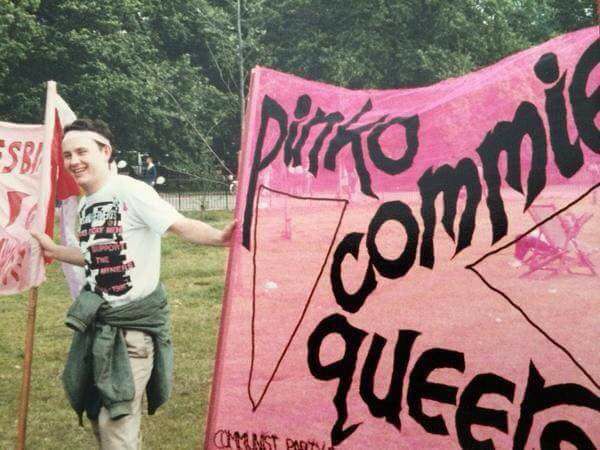
Ashton died of complications related to AIDS, at a time when the UK government had failed to take action to combat HIV.
His friend, LGSM co-founder Mike Jackson, stated at a memorial event: “To this day, Mark’s loss remains deeply felt by so many family members and friends… Driven, principled and charismatic, Mark would have achieved so much more if he had not died so young.”
The group, and Mark, were immortalised in the fantastic 2014 film, Pride.
Learn more about LGSM and Mark, in our podcast episodes 27-29 with participants. Find them on every major podcast app or on our website: https://workingclasshistory.com/…/e23-25-lesbians-gays…/
 CHATTING CRITICALLY