Another Year of Increasing Authoritarianism begins. As Time Goes By. What to say?

As Time Goes By – a song to be added to my repertoire. Time slips by so quickly too. I’m conscious of losing touch with friends and comrades. Not only physically, inevitable though it is, given my presence on Crete but also via all the other means of communication [for better or worse] available to us. I’m conscious of finding it evermore difficult to write anything worthwhile or indeed to write in the absence of a culture of give and take, in a vacuum wherein speculative thoughts are treated as one’s final indelible word; within which forgiveness is forbidden.

However I am reading voraciously – as usual, to my detriment and to the disbelief of Marilyn, not fiction but article after limitless article of all manner of ideological persuasion. It might well be suggested that this promiscuity is at the heart of my political impotence, my failure to articulate much about anything. I don’t think so. It’s hardly insightful but we live in an increasingly explicit authoritarian world, where the compulsion to censor any expression of opposition to the imposition of varied forms of ideological certitude is rampant. Perchance I exaggerate. Yet, in my lifetime. I do not feel I have experienced such a level of intolerance to dissent or disagreement. And this hostility to heresy infects both the Left and Right with honorable exceptions on both sides of this increasingly redundant binary.

There are contemporary issues I ought to address, simply to share and check out my thinking, whatever its insights, whatever its flaws. I feel anxious, not such a parlous state, given the unbearable fear running through the lives of the people of Palestine, Iran and many places beyond. And, to be contrary, I would be granted permission by the Left to voice my solidarity in this regard, especially as my own political history of support, for example, for the Palestine Liberation Organisation [PLO] goes back to the 1970s. Yet, on other matters, I am advised to be silent. To voice any concern about transgender ideology or the climate change agenda is evidently beyond the pale. To do so is to ask for trouble, to risk excommunication from the ranks of the political righteous. In this instance my past political activism in support of the Gay and Lesbian Movement or my scathing critique of the capitalist imperative, ‘perpetual production, ceaseless consumption’ is irrelevant, not worth a sideways glance.

I am likely to be found guilty by association. After all, isn’t the Trump regime hostile to trans women and men, not to mention enthusiastic about fossil fuels?  Case closed, contradictions seemingly not allowed as evidence. Utterances are never placed in context, grounded in the circumstances of their uttering. Biographies, histories are not a source of memories to be both treasured and measured, respected and scrutinised for their past, present and future significance or otherwise. They are to be interrogated for unpardonable sins as defined by today’s Thought Police.  

Musing about all of this messy reality is accompanied by a feeling of oft-times hopelessness, which never quite admits defeat. I will continue, even if I fail to say anything useful myself, to point people to commentators I find stimulating from across the ideological spectrum. More than ever I endeavour to read and hear what is actually being said rather than assume to know what is being said on the basis of knee-jerk prejudice, bias and stereotype. I start from the content, not the source.  I favour not just freedom of speech but what the Athenians called parrhesia, frank and fearless speech. Foucault revived the concept in his later work – https://foucault.info/parrhesia/

To begin with, what is the general meaning of the word ” parrhesia”? Etymologically, “parrhesiazesthai” means ” to say everything –from ” pan” πάυ and ” rhema” [δήμα] (that which is said). The one who uses parrhesia, the parrhesiastes, is someone who says everything he has in mind : he does not hide anything, but opens his heart and mind completely to other people through his discourse. In parrhesia, the speaker is supposed to give a complete and exact account of what he has in mind so that the audience is able to comprehend exactly what the speaker thinks. The word ” parrhesia” then, refers to a type of relationship between the speaker and what he says. For in parrhesia, the speaker makes it manifestly clear and obvious that what he says is his own opinion. And he does this by avoiding any kind of rhetorical form which would veil what he thinks. Instead, the parrhesiastes uses the most direct words and forms of expression he can find. Whereas rhetoric provides the speaker with technical devices to help him prevail upon the minds of his audience (regardless of the rhetorician’s own opinion concerning what he says), in parrhesia, the parrhesiastes acts on other people’s mind by showing them as directly as possible what he actually believes.

Whether any of this comes to pass, hardly matters, and depends on 2026 being less turbulent personally than this past year. For the first time in my life I’ve been dogged by a variety of health problems, culminating in being rushed into hospital for fear of a stroke. Thankfully a series of scans and tests revealed no visible problems, apart from hinting that I am possessed by a hidden, troubled mind! Given my age, continuing problems with my sight and what Les Dawson with a knowing glance downwards to the prostate would dub a ‘man’s problem’ are hardly unique.

It’s tempting to seek refuge in my beautiful surroundings, walking and cycling as best I can. Sadly I am no longer accompanied on my rambles by dearest, sweetest Glyka, our 17 year old dog and loving companion , who died before Christmas. I was distraught as was Marilyn.  Over the years Glyka taught me to appreciate herself, her fellow creatures and indeed Nature itself. She taught me to take my time and take in my surroundings; to acknowledge the cats, which she never chased, the dogs, towards whom she was a bit stand-offish, to chat to the sheep and goats, who sometimes replied imploringly, to be quiet so as to catch the birdsong and to gaze across the olive groves to the splendour of the towering White Mountains. As for herself she watched and listened, ever by my side, but never barked. We were free spirits or so we believed.
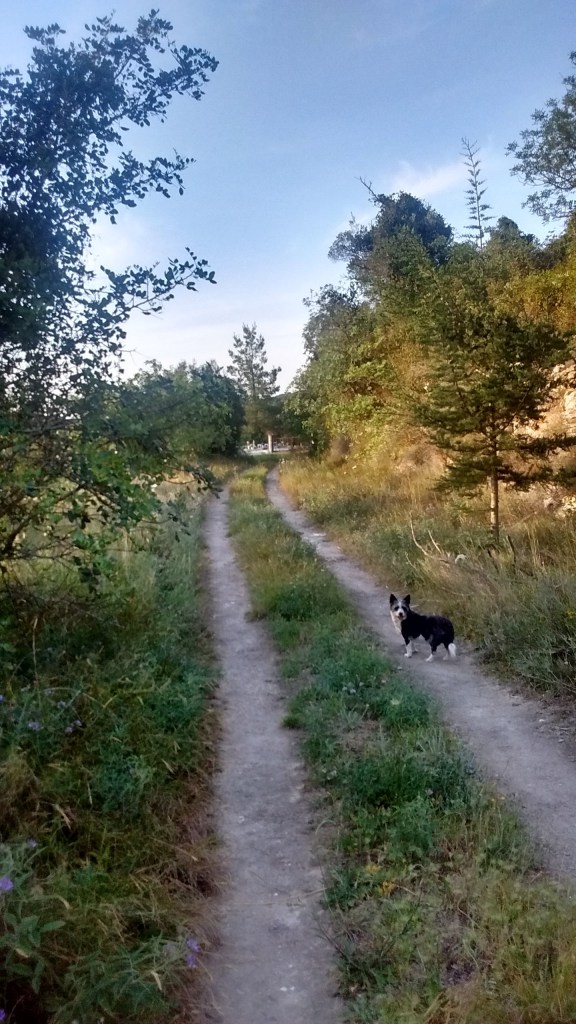
My dearest companion, Glyka

From my contact since the beginning of the COVID melodrama with dissidents of all colours I have been struck by how many are of a religious persuasion. Those to whom I’ve warmed have not been of an evangelical bent. However the conversations have often taken a spiritual turn. Over the years I’ve been quietly frustrated by what I see as religion’s appropriation of spirituality as its own. I’ve tried to be true to a spirit of human creativity, of cooperation, of justice and love. These past years closer to Nature, guided by Glyka, Leo, our aristocratic rescue horse, by the playful bin cats I feed, by Stelios’s adventurous goats, amazed by the way our brick-strewn barren garden has blossomed, I have sensed another level of spiritual awareness. Nevertheless I remain an atheist. I feel no need for a deity to give purpose to my existence. I remain a revolutionary humanist, a steadfast universalist, who has come to cherish the Earth in all its glory.

I do not know what I would do without music to soothe my spirits. Last week I sang ‘a capella’ in our village hall. I began with Dowland’s desire, ‘Music, music for a while, shall all your cares beguile’- somewhat truncated and hardly as beautiful as the wonderful Alfred Deller.

My generous neighbour, Ken Carpenter filmed some of the concert I gave to a small audience in our village hall. If I have the courage I will post a link to these videos soon. Listening and encouraging my effort, even entranced [!] were my very dearest friends, Maria and Linda Manousaki. Maria is an inspiration, not only as violin virtuoso but also as the driving force behind the diverse groupings of musicians she brings together here on Crete – for example, two very different string quartets, the Melos Ensemble play arrangements from the classical and jazz repertoires, whilst Tetracho improvise upon the indigenous Cretan tradition . In the next few weeks Linda at the piano and I will be rehearsing songs from American musicals. She will engage with my musical myopia, symbolised by the worried, ‘what key are we in?’ Who knows I might even sing accompanied sometime in the future!? We will see.
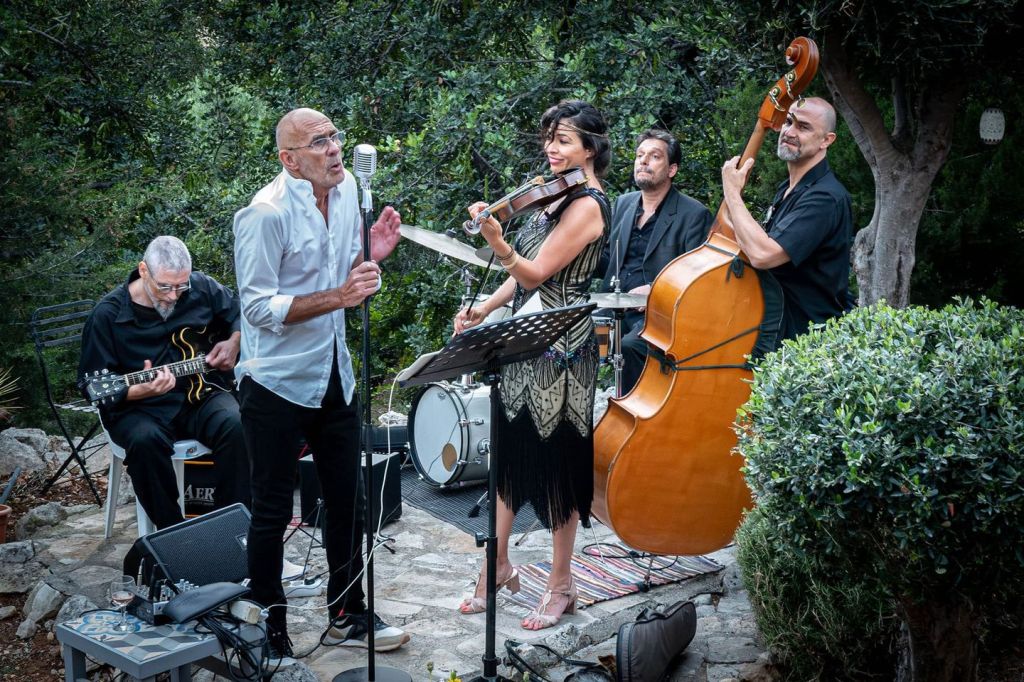
Privileged to be singing with Maria and the Swinging Strings

This piece is silent on the impact of Artificial Intelligence on our lives. It does not speak directly to the killings on the streets of Gaza, Teheran and Minneapolis. The silence is not by chance. I will break it but doing so is haunted by the knowledge that increasingly words, sounds and images tease, alarm as to their authenticity. It has always been necessary to be critical of what we read, hear and see. Today it is an unceasing and tiring obligation. And through the fog enveloping the truth I am inspired by the sight of ordinary people acting courageously in unison, striving against the odds to be agents of their own destinies. I refuse the concerted attempts across the ideological divide to deny them their autonomy, to cast them as mere pawns in the clutches of the oligarchs, the intelligence agencies, the corporations, the technocrats, the media, right or left-wing agitators or whomever.

Solidarity from an armchair radical, who needs to get on his bike.

Love & struggle,

Tony

On reading afresh this New Year’s ramble I’m afraid to say it’s more of the same navel-gazing as previous years – the same doubts and the same themes. Somewhat wearying, I fear. At the same time it indicates that the social and political situation isn’t getting better. Indeed it’s getting worse.


In an interview on Bad Faith, Gabor Mate suggests he has never experienced such darkness.
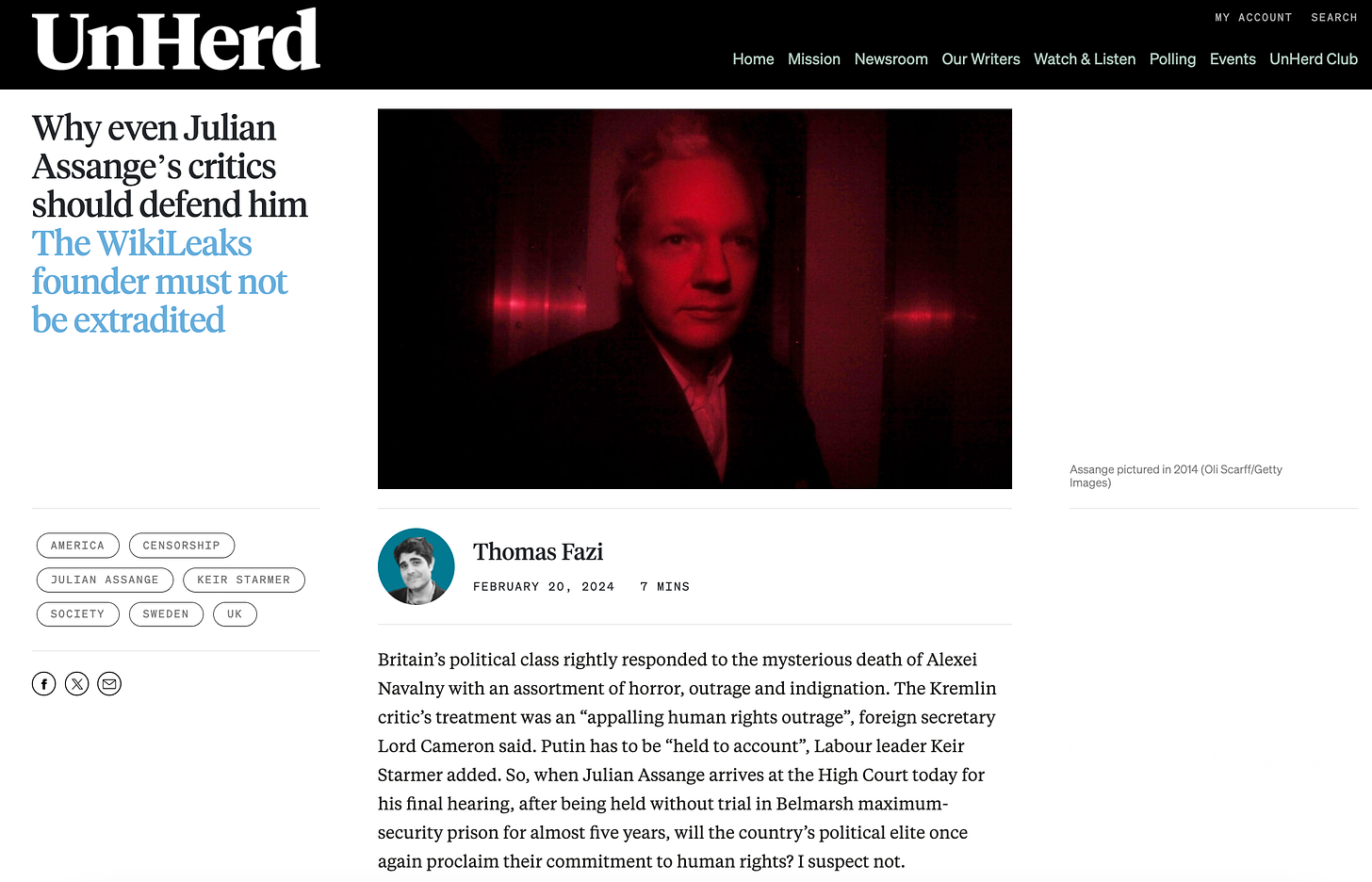

Assange’s fate hangs in the balance: Thomas Fazi voices the fear of all opposed to authoritarianism, whatever its cloak

Britain’s political class rightly responded to the mysterious death of Alexei Navalny with an assortment of horror, outrage and indignation. The Kremlin critic’s treatment was an “appalling human rights outrage”, foreign secretary Lord Cameron said. Putin has to be “held to account”, Labour leader Keir Starmer added. So, when Julian Assange arrives at the High Court today for his final hearing, after being held without trial in Belmarsh maximum-security prison for almost five years, will the country’s political elite once again proclaim their commitment to human rights? I suspect not.

If the British state allows Assange to be extradited to the US, it won’t be dealing a potentially deadly blow just to one man, but to democracy itself

THOMAS FAZI

FEB 20, 2024

I’ve written for UnHerd about the two-day hearing starting today in which the UK High Court will announce its final decision on Assange’s extradition to the US. If the court rules out a further appeal, Assange could be immediately extradited to the United States, where he will almost certainly be incarcerated for the rest of his life on charges of espionage — most likely in extremely punitive conditions that will push his already critical physical and psychological conditions over the brink. “His life is at risk every single day he stays in prison”, his wife Stella Assange said. “If he’s extradited, he will die”.

The British government’s lack of concern for Assange’s fate is not surprising: they are the ones that put him in prison in the first place, after all. More worrying is the fact that much of the British public also seems relatively unconcerned with the case. This, I suspect, is the result of the relentless smear campaign waged against Assange over the past decade and a half, aimed at destroying his reputation, depriving him of public support and muddying the waters surround his case.

This is why in the article I try to debunk several myths about the Assange case, from the trumped-up rape charges to the depiction of Assange as a fugitive from justice.

Read the article here.

SUFFOCATING, NOT GOING UNDER AND TAKING A BREATH

When I was about 8 years old my primary school teacher, frustrated by my reluctance to enter, pushed me into the pool at the town’s Baths.  I thought I was going to drown but my fellow pupils came to the rescue.  How could she have done this?  What callousness!  Or so the story goes.  In truth I’m not sure the incident ever happened.  However, I’ve told the tale so many times, often embellished, that I’ve come to believe it.  Why the need for this dubious childhood anecdote?  Certainly it has served to excuse my genuine fear of putting my head under water.  Friends who have sought to teach me to swim can attest to my frenzied splashing in protest.  Indeed it appears to explain my life-long struggle to stifle frightening dreams, within which I experience being suffocated, physically with a pillow, or psychologically by guilt, having betrayed my beliefs or people dear to me.  I awake dramatically, fighting for my breath.  By and large I deal with this, park the neurosis in its place.  And then again, perhaps not.

For over the last four years, in particular, I have felt suffocated, drowning in an unrelenting deluge of information, opinion, analysis and gossip.  I experience being in a state of alternative asphyxia.  It is not that I am starved of the oxygen of ideas, rather I gorge, I binge compulsively on their 24/7 availability. Some sort of diet beckons.

This self-indulgent, breathless cry for relief from the day-to-day assault on my senses inflicted by the media of whatever ilk is very much personal.  It is not to be taken in any way as an argument against the widest possible array of views being out there and accessible.  I oppose censorship, the suppression of opinion, most of all when I disagree even vehemently with such speculation.  I stand against authoritarianism, whether dressed in the cloak of the Left, Centre or Right.  Obviously I have no time for the manufactured categories of mis and disinformation through which the powerful seek to silence criticism and opposition.  Plainly the charge of misinformation is directed principally at those who question the dominant narrative.  It is applied to those who desire to make public what the ruling class wishes to remain private. According to the ever suave Barack Obama, I’m severely mistaken. I’m sinking into the ‘raw sewage’ pumped into the public square by the alternative media. Thus, misled, he opines it’s no wonder I’ve lost faith in society’s politicians, institutions and media and in doing so I represent a disturbing threat – let’s not mince his words –  to the future of humankind. Given this apocalyptic charge, it’s no surprise that the 2024 World Economic Forum in Davos is deeply bothered about my dissidence.

In his opening remarks to the conference of the great and good, Klaus Schwab, its founder and chair expressed his concern – “We must rebuild trust – trust in the future, trust in our capacity to overcome challenges and, most importantly, trust in each other.” In order to win back my undying support the elite will continue to encourage the creation of an armoury of so-called ‘independent’ disinformation agencies, funded by a mix of  private and public sources. For example the European Union has “a network of  anti-disinformation hubs that are part of the European Digital Media Observatory (EDMO), the independent platform for fact-checkers, academic researchers and other relevant stakeholders contributing to addressing disinformation in Europe”. Forgive the obvious but there is not the faintest scent of humility in these manoeuvrings, the slightest nod of recognition that their arrogant and authoritarian programme of propaganda and restriction might have something to do with our mistrust of their motives.

In the UK’s recently passed ‘Online Safety Bill’ you can see how the government intends to win back our trust. Section 179 section makes it illegal to publish false information with intent to cause harm…..

…..but Section 180 exempts all Mainstream Media outlets from this new law!

Of course I might not be seeing the wall for the bricks but this suggests strongly that the MSM are explicitly permitted to “knowingly publish false information with intent to cause non-trivial harm”. Yet you or I can be imprisoned for a year for committing a criminal act in drawing attention to their conscious deceit. A touch topsy-turvy!

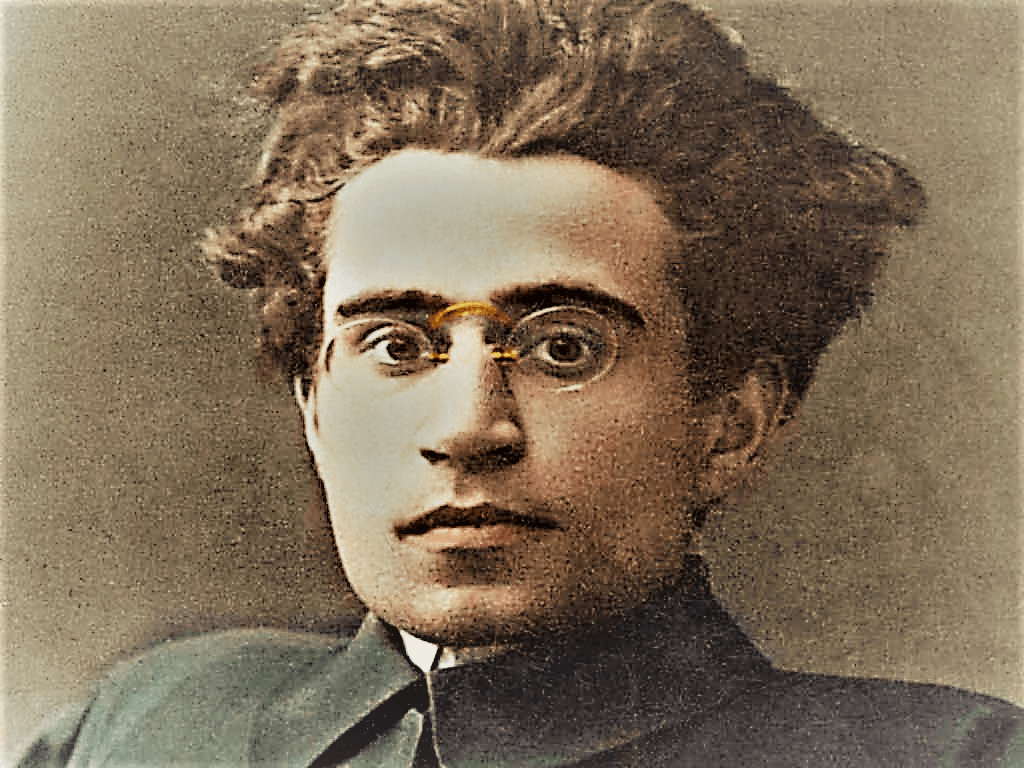
Hence, for my part, I will not be intimidated into accepting the powerful’s rule over what I think or believe. Perhaps you might think me simple but, on a day-to-day basis, I will proceed on the basis of receiving, reading and thinking about information. It will be whatever it is, a product of those who put it together, informed by their expertise or lack of it, their integrity, their prejudices, their beliefs and so on.  It is my job as the aspiring, thoughtful citizen of Aristotle’s imagination to interpret and judge what I am told to the best of my faculties. Certainly such an ability, as far as it goes in my case, is born of a splicing of political activism with professional education and a measure of involvement in academia. At my most pretentious I fancied myself as one of Gramsci’s organic intellectuals.

Thanks to avanti.it

In this context, summed up in the world of youth and community work [YCW]  work, within which I laboured, as the desire to be a critically reflective practitioner, I didn’t expect to be so isolated as the COVID manufactured melodrama unfolded. I remain perplexed at the extent to which the professional class, including its YCW members, embraced and colluded uncritically with an unevidenced and unethical regime of societal restriction. An emergency was asserted but never proven. Fear provided its justification. Naively, I thought such authoritarianism would spark resistance. In retrospect, I failed to recognise how deeply behaviourism, its apparatus of preordained scripts, prescribed targets and imposed outcomes, was embedded in the professional psyche – not least in work with young people.This acceptance of a discourse of certainty about the correctness of our data-driven, objective models, the righteousness of our impact, the benificence of our worthy goals,  spilled over into life as a whole. And, as far as I can see, practitioners remain in denial as to what they were up to. No more than fleeting research confirms that masking, social distancing [made up on the back of a cigarette packet], the closure of children’s and young people’s provision were harmful and unnecessary. I await the National Youth Agency even shyly allowing it was a touch over the top, even as it bemoans a deterioration in young people’s mental health. Evidently it was the virus ‘wot dun it’ not the conscious application by practitioners of draconian social policy. Perhaps, though I’m too harsh, even the much revered Noam Chomsky, ‘an intellectual superstar’, according to the Guardian, succumbed utterly to the smear that the unvaccinated were dangerous and irresponsible, arguing that they should be ‘isolated’.

Ironically and thankfully, Chomsky along with much of the Left recovered his balance as the seemingly endless tragedy of Gaza erupted, as genocide stared us in the face. Almost overnight we rediscovered our ‘instinctive mistrust of the state’, of careerist and opportunist politicians, of undemocratic, unelected bodies of experts. In particular, perhaps, having swallowed whole the COVID propaganda spewing from the mass media, we remembered belatedly our relentless and scathing critique of the bourgeois press, which goes back at least in academic and activist circles to 1974 and the creation of the Glasgow Media Group. 

Enough is enough. I’ve peddled this perspective before without reaction, which is fair enough. Who on earth am I? My insignificance acknowledged, it does mean therefore that I must take a deep breath about my suffocating immersion in the currents of available opinion. It is extraordinary but I’m ‘sut on mi bum’ to use a Lancashire expression more than ever in my whole life.  True, I still drag myself out more or less every day to indulge the narcotic of my lingering athletic obsession.  I persuade myself I feel better for having done it.  Yet, outside this hour or so of exertion, I’m sometimes spending up to eight hours hunched over the laptop in a pompous search for the Holy Grail containing ‘the Truth’! Inevitably it’s always just out of reach. I need a break from this self-inflicted imprisonment.

To cut my usual ramble short I’m determined to work out a fresh approach in my declining days. I need to get out more as the saying goes.

  1. I won’t abandon Chatting Critically but, in addition to my occasional originals, I want to use it more as a conduit to challenging thinkers and activists who you might not trip over. In doing so I’ve already culled the number of people I’ve been following because I can’t keep up. A future post  will single out blogs and websites, which continue to stimulate me. You might well shake your head at my choices. On the ground I remain committed to our local Chatting Critically group.
  2. I shall spend more time on a project to record the history of the Lancashire Walking Club , of which I am a life member. It gives me pleasure, believe it or not, to do so.
  3. I am close to giving up on even being the In Defence of Youth Work [IDYW] archivist, the initiative of which I was once coordinator. Few seem interested. To all appearances its open-ended philosophy has been defeated – see the inanities of its supposed Facebook page, which ought to be closed out of respect to IDYW’s corpse.
  4. I’m going to ramble and cycle as I wish without feeling the need to rush back home.
  5. I’m going to spend more time singing and becoming musically literate.
  6. I’m going to  spend more time musing for the sake of musing in our village kafeneion.
  7. I cannot promise but I ought to improve my Greek.

On reading this afresh it ends up looking like a belated set of New Year’s resolutions. Given my past track record in keeping to such sensible proposals as cutting down on the village wine, the omens are not promising. We will see.

Tony Taylor


To end positively, let me introduce you to the writings of W.D. James, who teaches philosophy in Kentucky, USA and his substack Philosopher’s Holler

He explains:

Egalitarian Anti-Modernist philosophical ruminations on our contemporary conundrums. In my native dialect, a ‘holler’ can refer to a hollow (empty space), a yell, or a work song.

I’m thinking my way through our current times and I tend to do that by digging into the ‘classics’ of Westen political philosophy to see what light they can shine on the contemporary moment.

My basic stance is characterized by:

  • Anti-Modernism
  • Anti-Globalism
  • Deep respect for pre-modern wisdom traditions, including religious traditions
  • Liberty
  • Defense of the opportunity for a good life for everyone
  • A critique of the modern state
  • Grounding in nature/reality, intellectually, morally, and existentially

For my part, TT speaking, I would recommend you download and dip into the free pdf, Egalitarian Anti-Modernism

CONTENTS
Foreword by Paul Cudenec
Part 1: Was Jerusalem Builded Here?
Part 2: Jean-Jacques Against the Pathologies
of Civilization
Part 3: Rousseau and the Evils of Inequality
Part 4: Rousseau’s Revival
Part 5: William Morris and the Political
Economy of Beauty
Part 6: William Morris – Dreaming of Justice
and of Home
Part 7: What is Wrong With the World?
Part 8: Chesterton Against Servility
Part 9: Catastrophe
Part 10: Egalitarian Anti-Modernism and the
Contemporary Political Landscape

I enjoyed and was challenged by its content and argument, given that for a long time in my political life I believed in the inexorable relationship between progress and the continual development of the productive forces. I’m less confident nowadays.

The price of speaking out – a courageous headteacher puts his head above the parapets

On a number of occasions, both during and post the pandemic, faced with overwhelming professional compliance and collusion, I have expressed my despair and dismay. As best I can see and I have scoured the mainstream and alternative media for dissident voices, almost to a person, the education profession has collaborated with utterly unnecessary draconian restrictions on children’s and young people’s lives. I remain perplexed that teachers, play and youth workers, together with lecturers claiming as a result of their training to be politically informed and critically reflective could acquiesce with scarcely a murmur to a shoddily evidenced, glaringly opportunist and organised global intervention that mocked the very notion of sovereign democratic states. To add to my perplexion education professionals, amongst others, are prone to waxing lyrical about the importance of ethics, of codes come to that, yet they remained silent, nay colluded with the unethical campaign of fear concocted by SAGE’s unholy team of behavioural psychologists.

Perhaps most upsetting is that we now observe a profession in denial. Contradictorily, given the less than unusual coronavirus was marketed as an existential threat to humanity, it’s almost as if nothing much happened really. Apparently, there’s no need for any of that reflective malarkey, better the well-worn brush under the carpet. Thinking only of my old back garden in Youth Work, I suspect I will wait in vain for the appearance of any self-critical piece, ‘What Did We Do In The COVID War?’ from the likes of the National Youth Agency, the Centre for Youth Impact, the Training Agencies or the trade unions.

Without a hint of embarrassment, it’s business as usual after the unusual. There’s an unsaid caveat though. If anything unusual, as decided by our betters, does come up, we will again do as we are told and keep our mouths shut – for the common good, I’m sure. For what it’s worth I think, this would be tragic. These are not normal times. More emergencies await us. More than ever we need to talk openly to one another without the fear of being wrong, trashed or smeared.

I take comfort and inspiration from the following.

The price of speaking out

The author of this article is Mike Fairclough, a headteacher who blew the whistle on what he felt were serious safeguarding concerns about the impact of Covid interventions on children. Though whistleblowers are in principle protected by the law, he has been repeatedly smeared and victimised for voicing his concerns. Here he tells his story.

There is a great deal of discussion in the media about free speech and censorship. What are we allowed to talk about and who has the authority to silence us? Particularly in the wake of the pandemic — a period which saw increased anxiety about the consequences of expressing our opinions or even asking questions about the government’s response to Covid — but also around issues such as sex education in schools and identity politics, the closing down of debate has created a damaging culture of self-censorship. Worryingly, this has influenced many adults to put their own self-preservation ahead of the needs of children. 

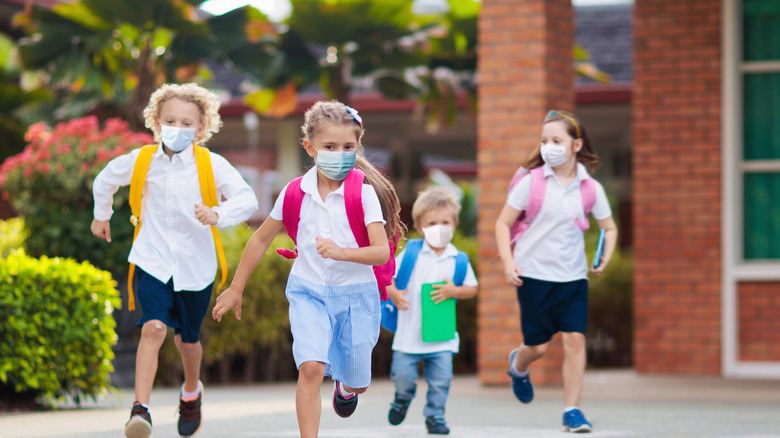
As the headteacher of a UK junior school, and a parent of four children, I saw it as my moral duty to speak out about my concerns regarding the catastrophic harms that the pandemic policy was doing to my pupils — from school closures and remote learning, masks, cancellations of children’s sports and lives, and then of course the drive to vaccinate children against Covid.

My approach has always been to weigh the benefits of these interventions against the known risks and safeguarding flags.  As regards the Covid vaccines, my assessment was simply that we shouldn’t apply a  medical intervention to children unless there is a clear benefit and a proven safety record — a view which until 2020 would have been seen not only as a reasonable position, consistent with medical ethics, but a position against which to argue would have been considered extreme.  It was clear early on that for healthy children there was minimal risk from the virus and therefore no, or only very minimal, clinical benefit from the vaccine; and critically there was, and is still, no long-term safety data. 

So it was my honestly held view as a parent and headteacher that the roll-out to children constituted a potentially serious safeguarding issue, and that I was legally as well as morally obliged to voice my concerns about this.  People who work in education are obliged to attend annual safeguarding training which informs us that we must report all safeguarding concerns.  Indeed,  attempting to prevent unnecessary harm to children is a legal requirement within my profession.  The professional who turns a blind eye to abuse is held equally accountable, even if not directly enacting the harm themselves. Silence is never an option.

However, my experience of becoming a whistleblower on these safeguarding issues — lockdowns and masks as much as vaccines — is one of relentless attacks and smears both online and in the press, frequently being mis-labelled as an “anti-vaxxer”, and enduring multiple attempts to silence me.

My employer has supported three investigations into my conduct, following whistleblowing complaints relating to views I had expressed about child safeguarding.  Indeed, the most recent unfounded allegation involved the complainants reporting me to the Department for Education’s Counter Extremism team as well as to Ofsted.  Results of an FOI request reveal that I have also been monitored by the UK Counter Disinformation Unit. 

Although I have been cleared of any wrong-doing on all occasions, following independent investigations, these attacks have inevitably taken their toll on me. My nineteen-year career as a headteacher has been overwhelmingly successful up until this point. My employer, Ofsted and the DfE have always supported my educational innovations and celebrated the achievements of the school prior to this time. However, I am now perceived as an extremist and a troublemaker, despite being cleared of the radical allegations against me. I have also been told by former colleagues that I deserve to be punished and should never have spoken out. It appears that any criticism of the government in relation to its pandemic response and its effects on children is seen as a form of blasphemy by devout followers of the orthodox Covid consensus. 

Some of those colleagues believe I was wrong to even question the vaccine roll-out to children because, they tell me, children needed to be vaccinated in order to protect vulnerable adults. I go to sleep thinking about the situation, I dream about it and then wake up in the morning worrying about it again. As a result, my health has suffered in ways which I have never before experienced. I have lost weight, have a constant knot in the pit of my stomach and feel agitated and low much of the time. My personal relationships have also suffered and it feels like every aspect of my life has taken a hit. All because I did my job by blowing the whistle about my safeguarding concerns for the children in my care.  This is something which I should be protected for doing, not attacked for, provided I have acted in good faith. I don’t regret speaking out but I won’t pretend that it has been an easy ride.

Along the way, I have received support from many people, including fellow headteachers and others within my profession, albeit almost always in private messages and secretive whispers. These people have thanked me for voicing my opinions but said that they have been too fearful to speak out themselves. Sometimes they have pointed to the attacks which I have faced as the reason for their silence. I have been grateful for their encouragement but I feel it’s now important for everyone to find their voice. If we see a safeguarding concern regarding children’s health and wellbeing we have a moral obligation to report it. I will emphasise again, it is also a legal duty within the education profession to do this. 

In the shadow of this pandemic I believe we all now need to empower ourselves, and each other, to speak up and speak out, rather than simply leaving it to others to fight our corner.  Nowhere is this need more urgent than in the context of safeguarding for children.

As a career educator, I have a strongly held philosophical belief in the importance of critical thinking and in freedom of speech. I challenge orthodoxies when I encounter them and then publicly share my thoughts, always careful to maintain respect for other people’s differing views and trying always to remain open to changing my existing opinions.

I don’t suggest this is a new idea: educators and thinkers have adopted this approach to life for millennia, with philosophers such as Socrates using this method of thinking and communicating since the time of ancient Greece. And yet, though we like to think that we live in an advanced and progressive liberal democracy, we now find that challenging orthodoxies has become one of the greatest taboos. Critical thinking is frequently assigned to the realms of the conspiracy theorist and pointing out the obvious can become a punishable offence with sanctions delivered both by zealous authorities and by our fellow citizens.

There is an increasing number of people who now say that they opposed many of the government’s pandemic responses but didn’t make their views public at the time. Individuals who had recognised the potential harms caused by lockdowns, masks or the vaccine mandates but stayed silent. The minority who did speak openly about their concerns were often attacked, which no doubt will have played a part in others’ self-censorship. But, if more people had publicly voiced their concerns, I’m sure we could have collectively prevented at least some of the unnecessary harms unleashed on us, and on our children. 

This is why it is so important that we create a cultural landscape within which different opinions can be freely expressed. And I believe that we each have a significant role to play in bringing this about. Speaking our truth about controversial or sensitive subjects and ending this culture of self-censorship and fear. If we don’t do this, we risk repeating the mistakes of the past few years. Watching in silence at harms taking place around us instead of standing up and speaking our truth. Critical thinking and free speech are not dangerous. They are what free and democratic societies are built upon. Fight for them and they — and we — will flourish. Leave it to others and we risk losing our hard-won civic freedoms forever: a future for our children which none of us want to see.

Many thanks to UsForThem for the original

usforthem2020.substack.com

Postscript

As I read this afresh I’m moved to wonder how I might have responded if I had been transported to be, if not a Chief Youth Officer, some brand of Senior Manager within the remains of Services for Young People. Would I have had the bottle to stand my ground and report to politicians and bureaucrats my principled and informed opposition to the closure of playgrounds and youth centres, to express my concern that the imposition of masks and social distancing had no solid empirical basis and would undermine the very foundations of relational education? I like to think so but it’s easy to be brave from a distance. Certainly, it seems likely that when word got out about such a stance, whatever my track record, I would have become persona non grata overnight. Quite how this immediate, damning and long-lasting judgement of my worth squares with the person-centred, process-led and forgiving youth and community work tradition of yesteryear [?] is for another time.

Camus on vanity and the joy of living alone

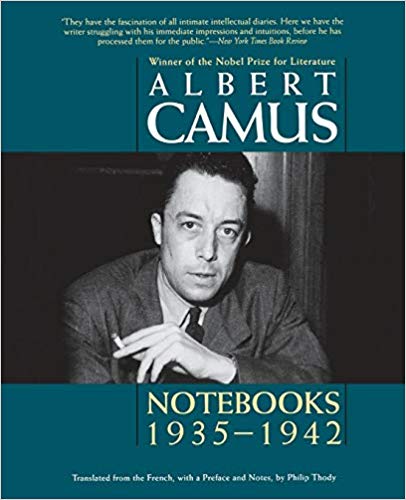
On a number of occasions, I’ve talked about using this blog as a vehicle for other people’s writing. And there is a great deal of thoughtful, challenging material out there. It feels like a useful idea, even if my audience is sparse. Inevitably, given my disposition, most will be political in intent. However, for starters, here’s a beautiful, unsettling and contradictory quote from the enigmatic Albert Camus.

In the meantime, I’ve set off writing up my notes from the talk on Authoritarianism. It’s become clear that the notes constitute only a beginning. Even as I scribble more questions and even answers come to light. These need to be scrutinised and incorporated. Who knows when and where it will end?

Every time a man (or I myself) gives way to vanity, every time he thinks and lives in order to show off, this is a betrayal. Every time, it has always been the great misfortune of wanting to show off which has lessened me in the presence of truth. We do not need to reveal ourselves to others, but only to those we love, for then we are no longer revealing ourselves in order to seem but in order to give. There is much more strength in a man who reveals himself only when it is necessary. I have suffered from being alone, but because I have been able to keep my secret I have overcome the suffering of loneliness. To go right to the end implies knowing how to keep one’s secret. And, today, there is no greater joy than to live alone and unknown. My deepest joy is to write. To accept the world and to accept pleasure—but only when I am stripped bare of everything. I should not be worthy to love the bare and empty beaches if I could not remain naked in the presence of myself…” ~Albert Camus (Book: Notebooks 1935-1942)

Thanks to Philo Thoughts at https://www.facebook.com/philo.thoughtspage

There’s a host of information and a fascinating biography on the Albert Camus Society website

Talking about Authoritarianism in a quiet, idyllic Greek village

A recent painting of a village house by Marilyn

A couple of days ago I gave a talk initially entitled ‘Sleepwalking into Authoritarianism’ in the surreal setting of a sleepy Greek village. As is my wont I had made heavy weather of putting together the presentation. Even the day before the event the floor around my desk was laden with discarded attempts to write something worth hearing.

Amongst the many considerations influencing my weary way – I still handwrite and forever return to my varied beginnings to start afresh – were two in particular.

  1. I felt overwhelmed with information. I didn’t view this mass of opinion as misinformed, disinformed or whatever. It was simply stuff I had to scrutinise to the best of my ability and in the full knowledge of my own ideological disposition. Somehow I had to pull something together that reflected my sense of what’s happening in society without boring folk to tears.
  2. And the folk in question, so it proved, were a motley bunch with no shared background, expertise or experience. Even if a majority were retired immigrants from the UK, others present were younger, alongside those for whom English was a second language.

In the event, it seemed to go well. I was forgiven for my age-old habit of preparing flip chart prompts, only to overlook them completely. There was exquisitely timed melodrama. As I uttered the exclamation, ‘all hell was let loose’ a plastic chair, not for the first or last time on Crete, collapsed under poor Ralph sitting in the front row. He went down with quite a wallop, his coffee flying in all directions. As ever in such circumstances hilarity mixed with concern. However, Ralph quickly regained his composure, aided by the provision of two chairs in one. In accord with the adage, the show went on regardless. I hardly had time to take a breath.

In truth, if I dare use such an abused phrase, this lively moment was probably a blessed relief, given the doom-laden content of much of my offering. Nonetheless, a number of people responded positively to the idea of a monthly discussion group, to the opportunity of meeting regularly to converse critically about what’s going on in the world.

Thus I will write up my notes under the changed title, ‘Authoritarianism: Chains Loosened, Shackles Tightened’. and incorporate some of the telling points made in the Q&A end to the morning. Hopefully, I’ll sort this out in the next fortnight. All being well we will meet in the week beginning Sunday, March 19th. Further details will be circulated soon.

Thanks to all who came, to the committee of the Kalamitsi village for the use of the Old School and to Phil and Fran [Kalamitsi Arts Group] for the arrangements.

Are youth workers chatting critically about their compliance with or resistance to the closing down of young people’s lives?

Back in January, I published a post, What about Children and Young People? Are they no more than collateral damage? The opening sentence declared, ‘from the very beginning, March 2020, of the utterly undemocratic imposition of COVID-inspired sweeping restrictions on social existence I feared for children and young people.’

I was perplexed from the outset at what seemed to be the absence of debate and the utter lack of opposition to the demanded closures of children’s and young people’s provision – from playgrounds through schools and youth facilities to universities. I am being diplomatic. I was pissed off and angry. It was plain that such draconian, disproportionate action would be deeply damaging. The belated acknowledgement in the summer of 2021 that the lockdown was creating serious mental health issues for the younger generation, crocodile tears, merely confirmed my angst. Then, a humble breath taken, I recognised it was easy for me to be so moved. If I was still a practising youth worker. teacher or lecturer what would I have done during the last two years?

Towards the end of the piece I commented:

Certainly in the coming weeks, as the pandemic narrative unravels, it would be revealing to hear the thoughts of UK youth workers, teachers and lecturers about their sense of the impact upon children and young people, upon themselves of the two years lost.

I’m still waiting but prodded by an Opinion article in the Guardian, ‘Evidence grows of lockdown harm to the young. But we act as if nothing happened‘ by Martha Gill, I’ll return to the issue by way of a recent criticism of lockdown.

Written by Dr Zenobia Storah, Child and Adolescent Clinical Psychologist, it is entitled, ‘Reflections of a Child Psychologist on the Pandemic Response, 2 years on.’ It deserves to be read in full, particularly perhaps by professionals in the fields of welfare and education. At one point she muses.

Something unexpected happened in Spring and Summer of 2020. I found myself standing apart from my colleagues. I could understand that in the initial stages of the pandemic, due to the particular threat that Covid posed to the elderly, the government’s decision had been to focus on the protection of older members of the population. But as the weeks wore on and I imagined the harm being done to children across the country, informed both by my training and my professional experience, it was clear to me that too much weight was being focussed on the protection of adults at the enormous expense of the less obvious (but more long-term) damage to the future and well-being of children and young people. And yet those who I would expect to be my natural allies due to shared knowledge and experience remained silent. There was no national, grown-up discussion anywhere about how we might balance the need to protect the most vulnerable from Covid with the interests of the young, and how we could remain faithful to our national commitment to children’s best interests being paramount. Any attempt to introduce such discussion was met with derision and accusations of moral decrepitude. To my astonishment, this was also the case on professional online forums, where it became increasingly difficult to raise concerns. It seemed to me that psychologists, who describe themselves as ‘scientist-practitioners’, should be asking serious questions about society-wide decisions to impose restrictions and mandates that would inevitably harm children and young people (and other vulnerable groups). At the very least, they should all be calling for a broader discussion, which they would be uniquely placed to inform, and at best, an extremely high bar (in terms of cost-benefit analysis) for the introduction of such measures. Yet the general view amongst those working with children and young people – and the official view of most professional bodies including my own – was that the moral responsibility of child professionals was to support government policy (at whatever cost to society and whilst asking no questions – or so it seemed to me) and then to work to mitigate the impact on mental or physical health. The alternative view – that policies that kept children out of schools, cut them off from families and friends, kept them from participating in outdoor sports, normal play, activity and socialising and prevented them from accessing healthcare and other support services should not be in place at all – was anathema. This was disturbing and confusing. I could not understand how, given the values and knowledge we had all shared before March 2020, this had come about.

She concludes.

We always knew what circumstances and experiences children needed in order to thrive, to be physically well and to be mentally healthy, and we knew that the unprecedented social experiment that took place from March 2020 deprived them of many of these things and would put many at risk of serious harm. The collateral damage outlined in all these studies and reports could have been foreseen and warned against by many more child professionals than ever spoke out. In moving into the post-pandemic era, it is essential that we continue to speak of these harms, to measure and describe them and to share these findings with our colleagues and the general public. We need to welcome into the discussion the concerns of many people who, at the time, were persuaded that reduced transmission of Covid trumped everything else, including the safety and mental and physical health of children and young people. It would be good to reach a point where there is full acknowledgement of the harms caused and the catastrophic errors made that led to them. Perhaps the Covid Inquiry will lead society to ask itself how we ever got to a point where children and young people were routinely subjected to harmful and unevidenced interventions and restrictions. As we support recovery, all those working with children and those in government must re-commit to the principles of the UN Convention for the Rights of the Child. And we must ensure that we never subject a generation of children to such experiences ever again.

Speaking purely of youth workers, managers and lecturers, fond of proclaiming themselves to be critical practitioners par excellence, to what extent at a local, regional and national level are they coming together to consider what has been going on over the pandemic years? To what extent are they encouraging young people to discuss the rights and wrongs of the authoritarian clampdown on their lives? Or is the profession pretending the last two years never happened? Such collective myopia bodes ill for a future, within which an emboldened ruling class is confident that its diktat will be fearfully obeyed and that amongst its messengers of anxiety will be indeed youth workers, managers and lecturers.

As the New Year dawns – being bullied into COVID compliance

New Year’s Day 2022 – an azure and windless sky beckons, promises and resolutions hang not yet tested in the still air. New Year’s Days I’ve had too many to mention but this one is different. It’s surreal, sinister and disconcerting.

I’m now into my 75th year on this god-forsaken earth. For more than half a century I’ve spouted forth about the evils of capitalism, even advocated revolution but my stance has not cost me dear. A tapped phone here, a night on a police station floor there, a few bruises on the picket line. Nothing to write home about. Indeed, it might well be argued that I’ve made something of a career out of being the useful ‘token ‘radical, not ‘in and against’ rather ‘in and compromised’ by the State. I’m of a post-war generation, whose lives were improved to different degrees by the struggles of our forefathers and mothers. With all its warts, and I railed against its shortcomings, the social-democratic society was a step forward. Neoliberalism has been closing down its gains for over forty years. I’ve sought to criticise this assault, arguing against the insidious influence of behaviourist psychology and worrying about the danger of us sleepwalking into an authoritarian and intolerant society. Again I have not been taken to task by the powerful for this dissension. As far as being troubled goes, it’s been wrought by my own self-doubt and anxiety. As a dear friend whispered gently, ‘being a couch revolutionary isn’t exactly uncomfortable’.

Two years ago I would have shaken my bald pate in disbelief at the predicament I face this New Year’s Day. The Greek government has determined that all the citizens and residents of the country, who are over 60 years of age will be vaccinated with the ‘booster’. Refusing to comply will lead to the following State punishments.

  • Each person resisting will be fined 100 euros each successive month until they give in. Over 25% of Greek pensioners, around 700,00 persons, receive less tha 500 Euros a month and even the average pension amounts to only 869 euros before deductions. In my case it seems that if I resist the 100 Euros will be procured for the government by my accountant.
  • Each person resisting will not possess therefore a valid vaccine passport. This means they will only be allowed access to supermarkets, grocery stores and chemists, to food and medicine. They will be barred from all public indoor spaces – tavernas, kafeneion, the beating heart of Greek life, even, I’m not sure, the Church – and public events. If this is enforced they will be excluded from the majority of what we might call civil society.

I want you to be shocked and angry in the face of such a draconian scenario, imposed by a government without an ethical leg to stand on. I worry that the propaganda machine churning out numbers, numbers, numbers will continue to cloud the issue. Mass testing alongside the emergence of a milder but more infectious variant will inevitably mean an upsurge in infections, leave aside the fact that the USA Centre for Disease Control has just disowned the PCR test, admitting its unreliability. A touch late, methinks.

In essence, the Mitsotakis government’s authoritarianism, whilst running deep in its historical blood, is inseparable from the influence of the corporate and pharmaceutical giants of our era. It is about power and profit. It is about politics. It is not about health. At this point, some readers may sigh. Am I in Covid denial? For now, I will only say that I believe that the COVID threat to society as a whole has been exaggerated enormously; that from a health point of view things could have been managed so very differently.

AgePeak Case Fatality Rate in winter 2020Case Fatality rate in June 2021
<204 in 100,0004 in 100,000
20-2914 in 100,00020 in 100,000
30-398 in 10,000 5 in 10,000 
40-492 in 1000 1 in 1000
50-598 in 10003 in 1000
60-693.3%1.4%
70-7914%3.8%
80 or above33%15%

Table 1: Proportion of people catching covid who die with it by age in England official gov.uk figures

The data presented above for June 2021 does not take into account booster vaccinations, early treatments and Omicron being less dangerous than earlier variants. These figures are calculated based on every ‘covid death’ including those where covid may well have been a bystander infection as often occurs with respiratory viruses. [Taken from ‘The Six Miracles of COVID’ Health Advice Recovery Team]

Thus, walking Glyka this morning, I felt my back was against the stone wall running down our lane, never mind that it was crumbling with the passing years. What to do? If I decline to be boosted I don’t think I am a health hazard. I don’t think I am being irresponsible. The growing evidence, given the vaccine has not lived up to the hype, is that the unvaccinated and the vaccinated are no more dangerous in terms of transmission to each other than each other. The mandatory vaccination of the over 60s here in Greece owes nothing to its democratic tradition, harking back much more to the dark days of the junta. As with all authoritarianism, it is industrial in its practice. The idea that treatment ought to be tailored to the particular history and circumstances of the individual is an anathema; that the principle of bodily autonomy, ‘our body, our choice’, is fundamental regarded as passe; that a healthy older person with no underlying comorbidities with legitimate concerns about the safety of an experimental drug has every right to demur is seen as utterly unacceptable; and as for the once cherished notion of informed consent that’s consigned to the historical bin.

Obviously, given my analysis of the situation, I should refuse the jab. Yet I prevaricate. I’m perplexed and angry. There’s nothing unique about the corner I’m in. Insofar as it’s special it’s to do with relationships, most intimately with my family. Becoming a ‘refusenik’ would curtail all sorts of simple social acts, just having a morning coffee down in the village. It would prevent me from travelling to see my children and grandchildren. Perhaps, if I was made of sterner stuff I would hold out. As things stand, in the absence of visible collective resistance, I suspect, I will shame-facedly comply. I have until the 16th of January to decide. Rather than be true to the active intent of the slogan, ‘educate, agitate, organise’ I’ll retreat passively into being agitated. I will persuade myself that I will live to fight another day. Will that be when the fourth jab is demanded? History will be the judge.

Searching for Understanding in the face of Power and Propaganda Part Five [i]: The Impossible Dream

Searching for Understanding in the face of Power and Propaganda: The Impossible Dream

Ta to greekcitytimes.com

I had a dream last night. Hardly newsworthy but personally troubling. In truth my sleep is often disturbed by nocturnal neurosis. I’m forever anxious in the scenarios summoned up by my unconscious, forever forgetting, forever failing to fulfil tasks or promises, forever letting myself down. Now and again the tales are so real I awake suffused with dread about my comeuppance, thankfully followed by a huge sigh of relief as reality sets in. This feeling of release is almost worth the worrying somnolent journey.

Last night’s dream was a warning. Indeed it was stuffed full of shots across my bow. Friends, comrades and acquaintances, old and new, offered their advice in a variety of styles from a concerned Rogerian whisper to an insistent authoritative instruction. Their recommendations were mouthed in a diversity of settings – a staff meeting, a conference, a trade union demo, the pub or indeed the living room. The message went along the lines of ‘keep your counsel’, ‘best to let all this go’, ‘would be wiser to keep a back seat’ and ‘just shut up about it’. ‘It’ was questioning the COVID narrative.

Unravelling why I was thus reprimanded hardly needed a psychoanalyst. Yesterday I was messing around with a couple of interrelated bits of writing focused on the benefits and deficits of pandemic-led social policy. In particular I was looking at the impact upon children and young people of the closure of schools and youth provision. All the more so as UNISON had underlined in its call for the return of face masks in secondary school classrooms and the reintroduction of “bubbles” the deeply problematic character of the regimes being imposed even when schools are open. As I scribbled, a long-standing trade union activist I was very conscious of treading on thin ice. The more I mused the more critical I became of the stance of both UNISON and the National Education Union [NEU], which seemed to be profoundly at odds with a commitment to pupils and students. I was feeling nervous about how I was going to explain my disagreement.

Then, despite my effort to ignore the news, my Chromebook threw up a notification of the latest SAGE doom-mongering modelling. Reluctantly I visited the Guardian web site to read.

The scale of the threat posed by the Omicron variant was laid bare by government scientists last night as they warned that there are now hundreds of thousands of infections every day. That daily number could reach between 600,000 and 2 million by the end of the month if new restrictions are not brought in immediately. broad

The government’s SPI-M-O group of scientists, which reports to the Scientific Advisory Group for Emergencies (SAGE), also warned that, based on their modelling, hospitalisations could peak between 3,000 and 10,000 a day and deaths at between 600 and 6,000 a day.

I bridled at their stupefying arrogance in claiming that a speculation of ‘between 600 and 6,000 deaths a day’ was somehow scientific. A soothsayer could hardly do worse. I felt anxious and hopeless. The spectre of authoritarianism was returning to haunt both the present and the future.

The advisers suggested reintroducing measures “equivalent to those in place after step 2 or step 1 of the roadmap in England”. Rules at that time included the “rule of six” and just two households meeting; they also barred holidays abroad, while care-home residents were allowed only one regular visitor.

Reviving its role as the Ministry of Fear SAGE marketed a return to a Stage 1 clampdown by suggesting that ‘infections could be limited to between 200,000 and a million a day. Hospitalisations could run at between 1,500 and 5,000 admissions a day and daily deaths would be 200 to 2,000′.

The size and scope of this propaganda stopped me in my tracks. As ever the tame media obeyed the whip, trotting out the cliches – tidal waves and avalanches of cases. Is it any wonder there are a lot? This last week 9,390,590 tests were carried out. Of these 513,574 tested positive, which as we know doesn’t tell us a great deal in terms of the severity of the symptoms. An alternative headline could be ‘almost 9 million people didn’t have COVID’ but that’s hardly the issue. More to the point is that on the back of very limited early data on the OMICRON variant we rush to impose restrictions that have still not been tested for their effectiveness.

Now and again I wake from a dream gasping for breath, believing I am being smothered. I felt something similar, a tightening chest, as I took in the long queues for the all but mandatory booster, reflecting that they were less than likely to be consulted before being jabbed. Wondering too, on what basis have so many embraced apparently the oft confused and inconsistent hegemonic narrative? Matthias Desmet, the Belgian Professor of Psychology at Ghent University advances the notion that those supportive of the dominant version of events are in a state of collective hypnosis. My intuition is to resist such a sweeping generalisation about why people think and act in the ways they do. I am more sympathetic to his view that in an individualistic society bereft of a vision for the future even the imposition from above of a sense of solidarity has furnished a collective purpose, a reason for existence. As of now this an important discussion for another day.

Back to last night I found myself in the wake of the media storm, embarrassed to be thinking, “perhaps I’ll leave posting these thoughts till after Xmas, to when things die down a little.” ‘Why,” I asked myself guiltily? “What on earth are you bothered about?” Weary I retreated to my bed, to be beset therein by the troubling dreams.

This morning, having walked our Glyka and, for her, made the porridge, glistening with honey, I discerned the wood for the trees. The questions asked of me by my ghostly friends were but my own to myself. One in particular leapt out, voiced in the dream by a close comrade of many years. The interlocutor began by pointing out that across fifty years in the youth work world as worker, manager, lecturer and activist I had achieved a decent reputation. Yes, I was seen as something of a radical maverick but a likeable one at that. My friend’s tone altered. Didn’t I realise that challenging the lockdowns, the vaccines will be regarded as siding with the Right, worst of all as abandoning all you have stood for? They warned, if you go any further down this path, you will be cancelled.

Knowing this was in fact what I was thinking myself when I sought sleep last night felt sobering and liberating. Reputations, intact or tattered, are the province of the beholders. Across the last 20 months men and women, high and low, have risked their careers and livelihoods to speak out against tyranny. Proof of the tyrannical nature of society today is the suppression of the ideas and the assassination of the characters of those in opposition to what’s going on. In this context my overnight self-centred anxiety is pathetic. However in its ordinariness it does reveal the obstacles we face in mounting resistance to the creeping toralitarianism, which threatens to be the new norm. There will be so many, who disagree with the present state of affairs but who fear for their jobs and families, scared to speak out.

For what it’s worth, settling my debts, at least for now with my debilitating dream means I will risk getting on the wrong side, being on the wrong side.

More than ever I think we are at a pivotal moment in history.

As I finish this quasi-confessional, Austria has rendered ‘vaccinations’ mandatory with Germany about to follow in its neighbour’s footsteps. The new German Chancellor is quoted as saying, “for my government there are no more red lines as far as doing what needs to be done.” ‘Covid passes’ have been approved in France and the UK. Here in Greece ‘unvaccinated’ pensioners will be fined directly by reducing the amount of their state-pension payments. Whilst in the Victoria State of Australia ‘unvaccinated’ teachers will not be paid during the summer holidays and will be sacked in April if they do not comply with compulsory inoculation. Perhaps I should compile a more extensive account of the heavy-handed measures being taken across the globe. The list goes on….

Democracy faces Dictatorship

Humane, emotional, spiritual and intellectual freedom faces Inhumane, cold, mechanical and behavioural slavery.

For what it’s worth I’ll keep going on about ‘IT’ – in spite of the voices in my dreams.

Remembrance Day: Young People in the Firing Line?

Wigan Cenotaph, Lancashire

As a child and a young person, Remembrance Sunday was always a moment of great importance in my family. My father unfurled the Union Jack on the flag pole in our council house garden. Moustache waxed, smartly turned out, a sailor, he was the proud bearer of the White Ensign standard as we marched to the Cenotaph. Only half grasping the common bond uniting the men and women, who had in differing ways experienced the ravages of war, the ceremony touched my youthful soul. The impeccable, almost endless silence broken by the mournful, moving bugle sounding the Last Post. The profound sense of loss expressed in Laurence Binyon’s ‘For the Fallen’.

They shall grow not old, as we that are left grow old:
Age shall not weary them, nor the years condemn.
At the going down of the sun and in the morning
We will remember them.

As I grew older I rebelled against my father’s patriotism. For quite a time I adopted the view that Remembrance Sunday had lapsed ironically into a celebration of war, into a justification for the excessive spending on Defence. I kept a somewhat pompous distance from the proceedings. I didn’t don a red poppy. My pomposity was paralleled by the ritualistic and ostentatious self-righteousness displayed by those poppy-wearers in the public eye.

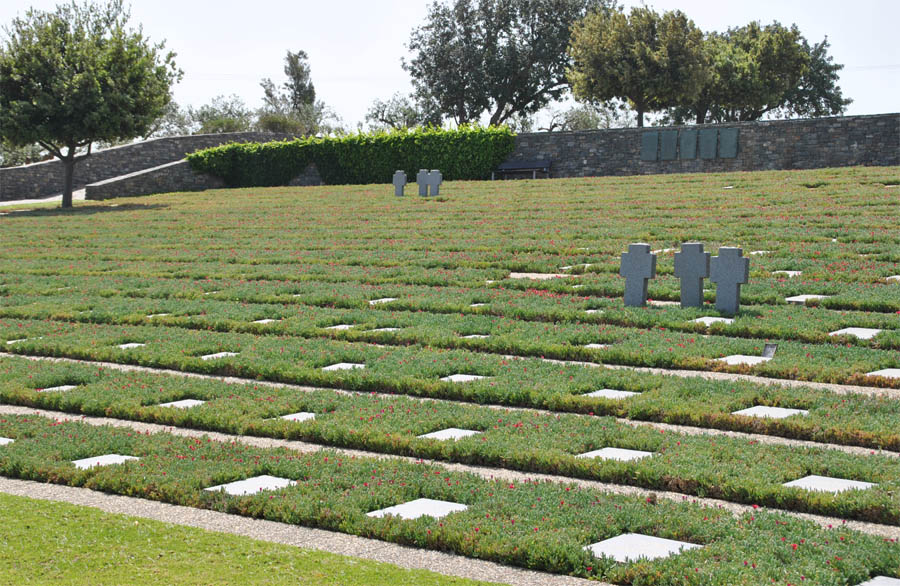
German War Cemetery, Maleme, Crete

My own pretence was pricked a quarter of a century ago. The occasion was a visit to the Second World War German cemetery in Maleme on the island of Crete. Row upon eternal row of simple headstones stretched into the distance remembering hundreds of dead German soldiers aged 16 to 18 years. Hardly a stone’s throw away, I stood moist-eyed once more in front of a village memorial commemorating the execution of the young and old men of the Cretan Resistance. In whose interests was this tragic, bloody loss of life?

The experience led me back to reading afresh descriptions and analyses of the World Wars. To an extent, I could get my head around the Second being the defence of Democracy against Fascism. However, no such positive rationale surfaced to soften my anger and tears at the meaningless slaughter of a generation from aristocrat to proletarian in the First. In whose possible interests could this frightening futility be imagined? For what it’s worth I understand the First as an inexorable consequence of the political and economic crisis of the day and the ruling class imperative to establish a new order of power and influence. In its malevolent eyes, youth could and would pay the price,

Anthem for Doomed Youth

What passing-bells for these who die as cattle?
— Only the monstrous anger of the guns.
Only the stuttering rifles’ rapid rattle
Can patter out their hasty orisons.
No mockeries now for them; no prayers nor bells;
Nor any voice of mourning save the choirs,—
The shrill, demented choirs of wailing shells;
And bugles calling for them from sad shires.

What candles may be held to speed them all?
Not in the hands of boys, but in their eyes
Shall shine the holy glimmers of goodbyes.
The pallor of girls’ brows shall be their pall;
Their flowers the tenderness of patient minds,
And each slow dusk a drawing-down of blinds.

Wilfred Owen

As a few people know I’ve been trying in recent weeks to pull together my thoughts about the manufactured COVID pandemic, described by the British Prime Minister as a war within which we’re all in it together. Given my history within youth work, I’ve been struck from the outset of this campaign and the imposition of the lockdown by the thrusting of young people into the frontline of this supposed battle, starved of resources. Their mentors, be they youth workers or teachers, have not been the collective of conscientious objectors demanded by these times as youth centres were abandoned and schools closed. And, of course, as it has suited, young people have been accused without a shred of evidence of being traitors to the cause, irresponsible ‘super-spreaders’, failing in the responsibility to protect their elders.

However, my growing anxiety about what is being done to young people as part of the elite’s need to create a renewed capitalist order was deepened with the news a few days ago coming out of the USA. In key cities such as New York and Chicago, children, five years upwards are being offered a $100 bribe to get the experimental drug. On the basis of what medical evidence and what sort of ethics does a society agree to ‘vaccinate’ children, who are neither at risk themselves nor a risk to others? And in seeking to do so, hasn’t the slightest idea of what might be the medium and long-term consequences? This flagrant disregard of a fundamental principle of medicine that its practitioners do no harm is the tip of the iceberg when it comes to assessing the harm being done to today’s younger generation. Breasts are belatedly beaten as the inevitable impact on their mental health and their prospects for the future is revealed.

I fear that a Third World War of a contemporary character is unfolding. As in 1914 and 1939 capitalism is in crisis and seeks to establish a new order, a new normal that maintains, even increases its power over humanity. In this conflict, the younger generation is to the fore. Of course, my sweeping speculations, my problematic generalisations, my homogenisation of young people may be wide of the mark. However, in an immediate sense. whatever the failings of my broader analysis, young people and ourselves are facing an assault on taken-for-granted rights, unimaginable but two years ago.

To take perhaps an extreme example of the demands being made upon both the vaccinated and the unvaccinated from Australia, the first are obliged to carry proof to be ‘free’, the second excluded from New Normal existence. “If you want your freedoms, get the jab” cries the State Premier. **

Since October in France, the country’s health pass – or pass sanitaire – has been extended to under-18s, meaning all teenagers will need to show proof of vaccination or a negative Covid test to access places like cinemas, museums, restaurants and indoor shopping centres. Here on Crete, as of last Saturday, the everyday simple act of sipping a greek coffee in the village kafeneio requires showing QR codes and identity cards. Even on their own terms, these restrictions are riddled with contradictions, which I will speak to in Part Four of ‘Searching for an Understanding in the Face of Power and Propaganda.’

The generation, in whom we place our hopes for a more just and democratic society, is being trained to accept that freedom is the possession of the State. Obedience makes free.

To return to my father and his comrades statuesque and dignified as the Last Post pierced the cold November air, they believed they had fought for a better future. I remember to this day my dad’s explanation of why it was right to fight. ” We did it so my country would be a place where you would never have to show your papers to live”.

**

To put the Queensland draconian restrictions into context the official State COVID figures from March 1 to November 13, 2021, are:

CASES 2,106

ACTIVE CASES 19

TOTAL RECOVERED 2,078

DEATHS 7