
When Fear Becomes Strategy: Anti-semitism, Aliyah, and the Calculus of Zionism

Siyavash Doostkhah, an Iranian refugee himself, sends this thoughtful and provocative piece from Australia, which seeks both to engage with contradiction and to peer beneath the surface of things.
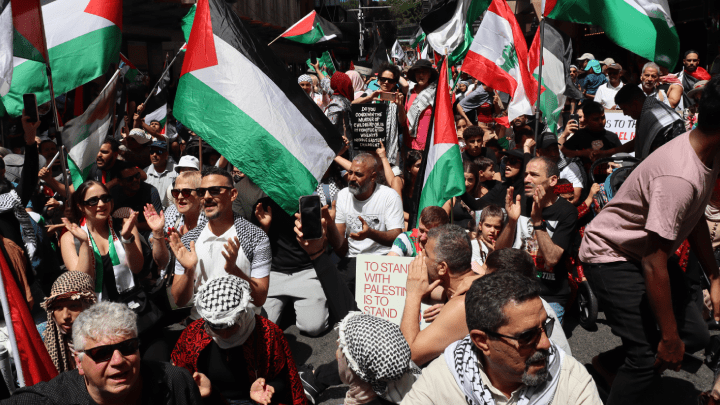
Pro-Palestine demo, Sydney, 2025. Thanks to sydneycriminallawyers.com.au

In recent months, Australia has witnessed an unprecedented rise in both impassioned pro-Palestinian activism and deeply troubling anti-Semitic incidents. Tens of thousands have marched through the streets of Sydney, Melbourne, and Brisbane, voicing legitimate grief and fury over the ongoing humanitarian catastrophe in Gaza. At the same time, Jewish schools have been defaced, community centres targeted, and Jewish Australians report growing fear and isolation.

This dual reality, empathy for Palestinians and anxiety within Jewish communities, demands careful and principled reflection. But equally important is this: Why is the Israeli government, self-proclaimed protector of the Jewish people, not doing more to counter this rising tide of antisemitism?

The silence, or, at best, tepid response, from Netanyahu’s administration isn’t just puzzling. It may be strategic.

There is a long, uncomfortable history in which fear has been used not only as a political tool but as an engine of migration. The Israeli state’s Zionist foundations have always relied, in part, on Aliyah, the migration of Jews to Israel, as both a demographic imperative and a spiritual calling. Throughout the 20th century, waves of migration were often triggered or accelerated by persecution: from Nazi Germany and post-war Europe to crises in Arab countries, Ethiopia, and the former Soviet Union. Often under the banner of rescue, but always with a demographic calculus in mind. Fear has long been a midwife to the Zionist project. In this vision, a swelling Jewish population is not merely a response to antisemitism, it is a geopolitical lever.

In the current moment, with the concept of Eretz Yisrael HaShlema “Greater Israel” driving Israeli policy and settlement expansion, we must ask: is fear again being used to accelerate Aliyah? Could the Israeli state be tolerating, or even quietly capitalising on, a global climate of antisemitism to encourage Jews to migrate “home”?

The Aliyah narrative has become more than a cultural call; it is a lever of statecraft. If Jews in Paris, New York, or Sydney no longer feel safe, Israel presents itself as refuge. But if Israel actively stokes the conflict that fuels that fear, through disproportionate violence, provocative incursions, and refusal to engage in diplomatic solutions, then we must ask: Is it still acting in the interest of Jewish safety, or in the interest of a nationalistic expansion project?

For progressive Australians, particularly those committed to Palestinian justice, the challenge is delicate. Solidarity must not slide into complicity. There is a fine but vital line between opposing the Israeli occupation and inadvertently legitimising oppressive actors such as Hamas or the Islamic Republic of Iran, both of whom exploit Palestinian suffering while offering no vision of human rights or freedom. Hamas’s violent tactics and Iran’s authoritarian repression cannot be sanitised simply because they oppose Israel.

Just yesterday, a protestor in Sydney was seen holding a poster of Ayatollah Khamenei, the brutal dictator of Iran, at the pro-Palestinian rally across the Harbour Bridge. That image, with thousands of Australians in the background, will no doubt be used by the Iranian regime and its supporters to manufacture legitimacy. This is how protests are hijacked.

I first encountered this tactic in the 80’s, when I was a refugee in India. On a crowded train platform, I witnessed a man tossing handfuls of coins into the air. Predictably, a crowd quickly gathered. Then, suddenly, placards bearing the image of Rajavi, the leader of the MEK organisation, were raised in the crowd, and someone began photographing the scene. These photos would later be used to suggest mass support for the MEK among Iranian dissidents in exile, an illusion created with a bag of coins and a camera.

We cannot afford to be naive. In Australia, outrage at Israeli state violence must not drift into antisemitism, overt or coded. When Jewish businesses are attacked in Melbourne, when graffiti defiles synagogues in Sydney, or when Jewish Australians feel compelled to hide symbols of their identity, it does not weaken the occupation, it strengthens it. It reinforces the Israeli narrative that the diaspora is unsafe and that Aliyah is the only answer.

There is an old strategy at play: If Jews feel unwelcome elsewhere, the Zionist project gains strength. If Palestinians are framed as irredeemable threats, then Israeli expansionism proceeds unchecked. The answer, for those of us who reject both antisemitism and colonialism, is to break this cycle, not feed it.

We must hold the Israeli government to account, yes, but we must also call out those who hijack solidarity for their own bigotry. We must demand justice for Palestinians, but not by echoing the authoritarian rhetoric of Hamas or Tehran. And we must ensure Jewish Australians are not collateral damage in a geopolitical game they did not consent to play.

True solidarity is principled. It condemns ethnic cleansing and occupation without resorting to hate. It recognises that antisemitism, even when disguised as anti-Zionism, serves no liberation. And it sees clearly how fear, if left unchecked, can become a weapon in the hands of those who seek to redraw borders, not build bridges.

If we are to help build a future where both Palestinians and Israelis can live with dignity and peace, then progressive Australia must sharpen its lens, and its conscience.


With their permission I attach the dialogue between Siyavash and Rasheed, which unfolded on Facebook following the appearance of Siyavash’s original. I do so because such a healthy exchange of opinion is all too rare in the intolerant and suffocating atmosphere dominant today.

Rasheed Abu Hamda responds to Siyavash:

In Brisbane where the protests took place in the last two years there were many jewish voices who spoke against the Israeli occupation of Palestine. And no one made them feel unwelcome otherwise they would’ve stopped attending the protests.

Anecdotally, at least in Brisbane I don’t think that antisemitism is disguising as anti-Zionism.

There was a shop in Paddington that was named and shamed because they were very open about supporting Israeli practices in occupied Palestine. This was an example where an Australian Jewish were overtly in support of Israeli terrorism. I haven’t heard of a single account in Brisbane where Australian Jewish were targeted because of their faith. Targeted because they sided with the apartheid state? Yes, especially the ones who went to Israel to serve in the IDF. My other take on the article is Iranian regime and HAMAS painted with a similar brush is not tactful. HAMAS was a direct produce of 50 years of occupation. It’s like a foster kid who was removed from a violent home and continued to move from family to another. A foster kid that was failed by the system – the international community that let Israel go on and on ( for decades) in their barabric attacks on Palestinians. And when the foster kid grown up and have more power to cause damage to the system, what do we do? We incarcerate the kid. Without taking responsibility (as international community) to acknowledge the systematic failure. The latter continue as we speak 77 years and counting. Addressing the symptoms is less effective than addressing the root cause of this chronic problem.

Siyavash replies:

 Hey Rasheed, I really appreciate you taking the time to reflect and share your thoughts, there’s clearly deep care in your words and I totally respect that. I just want to clarify a few things, not defensively, but to continue the dialogue with honesty.

Firstly, I never said Jewish people were being targeted at the protests themselves. In fact, I fully acknowledge and celebrate the many Jewish voices who stand in solidarity with Palestinians, those voices are powerful and necessary. But outside of those protest spaces, there have been disturbing incidents across Australia with many families reporting feeling unsafe just for being visibly or knowingly Jewish.

As someone who’s been part of anti-Zionist activism in Brisbane since the early days, when it was just a small handful of us, I’ve observed a real shift in recent years. There’s been a creeping conflation of “Israeli” and “Jew,” even in educated circles. I get where it’s coming from, people are angry, traumatised, and rightly horrified by what’s happening to Palestinians. But I think it’s dangerous when that anger is redirected, intentionally or not, at Jewish people more broadly.

You mentioned that Hamas is a result of decades of occupation. I hear that analogy, and yes, the international community absolutely bears responsibility for abandoning Palestinians. But I still think it’s important to be honest about how Hamas came to power. Its rise wasn’t entirely organic. Israel once saw Hamas as a counterweight to the PLO, helping it grow in the 80s to weaken secular Palestinian nationalism.

That’s what I was getting at when I grouped Hamas and the Iranian regime together, not because they’re the same, but because both have been propped up in various ways by external powers (including the West and Israel) when it suited their strategic interests. And now they serve as convenient “boogeymen” to justify continued military aggression and repression.

I also worry when I see some on the Western left romanticising these authoritarian groups simply because they oppose Israel. I’ve lived through this myself, as a refugee from Iran, I watched the left in my country get crushed by the very theocracy they once helped empower. The Iranian left thought they could ally with religious fundamentalists to bring down the Shah, and they were the first ones the regime turned on after the revolution.

It’s a tough, messy landscape. But I think we owe it to ourselves, and to the Palestinian people, to stay sharp, to question all forms of power, and to be wary of letting righteous anger cloud our ethics. We can (and must) be anti-occupation, anti-colonial, and still protect Jewish communities from harm and fear. The two things are not mutually exclusive.

Let’s keep talking.

Over to Rasheed

Thank you Siyavash for sharing your thoughts – I do appreciate you and your thoughts. The Jewish people participating in protests was just an example to demonstrate that tolerance exist providing they are not pro-zionism – sorry I should have clarified that in the first place, a room for improvement. And to hear there are Jewish families who are not pro Zionism are being harassed, it doesn’t sets well with me. As this is what Palestinians are been subjected to and this is what we are protesting against. Except what Palestinians are enduring is more than harassment. As a Palestinian who lived as a refugee for most of my life and lost family members and farming lands to the occupation forces, the question remain in front of mind is do we focus our efforts to expose and hopfully remove the Apartheid system – the main cause of disease, get distracted with addressing the by products of the occupation, or address both while lives are lost on a daily bases in Gaza, West Bank and more Palestinians inside Israel are further marginalised? I personally belive that we need to stop the fire first and stop the one who caused it in the first place prior to get the house back in shape. I’d love to hear your views in that regards especially the ones that are different from what I just shared. After all, I don’t know what I don’t know and multiple perspectives helps us to see the picture better. P.S. I do admire Jewish people who can see right through the fake face of Zionism considering the fears and traumas of many generations while living in Europe. It takes a huge amount of courage to do so.

All of which prompts Siyavash to respond:

Thank you for your heartfelt and grounded message. If I were to sum up my response in a spirit you might relate to, given your deep love for dance, I’d offer the quote often attributed to Emma Goldman: “If I can’t dance, I don’t want to be part of your revolution.”

It speaks to the kind of liberation we both long for, one where joy, dignity, and humanity are not sacrificed in the process of resistance.

You asked an important question about whether we should focus our energy on the system of apartheid or deal with its toxic by-products too. I think the two are deeply linked. From my experience in Iran, I saw firsthand what happens when we think the “enemy of my enemy could be our friend.” We threw our lot in with religious fundamentalists just because they opposed the Shah. That miscalculation cost us deeply. We didn’t realise that by fighting one form of oppression, we were handing power to something even more repressive. That enemy of our enemy quickly became our jailer.

In Persian we say: “از چاله به چاه افتادن” — “to fall from a pothole into a well.” And another saying: “اول چاه را بکن بعد مناره را بدزد” — “Dig the well before you steal the minaret.”

They’re old phrases, but they feel painfully relevant now.

I worry deeply that the incredible sacrifice and resistance of the Palestinian people might one day be co-opted or hijacked by forces that do not represent their dreams for freedom and dignity. I say this not from afar, but from the lessons carved into the Iranian soul over the last 45 years. I look at what Hamas has become, and who benefits from its existence, and I sincerely hope that the secular and nationalist movements can once again take the reins and chart a course for true liberation, free of both occupation and authoritarianism.

Your personal story touches me. Losing land, family, and a sense of home is a grief I cannot claim to fully understand, but I see its depth and weight in your words. Your clarity and refusal to let that grief turn into hate or tunnel vision is powerful. That’s the kind of strength that builds bridges, not just in politics, but between hearts.

I truly hope that in our lifetimes, we’ll sit together in a café in a free Gaza, maybe even during a Waziz reunion concert, and look back on these conversations with gratitude, for having spoken honestly, and for having listened with open hearts.

Much love and respect

And Rasheed closes the conversation:

Thank you Siyavash for your kind and sweet response. I must say your writing style beyond being objective is charming and engaging. How did you do that?


Gus John challenges a hierarchy of oppression

Worrying times. As a right-wing government displays arrogantly its xenophobic character the potential opposition, within or without a shattered Labour Party, tears itself apart. One particular and revealing expression of this is the fearful flight from open and critical reflection on the question of antisemitism. Late last year I posted Gus John’s coruscating critique of Archbishop Welby’s support for the Chief Rabbi’s condemnation of Jeremy Corbyn. The Archbishop has not replied and I suspect the hope is that Gus will fade away – not at all likely! Indeed in pursuing the matter further he widens the argument in a way that raises challenging issues for all political and professional activity purporting to be anti-oppressive.

On 21 January 2020 Gus John wrote:


There has not been a response from the Church of England to my resignation from the Archbishops’ advisory committee on race following the Archbishop of Canterbury’s endorsement of the Chief Rabbi’s intervention in the last general election.  On 12 January, the Board of Deputies of British Jews demanded that Corbyn’s successor adopt 10 extraordinary pledges, one of which would make the Labour Party complicit in denying free speech and legitimate protest against Israel’s activities in Palestine.  Unbelievably, all the then 5 leadership contenders immediately rushed to affirm their adoption of those pledges.

In this piece, I argue that the Labour Party is implicitly accepting the argument that the Jewish community (as defined by the Chief Rabbi and the Board of Deputies) sits on the pinnacle of a hierarchy of oppression and therefore has an absolute right to determine what is antisemitic and what is not and that their experience of racism demands a different and entirely separate response from the Labour Party than that of any other section of the population facing racism on the basis of ethnicity or/and religion/faith.

I am calling on the Archbishop of Canterbury to have regard to the experience of racism that generations in the Anglican community has had and successive governments’ failure to tackle it and condemn the shamefully sectarian approach to combating racism that the Board of Deputies is advancing and that contenders for the Labour Party leadership are so unquestioningly embracing.

Labour’s Dangerous Capitulation to the Board of Deputies of British Jews on Antisemitism

Is that what the Archbishop of Canterbury wanted?

On Sunday 12 January 2020, the Board of Deputies of British Jews launched its 10 pledges which it demanded that each of Labour’s candidates for leader and deputy leader should sign up to in order to “begin healing its relationship with the Jewish community” after what it called the crisis of antisemitism under Jeremy Corbyn.  It claimed that Jew-hate “became a matter of great anxiety for the UK’s Jews” under Corbyn’s watch. Marie van der Zyl, the Board’s president, said she hoped the new leader of the opposition would address antisemitism in Labour “promptly and energetically”.

The 10 pledges the Board is demanding that candidates adopt are:

  1. The promise to resolve outstanding cases of alleged antisemitism
  2. To devolve the disciplinary process to an independent agent
  3. To ensure transparency in the complaints process
  4. Prevent re-admittance of prominent offenders
  5. Provide no platform for those who have been suspended or expelled for antisemitism.
  6. The full adoption of the International Holocaust Remembrance Alliance’s (IHRA) definition of antisemitism “with all its examples and clauses and without any caveats”
  7. To deliver anti-racism education programmes that have been approved by the Jewish Labour Movement, which would lead training
  8. To engage with the Jewish community via its “main representative groups and not through fringe organisations” such as Jewish Voice for Labour
  9. To replace “bland, generic statements” on anti-Jewish racism with “condemnation of specific harmful behaviours”
  10. For the Labour leader to take personal responsibility for ending the “antisemitism crisis”

The Board’s president, Mrs Marie van der Zyl accused some of the leadership candidates of remaining silent on antisemitism since campaigning began and condemned others who “appeared to have tailored their message depending on which section of the party they have been addressing”.

She added: “We will be frank. The relationship between Labour and the Jewish community, once rock solid, has been all but destroyed. Rebuilding will take more than mild expressions of regret. It will take a firm public commitment to agree to a specific course of action.

“Our Ten Pledges identify the key points we believe Labour needs to sign up to in order to begin healing its relationship with our community. All of these points, in one form or another, have previously been put to Jeremy Corbyn and his leadership team. Regrettably, action on any of these issues was limited at best, non-existent at worst.”

We expect that those seeking to move the party forward will openly and unequivocally endorse these Ten Pledges in full, making it clear that if elected as leader, or deputy leader, they will commit themselves to ensuring the adoption of all these points.”

Of the six declared leadership candidates, five had endorsed the Board’s demands as of Sunday afternoon: Sir Keir Starmer, Lisa Nandy, Jess Phillips, Rebecca Long-Bailey and Emily Thornberry, declaring on Twitter as follows:

Keir Starmer

@keirstarmer

The Labour Party’s handling of antisemitism has been completely unacceptable. It has caused deep distress for the Jewish community, which we must all accept responsibility for and apologise.

I support the recommendations put forward by the Board of Deputies. https://twitter.com/BoardofDeputies/status/1216290591442722816 …

Lisa Nandy

✔@lisanandy

We should never again be in a position where we’re telling Jewish grateful to the @BoardofDeputies for their initiative. Labour must accept all of these pledges in full.

Jess Phillips MP

✔@jessphillips

I absolutely endorse all these pledges in full. We need to work hard to make the Labour Party a safe space once again for the Jewish community. https://twitter.com/BoardofDeputies/status/1216290591442722816 …

Emily Thornberry

✔@EmilyThornberry

Without hesitation or qualification, I sign up to every one of these pledges. https://twitter.com/boardofdeputies/status/1216290591442722816 …

In an interview with Sky‘s Sophy Ridge, Ms Long-Bailey said she would adopt the Board’s ten pledges “straight away”. The Board of Deputies condemned the “conspicuous absence” of Clive Lewis, Dawn Butler and Richard Burgon. – @labourlewis @RichardBurgon and @DawnButlerBrent absent from the list of those who have signed the #TenPledges to tackle antisemitism in Labour

Comment

It is extraordinary that would be leaders of the Labour Party could even think about adopting those ten pledges. I am one of many who believe that such total and mindless capitulation to the Board of Deputies of British Jews would make Labour even more unelectable.  The IHRA’s definition and examples of antisemitism effectively allows those supportive of the state of Israel and its subjugation of the people of Palestine to charge antisemitism whenever anyone criticises Israel for its treatment of Palestinians. It allows for the conflation of anti-Zionism with anti-Semitism.

Kenneth Stern, the respected Jewish author of the definition has himself condemned the use of it by the pro-Israel lobby for using it ‘as a guide to what is or isn’t antisemitic’ and to silence free speech on Israel.  In an article ‘Why the man who drafted the IHRA definition condemns its use’, George Wilmers wrote: 

Despite a general belief to the contrary and its “adoption” by the UK government, the IHRA definition has no legal status in the UK, and for very good reason: as has been highlighted by leading legal authorities such as Hugh Tomlinson and Stephen Sedley, not only is it not a proper definition for legal purposes, but its legal adoption by any public authority would conflict with existing protected rights of free expression guaranteed by Article 10 of the European Convention on Human Rights. Nevertheless such is the power of the propaganda campaign for the IHRA cult that, abandoning rational considerations, the leadership of the Labour party have felt obliged to make obeisance to the IHRA’s holy status, even while discretely seeking to modify the text in order to mitigate some of its draconian effects.  Jewish Voice for Labour –  2 August 2118

But, the enthusiastic endorsement and adoption of the 10 pledges by those aspiring to lead the Labour Party is extraordinary for other reasons also.

First, those leadership contenders are accepting that the Labour Party is ‘institutionally antisemitic’ simply because the Board of Deputies and the pro-Israel lobby say so.  They appear not to be interested in the evidence and whether on the basis of that evidence the charge of antisemitism in Labour is justified. As early as March 2019, Jewish Voice for Labour published statistics on complaints of antisemitism and how they were being dealt with (See piece from Labour Briefing March 2019 at the end of this paper).

Jewish Voice for Labour noted that 453 allegations of antisemitism were being followed up by Labour:

‘453 is 0.08% of the party’s 540,000 members – that’s about 1/12th of 1%; 96 of these resulted in suspensions – that’s 0.01%, or 1/100th of 1% of members; there were twelve expulsions – that’s 0.002%, or 1/500th of 1% of members! ….these are vanishingly small statistics, especially when you consider that 2-5% of the general population are considered to be antisemitic…..Margaret Hodge MP was informed by Jennie Formby (general secretary of Jewish Voice for Labour) that of the 200 dossiers of cases of antisemitism she had submitted, only 20 were found to be by Labour Party members. In other words, her allegations of antisemitism in the party had been exaggerated tenfold. And single handedly she accounted for approaching one fifth of all referrals. Headlines proclaiming there was “no safe place for Jews in Corbyn’s Labour”, or that Labour needed, in the words of Marie van de Zyl, when vice-president of the Board of Deputies of British Jews, to “drain the cesspit of antisemitism”, have been shown to be contradicted by the evidence……. If the facts are at such odds with the accounts of leading politicians and mainstream media, there can be only one explanation – these accounts are driven by ulterior political agendas. Other forms of racism, for which manifestations in the UK are 70 times more prevalent than those for antisemitism, barely get a mention. (my emphasis)’

Yet, the President of the Board of Deputies, could write in the last week:

“It beggars belief that after four and a half years of failure on antisemitism, Richard Burgon and Dawn Butler still think that they know better than the Jewish community how to fight this vile prejudice.  No other minority would be treated in this way and this sort of thing is the very reason why Labour is being investigated for institutional antisemitism by the EHRC. In the Deputy Leadership election, members now have a clear choice about whether they want to become a credible party of opposition or waste yet more years fighting the Jewish community about who gets to define our oppression.  …..”

One wonders where Marie van de Zyl has been these last few decades and how she and the Board of Deputies of British Jews could possibly claim to be qualified To deliver anti-racism education programmes that have been approved by the Jewish Labour Movement, which would lead training’, especially if she could so unashamedly assert that  ‘No other minority would be treated in this way…’. 

Dawn Butler is a black woman and an MP in Brent of all places.  

For its part, the EHRC has failed to call to account the many schools across the land that have no regard for the public sector equality duty of the Equality Act 2010 and have no policy in place for implementing the duty.  It has failed to investigate schools, academies in particular, for the disproportionate number of young people they are excluding, black boys in particular. It has failed to investigate the phenomenon of black people meeting their death while in the custody of the state, with no one ever being found guilty of malicious neglect, manslaughter, or murder since police in West Yorkshire were convicted of grievous bodily harm after killing the street sleeper, David Oluwale and kicking his body into a river in 1969, despite the 700 black people who have met their deaths while in custody, or being detained in immigration lockups in the last three decades.

Maybe Ms van de Zyl might like to study the Institute of Race Relations harrowing report on this in preparation for delivering their ‘anti-racism education programme’.

http://www.irr.org.uk/news/black-deaths-in-custody/

Against the backcloth of discrimination routinely suffered by black people in public bodies as defined by the Equality Act 2010, in sport and in cultural industries and given the statistical data available to the Labour Party and to the EHRC, it is disturbing that that watchdog could justify its investigation into antisemitism in the Labour Party, given its abject failure to hold organisations to account for racism. And Islamophobia.

The sectarian antiracism of those who shout the loudest

The Board of Deputies wants the Labour Party to engage with the Jewish community via its “main representative groups and not through fringe organisations” such as Jewish Voice for Labour.  The Jewish community is not a homogenous collective and ‘main representative groups’ certainly do not have a mandate to speak for all Jews in the so-called Jewish community.  In any event, why should the Labour Party allow the Board of Deputies to dictate to it who in the ‘Jewish community’ it should engage with and how?

I suspect the truth is that the Board of Deputies and the pro-Israeli lobby have set themselves up as foghorns for the state of Israel and any Jews or/and Jewish organisations that do not subscribe to that agenda are off-message and are to be sidelined not just by them, but by the Labour Party also.  That is why they insist on using and demanding that the Labour Party use the defunct IHRA definition of antisemitism.

The Labour Party is being asked to pledge ‘to prevent re-admittance of prominent offenders’.  I struggle to see how this becomes the business of the Board of Deputies rather than that of policymakers and members in the Labour Party. The same goes for the demand that no platform should be provided for those suspended or expelled for antisemitism.  The Board of Deputies of British Jews stopped just short of an 11th pledge, i.e., mandate them to run the Labour Party by proxy.  For, surely, this would be a logical step in the light of the other 10 pledges and of their unquestioning and enthusiastic acceptance by contenders for the Labour leadership.

But then, this is not the first time that ‘the Jewish community’ has been encouraged to see itself as sitting at the apex of a pyramid of oppression.  Following the Labour election victory in 1997, thereby coming out of the Thatcher wilderness after 19 years, I was asked by Tony Blair to help establish a Race Relations Forum to advise Jack Straw, then Home Secretary, on matters of race and social exclusion.  There came a point when the Forum was asked to consider a proposal for a Holocaust Remembrance Day. Some of us argued passionately that:

  • while the Jewish holocaust was part of relatively recent history, the fact that over 400 years millions of Africans suffered genocide and sheer barbarism as their existential reality in Africa itself and in the trade in enslaved Africans
  • Britain refashioned the plantation system and eventually withdrew to form the club of Europe, leaving the descendants of enslaved Africans in its now forgotten colonies impoverished and constituting a reserve pool of labour
  • given that those drawn from that pool to help rebuild Britain after two devastating world wars were experiencing a society that steadfastly refused to confront the legacy of empire and the racism concomitant with it, Britain should not contemplate establishing and funding a Holocaust Memorial Day solely to mark the Jewish holocaust.

There was clearly no appetite in government for acknowledging the African holocaust and its complicity in genocide and the protracted brutalisation of Africans at home and in the diaspora.  What is more, civil servants were advising that a Slavery Memorial Day would no doubt encourage strident shouts for an apology for the enslavement of Africans, for British imperialism and for reparations.  In quick time, the first Holocaust Remembrance Day was planned and observed, later being marked annually with pageantry in cities outside London.

To this day, not only has there been no Slavery Remembrance Day, the British government has announced that it cannot afford to fund a monument in London.  Although the charity Memorial 2007 had planning permission to erect a sculpture in Hyde Park to remember the victims of the transatlantic trade in enslaved Africans, the government reckoned it did not have the £4m needed to fund it.  Instead, the charity had to settle for these encouraging words from government:

“We are supportive of the aims of the monument and the organisation. The suffering caused by slavery and the slave trade are among the most dishonourable and abhorrent chapters in human history.”

Meanwhile, the government has pledged its support for a Holocaust Memorial, estimated to cost £100m.  In 2015 the government committed £50 million to the project ‘to kick-start a society-wide fundraising effort’.  On 7 May 2019, the then Prime Minister Theresa May was joined by the 4 living former Prime Ministers – Sir John Major, Tony Blair, Gordon Brown and David Cameron – to back the proposal for the Holocaust Memorial in Victoria Tower Gardens beside parliament ‘to ensure we never forget one of the darkest chapters in human history’.

Prime Minister Theresa May said:

‘By putting our National Holocaust Memorial and Education Centre next to our Parliament, we make a solemn and eternal promise that Britain will never forget what happened in the Holocaust…. And this education centre will ensure that every generation understands the responsibility that we all share – to fight against hatred and prejudice in all its forms, wherever it is found’.

Announcing that the government was committing a further £25 million to the new National Holocaust Memorial and Learning Centre, Communities Secretary the Rt Hon James Brokenshire MP said:

I believe there can be no more powerful symbol of our commitment to remembering the men, women and children who were murdered in the Holocaust and subsequent genocides than by placing the Holocaust Memorial and Learning Centre, in the shadow of our Parliament at the heart of our democracy…The United Kingdom Holocaust Memorial is dedicated to the 6 million Jewish men, women and children murdered in the Holocaust and all other victims of the Nazis and their collaborators’.

So, £75m is provided without sweat or fuss for a Holocaust Memorial, a holocaust in which Britain was not involved, save for welcoming survivors, attending to their welfare and helping them rebuild their lives. The baddies were those Nazis to whom of course Britain is considerably more morally superior.  However, Britain owning its own genocide and atrocities against Africans over centuries and assisting current and future generations, especially white British, to understand the society and themselves against that historical canvass is an entirely different matter.

Commenting on the results of the Race Disparity Audit she commissioned in October 2017, Theresa May had this to say:

People who have lived with discrimination don’t need a government audit to make them aware of the scale of the challenge. But this audit means that for society as a whole – for government, for our public services – there is nowhere to hide. These issues are now out in the open. And the message is very simple: if these disparities cannot be explained then they must be changed. Britain has come a long way in my lifetime in spreading equality and opportunity. But the data we are publishing will provide the definitive evidence of how far we must still go in order to truly build a country that works for everyone.”

David Isaac, Chair of the Equality and Human Rights Commission commented: 

The findings of the race audit do not come as a shock to us. The Prime Minister should be applauded for laying out this information for all to see and we now need to use to the data to set the foundations for real change….”The Government must tackle the significant disparities confirmed by the audit in order to address the entrenched inequality that is so prevalent in our society.”

Despite all of that, however, shamefully and totally without compunction, the British government has declared that it has no intention of engaging with the UN Declaration on the International Decade for People of African Descent (2015-2024) and putting in place a programme of policies and actions consonant with the theme of Recognition, Justice and Development.  In proclaiming the Decade, the UN cited:

the need to strengthen national, regional and international cooperation in relation to the full enjoyment of economic, social, cultural, civil and political rights by people of African descent, and their full and equal participation in all aspects of society’.

The great abolitionist Frederick Douglass (1857) famously said:

Find out just what any people will quietly submit to and you have the exact measure of the injustice and wrong which will be imposed on them!

The Board of Deputies and the pro-Israel lobby clearly know the benefits of shouting the loudest and not quietly submitting to anything.  There are inherent dangers, however, in laying claim to a victim status that engenders a sectarian view of oppression and measures to combat it and a belief in your entitlement to see the world from your pinnacle in the hierarchy of oppression you construct in the process.

I firmly believe that the Board of Deputies’ 10 pledges and the adoption of them by the leadership of the Labour Party will cause deep resentment in the Party and country and is likely to lead to worse forms of antisemitism.  

Given his endorsement of the Chief Rabbi’s intervention in the run up to the general election, for all the reasons given above, I call upon the Archbishop of Canterbury to condemn the sectarianism and foul bullying by the Board of Deputies and the pro-Israel lobby among British Jews and their not so veiled attack on freedom of speech and the right of people, Labour Party members or not, to protest Israel’s treatment of the Palestinian people and the complicity of its allies in that.  If the Church is about justice and sowing peace and if it believes in the sanctity of life and the right of everyone to live with respect and dignity and to have their human rights safeguarded, then surely in the same way that Justin Welby saw fit to endorse the Chief Rabbi’s intervention before the December election, he has a duty to comment on how sinister, undemocratic and deeply divisive the current political arm twisting and attempts at silencing opposition to their agenda actually is.

For example, is the Board of Deputies demanding that ALL political parties adopt their 10 pledges?  If not, why not? Do they know how many people with antisemitic sentiments are members of those other parties?  When the President of the Board denounces Richard Burgon and Dawn Butler for not signing on to the 10 pledges as their fellow contenders rushed to do and says ‘no other minority would be treated in this way’, is she not denying or reconstructing the experience of all those who routinely face discrimination and marginalisation in the society and all sorts of hate crime, including racially aggravated harassment, assault, criminal damage and even murder?  Is it being suggested that antisemitism trumps all those horrendous experiences that African and Asian people, Roma and Gypsies, have been suffering in the society and its institutions since the second world war, at least? Where is there any acknowledgment of these stark and well known facts by the Board of Deputies?  How is it even possible for the President of the Board to make such a crass statement?  

It is all good and well for the Board of Deputies, the government and the Church of the establishment to condemn the antisemitic conduct of individuals and groups, whether Labour Party members or not.  They have long maintained a shrill silence, however, on the structural racism now embedded in the system as experienced by African and Asian heritage people for over half a century in the form of racist immigration laws, a climate created by government in which the country is encouraged to regard every African or Asian, Roma or Gypsy as potentially an illegal immigrant (‘Go Home or Face Arrest’), ‘sus’ laws, Prevent, school exclusions, harsher sentences for black offenders, black youth unemployment and much more besides.  It is that silence and a preoccupation with the vile antisemitic acts of individuals, or groups of individuals, that allows the President of the Board of Deputies of British Jews to make the utterly ridiculous claim that ‘…after four and a half years of failure on antisemitism, Richard Burgon and Dawn Butler still think that they know better than the Jewish community how to fight this vile prejudice.  No other minority would be treated in this way and this sort of thing is the very reason why Labour is being investigated for institutional antisemitism by the EHRC’.

The Muslim Council of Britain has come up with its own 10 pledges or manifesto commitments for the new Labour leadership. Perhaps every historically oppressed group on every rung of that pyramid of oppression atop of which the Jewish community sits should follow suit and get the Labour Party to commit to adopting their respective 10 pledges.

These are matters for serious debate and it requires us to challenge the Board of Deputies and the pro-Israel lobby for what is essentially an attack on our freedom and a denial of the experience of racism of huge swathes of the population and not just the 450,000 Jewish people in the UK.

Professor Gus John

International Consultant and Executive Coach

20 January 2020