Musings on the politics of youth work, community work and society at large – dedicated to the memory of Steve Waterhouse, Malcolm Ball and Sue Atkins, great youth workers, comrades and human beings
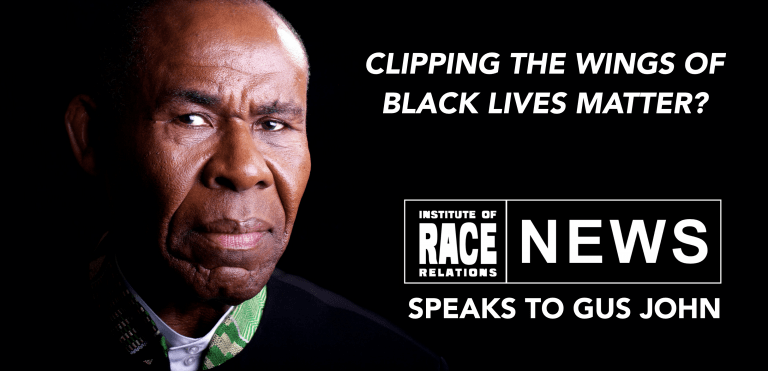
Following on from my last post, ‘Is anti-capitalist youth work next?‘ Gus John’s complementary, challenging perspective focuses in particular on the authoritarian threat to Black Lives Matter, whilst also questioning sharply what he describes as ‘the alternative provision industry’.
In this wide-ranging interview on the Institute of Race Relations web site, veteran educational campaigner Gus John draws connections between initiatives currently pursued by three government departments (education; children and families; culture, media and sport), and lays out what the government has in store for anti-racism, particularly Black Lives Matter.
He concludes:
Gus John: In summary then, this is the increasingly authoritarian state trying to tell BLM ‘we’re coming for you’. They are letting black campaigners know, we want to put you on the Prevent list and treat you as enemies of the state and of wider law-abiding society.
This, I fear, is the thin end of the wedge as far as the drift into totalitarianism is concerned. I would be delighted to be proven wrong, but it would not surprise me in the least if at least 50 percent of the strictures that have been introduced as a consequence of COVID are not written into law to hem us in for all time, thus curtailing many of our hard-won freedoms, while civil society feels it has to be similarly authoritarian, snooping and snitching on neighbours and seeking to criminalise every single non-conformist behaviour.
So, we must never fail to be vigilant and to see the connection between these seemingly consensual things. Above all, we need to take collective action and demonstrate to Boris Johnson and his government that we will not stand by and let them harass and curtail the freedoms of Black Lives Matter.
Professor Gus John is a lifelong campaigner for children’s education rights, a visiting professor at Coventry University and associate professor at the UCL Institute of Education. In 1999, he co-founded the Communities Empowerment Network (now INCLUDE, which he currently chairs), a charity that provides advocacy and representation for excluded students and their families. He was the first black director of education in the UK (1989-1996) as director of education and leisure services in the London Borough of Hackney.
Last week the wonderful anarchist, activist and academic, David Graeber met an untimely death. The obituaries are united in acknowledging the insight, optimism and humour he brought into the political sphere. In his words, “capitalism dominates, but it doesn’t pervade”. He argued that “the ultimate, hidden truth of the world is that it‘s something that we make, and could just as easily make differently.” My only quibble would be ‘easily’?
Losing Graeber is difficult, because having people with his attitude is so essential to preventing horrors and improving the world. But the good news is: David Graeber’s framework rejects the idea that David Graeber is unique. It does not assume that knowledge and insight are handed down from intellectuals. It treats people as intelligent, and respects them rather than talking down to them.
I’ll confess something to you: on my bike ride to the office, I began to cry a little bit, because everything fucking sucks so much already this year, and things are getting so bleak and may get bleaker, and now it’s David Graeber this time, really? And I realized the only way I’m ever going to be able to keep myself from lapsing into despair if I can get myself to truly internalize the anarchist attitude of limitless defiance. To keep David Graeber’s death from being a total devastating loss, I will have to ensure I learn his lessons. I made a vow to myself through my tears: I will always notice things. I will notice what I am not noticing. I will help others to notice things. I will expose the criminal squandering of human potential. I will be nice to the reader. I will see joy as an end in itself. I will try to cultivate the kind of intelligence and humor that David Graeber showed. And I will fight, because that is what anarchists do. They do not put up with bullshit or bureaucracy. They refuse to accept the inevitability of tedium and the squandering of the gift of life. They dare to demand the “impossible.” Rest in power, David Graeber.
At some point you have to look into each others’ eyes
Find below in full as tribute his provocative pamphlet of August 2013, later to become a book, with thanks to the STRIKE coop and magazine.
On the Phenomenon of Bullshit Jobs: A Work Rant by David Graeber
Ta to autonomynews.org
In the year 1930, John Maynard Keynes predicted that, by century’s end, technology would have advanced sufficiently that countries like Great Britain or the United States would have achieved a 15-hour work week. There’s every reason to believe he was right. In technological terms, we are quite capable of this. And yet it didn’t happen. Instead, technology has been marshaled, if anything, to figure out ways to make us all work more. In order to achieve this, jobs have had to be created that are, effectively, pointless. Huge swathes of people, in Europe and North America in particular, spend their entire working lives performing tasks they secretly believe do not really need to be performed. The moral and spiritual damage that comes from this situation is profound. It is a scar across our collective soul. Yet virtually no one talks about it.
Why did Keynes’ promised utopia—still being eagerly awaited in the ’60s—never materialise? The standard line today is that he didn’t figure in the massive increase in consumerism. Given the choice between less hours and more toys and pleasures, we’ve collectively chosen the latter. This presents a nice morality tale, but even a moment’s reflection shows it can’t really be true. Yes, we have witnessed the creation of an endless variety of new jobs and industries since the ’20s, but very few have anything to do with the production and distribution of sushi, iPhones, or fancy sneakers.
So what are these new jobs, precisely? A recent report comparing employment in the US between 1910 and 2000 gives us a clear picture (and I note, one pretty much exactly echoed in the UK). Over the course of the last century, the number of workers employed as domestic servants, in industry, and in the farm sector has collapsed dramatically. At the same time, ‘professional, managerial, clerical, sales, and service workers’ tripled, growing ‘from one-quarter to three-quarters of total employment.’ In other words, productive jobs have, just as predicted, been largely automated away (even if you count industrial workers globally, including the toiling masses in India and China, such workers are still not nearly so large a percentage of the world population as they used to be.)
But rather than allowing a massive reduction of working hours to free the world’s population to pursue their own projects, pleasures, visions, and ideas, we have seen the ballooning of not even so much of the ‘service’ sector as of the administrative sector, up to and including the creation of whole new industries like financial services or telemarketing, or the unprecedented expansion of sectors like corporate law, academic and health administration, human resources, and public relations. And these numbers do not even reflect on all those people whose job is to provide administrative, technical, or security support for these industries, or for that matter the whole host of ancillary industries (dog-washers, all-night pizza delivery) that only exist because everyone else is spending so much of their time working in all the other ones.
These are what I propose to call ‘bullshit jobs’.
It’s as if someone were out there making up pointless jobs just for the sake of keeping us all working. And here, precisely, lies the mystery. In capitalism, this is precisely what is not supposed to happen. Sure, in the old inefficient socialist states like the Soviet Union, where employment was considered both a right and a sacred duty, the system made up as many jobs as they had to (this is why in Soviet department stores it took three clerks to sell a piece of meat). But, of course, this is the sort of very problem market competition is supposed to fix. According to economic theory, at least, the last thing a profit-seeking firm is going to do is shell out money to workers they don’t really need to employ. Still, somehow, it happens.
While corporations may engage in ruthless downsizing, the layoffs and speed-ups invariably fall on that class of people who are actually making, moving, fixing and maintaining things; through some strange alchemy no one can quite explain, the number of salaried paper-pushers ultimately seems to expand, and more and more employees find themselves, not unlike Soviet workers actually, working 40 or even 50 hour weeks on paper, but effectively working 15 hours just as Keynes predicted, since the rest of their time is spent organizing or attending motivational seminars, updating their facebook profiles or downloading TV box-sets.
The answer clearly isn’t economic: it’s moral and political. The ruling class has figured out that a happy and productive population with free time on their hands is a mortal danger (think of what started to happen when this even began to be approximated in the ’60s). And, on the other hand, the feeling that work is a moral value in itself, and that anyone not willing to submit themselves to some kind of intense work discipline for most of their waking hours deserves nothing, is extraordinarily convenient for them.
Once, when contemplating the apparently endless growth of administrative responsibilities in British academic departments, I came up with one possible vision of hell. Hell is a collection of individuals who are spending the bulk of their time working on a task they don’t like and are not especially good at. Say they were hired because they were excellent cabinet-makers, and then discover they are expected to spend a great deal of their time frying fish. Neither does the task really need to be done—at least, there’s only a very limited number of fish that need to be fried. Yet somehow, they all become so obsessed with resentment at the thought that some of their co-workers might be spending more time making cabinets, and not doing their fair share of the fish-frying responsibilities, that before long there’s endless piles of useless badly cooked fish piling up all over the workshop and it’s all that anyone really does. I think this is actually a pretty accurate description of the moral dynamics of our own economy.
Now, I realise any such argument is going to run into immediate objections: ‘who are you to say what jobs are really “necessary”? What’s necessary anyway? You’re an anthropology professor, what’s the “need” for that?’ (And indeed a lot of tabloid readers would take the existence of my job as the very definition of wasteful social expenditure.) And on one level, this is obviously true. There can be no objective measure of social value.
I would not presume to tell someone who is convinced they are making a meaningful contribution to the world that, really, they are not. But what about those people who are themselves convinced their jobs are meaningless? Not long ago I got back in touch with a school friend who I hadn’t seen since I was 12. I was amazed to discover that in the interim, he had become first a poet, then the front man in an indie rock band. I’d heard some of his songs on the radio having no idea the singer was someone I actually knew. He was obviously brilliant, innovative, and his work had unquestionably brightened and improved the lives of people all over the world. Yet, after a couple of unsuccessful albums, he’d lost his contract, and plagued with debts and a newborn daughter, ended up, as he put it, ‘taking the default choice of so many directionless folk: law school.’ Now he’s a corporate lawyer working in a prominent New York firm. He was the first to admit that his job was utterly meaningless, contributed nothing to the world, and, in his own estimation, should not really exist.
There’s a lot of questions one could ask here, starting with, what does it say about our society that it seems to generate an extremely limited demand for talented poet-musicians, but an apparently infinite demand for specialists in corporate law? (Answer: if 1% of the population controls most of the disposable wealth, what we call ‘the market’ reflects what they think is useful or important, not anybody else.) But even more, it shows that most people in these jobs are ultimately aware of it. In fact, I’m not sure I’ve ever met a corporate lawyer who didn’t think their job was bullshit. The same goes for almost all the new industries outlined above. There is a whole class of salaried professionals that, should you meet them at parties and admit that you do something that might be considered interesting (an anthropologist, for example), will want to avoid even discussing their line of work entirely (one or t’other?) Give them a few drinks, and they will launch into tirades about how pointless and stupid their job really is.
This is a profound psychological violence here. How can one even begin to speak of dignity in labour when one secretly feels one’s job should not exist? How can it not create a sense of deep rage and resentment. Yet it is the peculiar genius of our society that its rulers have figured out a way, as in the case of the fish-fryers, to ensure that rage is directed precisely against those who actually do get to do meaningful work. For instance: in our society, there seems a general rule that, the more obviously one’s work benefits other people, the less one is likely to be paid for it. Again, an objective measure is hard to find, but one easy way to get a sense is to ask: what would happen were this entire class of people to simply disappear? Say what you like about nurses, garbage collectors, or mechanics, it’s obvious that were they to vanish in a puff of smoke, the results would be immediate and catastrophic. A world without teachers or dock-workers would soon be in trouble, and even one without science fiction writers or ska musicians would clearly be a lesser place. It’s not entirely clear how humanity would suffer were all private equity CEOs, lobbyists, PR researchers, actuaries, telemarketers, bailiffs or legal consultants to similarly vanish. (Many suspect it might markedly improve.) Yet apart from a handful of well-touted exceptions (doctors), the rule holds surprisingly well.
Even more perverse, there seems to be a broad sense that this is the way things should be. This is one of the secret strengths of right-wing populism. You can see it when tabloids whip up resentment against tube workers for paralysing London during contract disputes: the very fact that tube workers can paralyse London shows that their work is actually necessary, but this seems to be precisely what annoys people. It’s even clearer in the US, where Republicans have had remarkable success mobilizing resentment against school teachers, or auto workers (and not, significantly, against the school administrators or auto industry managers who actually cause the problems) for their supposedly bloated wages and benefits. It’s as if they are being told ‘but you get to teach children! Or make cars! You get to have real jobs! And on top of that you have the nerve to also expect middle-class pensions and health care?’
If someone had designed a work regime perfectly suited to maintaining the power of finance capital, it’s hard to see how they could have done a better job. Real, productive workers are relentlessly squeezed and exploited. The remainder are divided between a terrorised stratum of the, universally reviled, unemployed and a larger stratum who are basically paid to do nothing, in positions designed to make them identify with the perspectives and sensibilities of the ruling class (managers, administrators, etc.)—and particularly its financial avatars—but, at the same time, foster a simmering resentment against anyone whose work has clear and undeniable social value. Clearly, the system was never consciously designed. It emerged from almost a century of trial and error. But it is the only explanation for why, despite our technological capacities, we are not all working 3–4 hour days.
Protecting Life, Interrogating Death, Seeking Truth
Phil Scraton
Inquests offer the only opportunity for bereaved families to hear and cross-examine evidence concerning the context in which their loved one died. The Chief Coroner’s guidance on Covid-19 deaths advises against inquests investigating the significance of national policies and their implementation, concentrating only on the ‘facts’ of each death. In fact, there is no obligation on care homes or hospitals to report Covid deaths to the Coroner nor to hold inquests. Reflecting on the ground-breaking Hillsborough Inquests, 2014-2016 and the unprecedented jury findings at the inquest into the prison death of Joseph Rainey in Northern Ireland (2020), this talk focuses on bereaved families’ ‘right to know’, and have examined, the full circumstances and wider context in which their loved ones died.
Phil Scraton is Professor Emeritus in the School of Law, Queen’s University, Belfast. Widely published, his books include: In the Arms of the Law – Coroners’ Inquests and Deaths in Custody (with Kathryn Chadwick); The Violence of Incarceration (with Jude McCulloch); Power, Conflict and Criminalisation; Hillsborough The Truth. From 2010 he led the Hillsborough Independent Panel’s research, was principal author of its 2012 Report, Hillsborough and was seconded to the families’ legal teams throughout the 2014-2016 inquests. In 2018, with Rebecca Scott Bray, he co-convened the University of Sydney’s research programme on coroners’ inquests into deaths in custody and is co-investigator for the Irish Council of Civil Liberties’ project Deaths in Contested Circumstances and Coroners’ Inquests. In 2016 he was awarded the Freedom of the City of Liverpool.
The following piece was written a few weeks ago for inclusion in a CONCEPT Covid-19 special. Its opening is overtaken by events. As I write the unlocking of restrictions here on Crete gathers pace. Yet tension prevails. We wish to mingle, but with whom? We were safe on our island. We need tourism to survive, but do we fear the tourists? More than ever we need philanthropy, a love for our fellow human beings, solidarity not charity, but the virus in the hands of the powerful feeds misanthropy and xenophobia. I’ll try to tangle with this dilemma in the next week or so and pursue my call for resistance to either ‘business as usual or a ‘new normal’ – within and without of work
A virus-created radical moment: Not to be missed?
I am sitting in splendid isolation on a lush hillside above a Cretan village, where even the patriarchal kafeneio is closed. Outside its shuttered face a group of old men sit, less than socially distant, defying spasmodic police surveillance. A few kilometres away people queue obediently outside the supermarket, clutching in their plastic gloved hands the required Out-of-Home pass and their ID. There are health concerns, even though the island of 650,000 souls has precious few Covid-19 cases and only one death, but such melancholia is hardly new. Crete is awash with chemists, testing one’s blood pressure a daily routine. Notwithstanding the benefits of the Mediterranean diet it’s tempting to note that Hippocrates hailed from hereabouts and that hypochondria stems from Ancient Greek.
Crete’s splendid isolation
There is real fear, though not so much of the virus per se but of what lies ahead. As I write the island is closed for business. The tourism-oiled life blood of the local economy congeals. With cafes, tavernas, hotels, even beaches, empty of purpose, unemployment and debt soars. The Orthrus-headed threat of poverty and hunger hangs in the air. The questions on everybody’s lips are ‘when will this end?’ and ‘will we, do we, want to return to normal?’ At this moment, if assuredly we are not all in this together, from capitalist to peasant, humanity faces a fragile future.
For now, it’s ironically common-place for commentators to write that the neoliberal obsession with the free market and the self-centred individual has been utterly exposed. In this profound social crisis society turns to the public, not the private sector. Society turns to the nurse, not the entrepreneur. Capitalism’s endless pursuit of profit and growth is shown to be at odds with the common good and at odds with Nature itself
Against this tumultuous backcloth what are the alternatives as and when the virus loosens its grip? Three perhaps stand out on the grand canvas.
I. Despite the rhetoric that this is impossible, there will be an almost irresistible desire to return to normal. Even though this sordid ‘business as usual’ has created widening inequality – the world’s richest 1% have more than twice as much as 6.9 billion people – and life-threatening climate change.
2. And if, as is likely, this return to the status quo fails amidst what is speculated to be a second Great Depression of recession and austerity, there is the ever-present danger, as we bow to increased surveillance and policing, that an authoritarian, xenophobic politics with strong men at its helm moves to centre stage.
3. The third possibility depends on us. Are we able to build afresh on the recognition that we are essential; that our labour is the bedrock of society? Are we able to hold onto our renewed community experience of mutual aid and solidarity?
To wonder if the latter is possible brings us inexorably to the matter of consciousness. Do the circumstances thrust upon us herald the fulfilment of the revolutionary dream, the emergence of a people, conscious of themselves as the creators of history? Half a century ago as Cornelius Castoriadis revealed presciently neoliberalism’s moneyed ‘meaninglessness’, he posed the question, “to what extent does the contemporary situation give birth in people the desire and capacity to create a free and just society?”
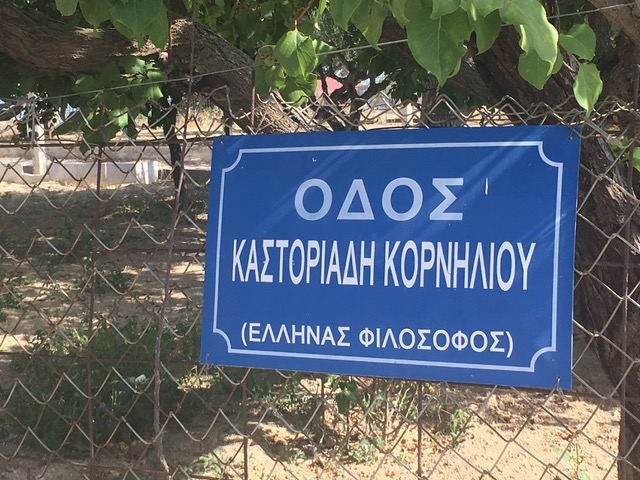
A recently discovered street sign in memory of Castoriadis Cornelius [Greek philosopher]. Thanks to David Curtis and Noelle McAfee.
Speaking of which brings me to the part that youth and community workers might play in the renaissance of collective, reflective solidarity. At its best, the radical tradition contesting the ideological space to be found within our practice has been founded on critical conversations and supportive relationships through which we are as much educated as those we aspire to educate. This is a dialogue riven with moments of intimate democracy, listening to one another, as the foundation of an authentic public democracy.
Alas, over the last 40 years we have been on the retreat. The agenda of social conformity has been strengthened immeasurably by the imposition of prescribed, predictable targets and outcomes, aimed at manufacturing the compliant and resilient individual. Pressured practitioners have sought to make the best of a bad job. However, certainly in England, a generation of workers in their acceptance of the planned interventions demanded from above have cooperated with ‘formalising the informal’. For my part, the recuperation by neoliberalism of even radical elements in our practice is symbolised by the now ritual abuse on all sides of the notion of empowerment, whereby we accept without demur the absurdity that the powerless can be empowered by the powerful.
In closing, I’ll propose that, as we return to work beyond the crisis, there is a fleeting, unmissable chance to revive our commitment to an open-ended, emancipatory dialogue with young people and the community. It will mean challenging, resisting a return to the managerialist implementation of imposed norms and expectations, the catechism of ‘impact’. Such resistance will necessitate the urgent renewal of our collective capacity in the workplace, through workers’ self-organisation and the trade unions.
At the risk of being melodramatic, this unexpected rebuke of Capitalism’s arrogance and excess marks an opening we cannot afford to let slip by. Surely, we cannot wash our hands of, keep our distance from, deny this once in a lifetime moment to turn the tide of history.
—————————————————————————————————————-
To find out more about my love of Cornelius Castoriadis see as a starter.
I’m pleased and humbled to have an article in this special Covid-19 issue of CONCEPT. In the next few days I hope to return to and extend the argument to be found therein, summed up in the final sentence.
Surely, we cannot wash our hands of, keep our distance from, deny this once in a lifetime moment to turn the tide of history
Leave this aside the issue as ever is rich in its diversity of themes and in its range of practitioners. Guided by Mae Shaw’s editorial I hope very much that you will dip into its critical contents.
Editorial – Mae Shaw
This is the first time we have published a supplementary issue of Concept in our almost 30-year history. We were first motivated by a ‘call for solidarity’ from Luke Campbell (in this issue), drawing on his work with a local community action network since the beginning of the Covid-19 crisis. We hastily set to, seeking contributions from organisations and individuals we thought may be interesting, or interested to respond. It was not intended to be representative of the field of practice; more of a snapshot. We are aware that alongside a general sense of dislocation at this grim and demanding time, there is also alarming evidence of differential circumstances and experiences on the ground. We hoped to capture some of this for our readers, and to offer a modest opportunity to record, reflect, express, share and, maybe even generate some small sense of solidarity, needed now more than ever. The response has been very encouraging, and the number of contributions has grown beyond our original estimate.
The now ubiquitous claim that ‘we are all in this together’ may be accurate in some general existential sense, but the contributions here demonstrate how existing social and material inequalities are reproduced and heightened in this catastrophe. As many of the articles illustrate, some people are stuck at home, while other people are stuck without homes. Susie Dalton highlights how home can be the most dangerous place for some women, while John Player argues that a decent home has become an almost hopeless aspiration for many homeless people in Scotland today. For some young carers, as Mel Aitken shows, home can be both a prison and a place of protection and affection in a time of lockdown, with exhausting personal consequences. In the South African context, where inequalities of class, race and gender are more endemic and visible, Astrid von Kotze demonstrates how the residual geography of apartheid dictates the parameters of what ‘home’ means in practice, with poor black people (women in particular) trying to mitigate the greatest threats from the virus in impossible conditions.
A matter of increasing and widespread concern is the extent to which ‘vulnerability’ is becoming a shorthand for lack of personal agency for some. George Lamb, disability rights activist, is concerned about the ways in which the current ‘vulnerability’ script may undo the gains made by the disability movement in their decades-long struggle for rights, not charity, denying the voices of disabled people at this critical time. Some of the same concerns about reconstituting forms of dependency, which have been so strenuously resisted in recent years, are emerging in relation to the implicit ‘ageism’ reflected in much public health policy. Emphasising the continuing agency of ‘vulnerable’ people needs to be a primary concern for practitioners in this field. In any case, if this crisis has taught us one very useful human lesson, it is that we are all profoundly vulnerable!
Making donations and volunteering to help others in respectful ways are important forms of agency, but so too is the capacity to question, and to accept that there will be contradictions. In struggling to make sense of the current reality, and using online resources to meet with like-minded others, Anne O’Donnell is rediscovering the ‘healing’ power of theory: the therapeutic properties of thinking, understanding, grasping, revisiting longstanding analytical frameworks and assessing the value of new ones. What’s more, as Lisa Rigby makes clear, this kind of critical awareness can creatively ‘bleed’ into other interrelated spheres which are not at present included sufficiently in public discourse: ‘…. public/private finance, international affairs, and ideas about health, including around the use of illicit drugs’.
Fear and growing anger about the cumulative effects of long-term austerity on the ability of public services to respond to crisis are matched by growing apprehension about the future of precious public assets. Callum McGregor is concerned that the now commonplace collective displays of ‘symbolic solidarity’ for ‘frontline’ workers do not inadvertently undermine a model of genuine ‘civic solidarity’ which expresses a selective determination to secure more equitable rights and rewards mediated through a democratic state polity. In the midst of such sincere outpouring of public goodwill, it can seem churlish to remind people that the British National Health Service is a tax-funded public service, not a charity – and certainly not a business. There will undoubtedly be attempts in due course to depoliticise this crisis, to reinforce rather than challenge the current ideological orthodoxy. But there will also undoubtedly be attempts to seize the crisis as an urgent educational opportunity; as a warning of even worse things to come unless that ideological orthodoxy is seriously challenged.
The immensely unequal distribution of private goods, gained at the expense of the wider public good, may become even more transparent as vast inequalities of wealth and privilege are laid bare. Tony Taylor believes that neoliberal fetishism of the free market and the sovereign individual has been fatally wounded; found completely inadequate to the demands of the current crisis, as ‘society turns to the nurse, not the entrepreneur’. At the same time, and depending on its severity, the crisis may force a fundamental rethink of what is a reasonable way to inhabit the planet, and the economic and social relations which sustain or destroy it.
Many of the contributions here draw attention to the power of community (in all its ambivalence), and to the creativity, empathy, reciprocity and mutuality inherent in human beings which can be either fostered or squandered. The question is how this critical and fearful rupture can generate a genuine and vibrant curriculum for educational work and action with communities of place, identity and interest. As Arundhati Roy rightly observes ‘Nothing could be worse than a return to normality’! We all look forward to looking back on this benighted time sooner rather than later. In the meantime, if you want to contribute to this discussion, please contact mae.shaw@ed.ac.uk
Over the past few weeks I’ve made untold efforts to write something useful about the present virus-induced crisis. Amidst the ‘noise’ generated by a waterfall of articles arguing that neoliberalism, its ideology of the free market and self-centred individualism, has been exposed, I seemed to have little to add and have fallen silent. Indeed the only moment when at least some words came to my mind resulted in a piece for a special COVID-19 edition of CONCEPT, the Scottish Community Education journal, which should appear soon.
It ends.
In closing I’ll propose that as we return to work beyond the crisis, there is a fleeting, unmissable chance to revive our commitment to an open-ended, emancipatory dialogue with young people and the community. It will mean challenging, resisting a return to the managerialist implementation of imposed norms and expectations, the catechism of impact. Such resistance will necessitate the urgent renewal of our collective capacity in the workplace, through workers’ self-organisation and the trade unions.
At the risk of being melodramatic this unexpected rebuke of Capitalism’s arrogance and excess marks an opening we cannot afford to let slip by. Surely, we cannot wash our hands of, keep our distance from, deny this once in a lifetime moment to turn the tide of history.
Obviously this sweeping, even pretentious contention needs more explanation and exploration, which I’ll pursue when the CONCEPT special comes out. In the meantime responses to the Citizen Enquiry explained below offer the prospect of gathering evidence from the grassroots about the repercussions of the crisis on young people and youth work. I have copy and pasted from the IDYW web site. I would urge folk to be involved if at all possible.
—————————————————————————————————————-
What is going on for youth work in these current circumstances? How are young people feeling? What challenges are youth workers and organisations facing?
Janet Batsleer and others (including members of our own steering group) have come together to call for a ‘Citizen Enquiry’ to find out – and document for the future – what is happening for young people and for youth work and youth workers in the current situation. They invite youth workers and young people to contribute diaries for one day per month, starting on Tuesday 12th May. The idea is to contribute these youth work diaries to the wider Mass Observation archive. More information will come out nearer the time, but for now, do get in touch with Janet (details below) if you are interested in contributing a diary, encouraging others to contribute, and / or joining a network of citizen enquirers willing to discuss and analyse the contributions. This is a bottom-up, citizen inquiry, not run by any university or institution, hoping to attract wide support from youth workers. We will be sharing more as the project progresses.
Call for a Citizen Enquiry: Youth Work and Young People Now
We propose to host a Citizen Enquiry through the community-based youth work sector concerning what is happening for young people and what is happening to youth work and youth workers now and over the coming months.
To do this we will need a) a network of correspondents in all parts of the United Kingdom and b) a network of citizen enquirers willing to join in discussing and analysing what is emerging. The main purpose is to find out What is happening here? And what is happening for young people? We do not only want to document youth work but get a snapshot into the lives of both youth workers and young people during this time and the coming months. So this can include the weather, the atmosphere, the food, the music, the emotions…whatever you want to include you can. We will be making a contribution to the wider picture of what is happening via Mass Observation (www.massobs.org.uk)
We will ask for diary entries each month for at least one day on the first week of the month (starting in May) from youth workers and if possible also with young people they are working with. We will also join the Mass Observation diary project on 12th May. In addition, we invite short reports (memos) on the following themes:
Vulnerabilities and Precarious lives
Who is missing? How is outreach work happening?
Crisis points and meeting basic needs
What is happening online?
Improvisation? Emotions?
Community networks?
Fears and hopes for the future of your organisation/youth project ?
Then a group of citizen researchers from the youth work sector will meet monthly to consider what has been submitted in their area, join a national meeting to see what is emerging and, after 6 months say , decide on what to enquire into further.
This will be an independent citizen led research project.
Those involved will be invited to submit their diaries via this enquiry to the Mass Observation archive at the University of Sussex who are undertaking a record of everyday experiences of the pandemic. They will be invited to use the ethical processes associated with Mass Observation and guidance of this will be given when people join the project.
As I prevaricate as to whether I’ve anything useful to say about the present crisis, my old friend and once fellow youth worker, Roy Ratcliffe is on to his seventh response to COVID-19 and its implications. In this one in particular Roy introduces his analysis with an appealing and revealing reworking of an old nursery rhyme.
For the want of…..?
With each update of news since the Pandemic commenced, I have been reminded of a childhood story told to me about how a king lost a war against an invader. The story went something along the lines of; For want of a nail, a horseshoe was lost; for the want of the shoe a horse was lost, for the want of the horse, the rider was lost, for the want of the rider, the message was lost, and for the want of the message the battle was lost. I also remember reading the story to my young children from a Ladybird book and then explaining its meaning to two four year olds. Later I reminded them of the moral when something occurred which illustrated the point from their immediate experience and not something only relevant to childhood fiction.
Surely this moral is, in one narrative form or another, a universal story based on many chains of cause and effect with costly negative consequences. If it was taught to at least two generations of working class kids in a moderate sized industrial town in Lancashire, surely it cannot have passed by the Eton, Harrow, Oxford, and Cambridge trained elites, many of whom sit atop our governmental, medical and scientific institutions. Are we not informed that they are in receipt of jaw-dropping salaries, perks and pensions precisely because they are the most intelligent and far-sighted individuals we have on this sceptered isle?
Perhaps future children should be taught a more updated narrative based upon events and elite incompetence so far but making the same obvious points of the consequences of a lack of foresight and due diligence. Such as;
For the want of compassion – bush meat was bled. For the want of diagnosis – a virus was spread. For the want of restrictions – a pandemic was fed. For the want of protection – doctors and nurses were dead.
For the want of precautions – the contagion went wide For the want of hand gel – infection came like a tide For the want of testing – people were herded inside For the want of ventilators – weak patients then died.
For the want of hospitals – empty buildings were sought For the want of health workers – volunteers were taught For the want of truth and honesty – excuses were thought For the want of an alternative – a bailout was bought.
For the want of humanity – big-business came first For the want of a home – some were not nursed For the want of a carer – many victims felt cursed. For the want of a conscience – not much was reversed.
READ IN FULL ROY’s FURTHER ANALYSIS OF THE SITUATION at
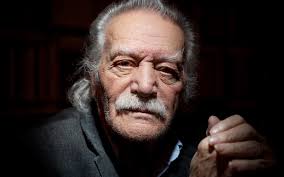
In recent weeks I’ve been trying to write something both critical and useful about the present COVID-19 crisis. My stumbling effort is put to shame upon hearing of the death of the great Greek critic and political activist, Manolis Glezos at the age of 98. Even in his final decade he was still writing, a book on social mobilisation here, a history of acronyms there.
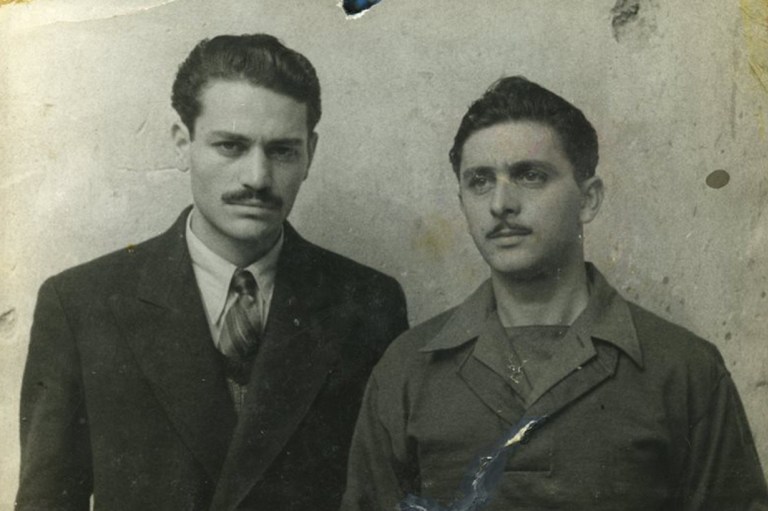
Together with Apostolos Santis, he earned legendary status in Greece on account of their dramatic act – the date, April 30th 1941. The daring duo tore down the swastika from the Acropolis. It had been hung on the ancient monument by the occupying Nazis. In their words they determined to remove the flag as it “offended all human ideals”.
However he was to become frustrated by the attention given to this impulsive heroism, remarking that ‘everyone identifies me with the flag incident…but I had done things before that, I had done things after that, and I’m doing things now.’
Indeed he had. Across the decades Glezos was imprisoned twenty eight times by the Germans, the Italians and then by Greek governments, suffering torture and solitary confinement. At the coup d’état of 21 April 1967, Glezos was arrested as a leader of the Left Opposition. During the Regime of the Colonels, the military dictatorship led by Giorgos Papadopoulos, he was exiled until his release in 1971. Looking back on nearly 16 years of incarceration he commented:
“They say to survive in prison you should love yourself, eat and read. Well I never loved myself, I didn’t care about food but I constantly read.”
His mercurial life witnessed him struggling with the classical contradiction between the price of involvement in parliamentary politics and the necessity of an extra-parliamentary commitment to struggle from below. In fact he was elected to the Greek Parliament on four occasions prior to the 21st century, twice as a representative of the United Democratic Left in the 1960s whilst still in prison, twice in the 1980s on a PASOK ticket, at the time the Greek version of the British Labour Party. It would seem he was chastened by this latter experience, withdrawing from Parliament to devote himself to the nurturing of grass-roots democratic projects and initiatives.
This focus was inspired by his love for the short-lived, but vibrant period of Athenian democracy, which in the words of Castoriadis sowed a seed, both frail yet hardy, for the future. When elected in 1986 as President of the Apeiranthos Community Council on Naxos, his home island, he immediately sought support for abolishing the privileges of the council, promoting the creation of a People’s Assembly founded on principles of direct democracy. Evidently the experiment was successful for many years, before it ran out of democratic steam. It would be fascinating to find out more about its demise, whether, to take but one factor, it foundered on the lack of a democratic commitment within a hierarchical Greek educational system.
He returned to mainstream political activity as the new century beckoned, involved in the rise of a rainbow alliance of the radical Left, Synaspismos. which was to give birth to SYRIZA [The Coaliton of the Radical Left]. The streets, oι δρόμοι, beckoned too. In March 2010, Glezos was participating in an anti-austerity protest in Athens, when he was hit in the face by a police tear gas canister. He was carried away injured. Back in the corridors of power he was elected as a SYRIZA MP in 2012 as the new found party rose to power on a wave of popular, progressive support. Thence in 2014 he entered the EU parliament, gaining 430,000 votes, more than any other candidate in Greece. Once there he addressed the assembled by way of Euripides and Theseus, arguing that the European Union should aspire to the example afforded by Ancient Athens, a free city, free of tyranny and ruled by the many.
Unsurprisingly Glezos was appalled by SYRIZA’s capitulation to the Troika following the people’s overwhelming rejection of a deal with the creditors, expressed in the July 2015 Greek referendum. In the aftermath he is quoted as reflecting,
“I apologize to the Greek people because I took part in this illusion, let’s react before it is too late”.
For now it does seem late in the day. Political disillusionment remains the norm in my adopted country. For Glezos resistance still ran deep in his veins. In 2017 in a scene of unbearable poignance, on a rain-soaked November day, this remarkable man, 95 years of age at the time, paid lonely homage to the fallen of the 1973 Polytechnic Uprising.
Four decades of neoliberal ideology, its explicit encouragement of self-centredness has undermined our belief in the common good. Ironically Manolis Glezos dies at a moment when the collective spirit threatens to rise from the ashes. For now I’ll leave him to have a last word with regard to not forgetting the past if we are both to grasp the present and the future.
The struggle continues,
Ο αγώνας συνεχίζεται
Why do I go on? Why I am doing this when I am 92 years and two months old? I could, after all, be sitting on a sofa in slippers with my feet up. So why do I do this? You think the man sitting opposite you is Manolis but you are wrong. I am not him. And I am not him because I have not forgotten that every time someone was about to be executed [during WWII], they said: ‘Don’t forget me. When you say good morning, think of me. When you raise a glass, say my name.’ And that is what I am doing talking to you, or doing any of this. The man you see before you is all those people. And all this is about not forgetting them.
I suspect only a handful of people know of my admiration for Cornelius Castoriadis, the remarkable Greek philosopher, psychoanalyst and political activist. Even some of my closest friends haven’t been persuaded to spend time with my faltering attempts to acquaint them with his thinking. Yet, across the years, his simple, yet profound proposal continues to resonate.
I ask to be able to participate directly in all the social decisions that may affect my existence, or the general course of the world in which I live. I do not accept the fact that my lot is decided, day after day, by people whose projects are hostile to me or simply unknown to me, and for whom we, that is I and everyone else, are only numbers in a general plan or pawns on a chessboard, and that, ultimately, my life and death are in the hands of people whom I know to be, necessarily, blind.
Indeed back in 2010 I contributed an article,’What has Cornelius Castoriadis to say about Youth Work?’ to Youth & Policy – see more below. In the ensuing years I have drawn on my understanding of Castoriadis, especially in a critique of neoliberalism’s overwhelming behavioural modification project, its goal being to turn us in on ourselves, to privatise our existence. Yet, in truth, I have ducked using explicitly key motifs in his work, notably the idea of the ‘imaginary’ as a way of shedding light on what’s going on in the world. Without doubt this reluctance stems from my long-lasting experience of an anti-intellectual and anti-theoretical tradition in youth work, little affected, it seems, by the shift in its full-time garb to being a graduate profession. I am on record as recognising this hostility to theory as not being at all simply bloody-mindedness. A significant amount of theory, as Castoriadis himself argues, is an effort to impose a template on reality, which often fails to convince. In this context it’s no wonder that practitioners fall back on ‘common-sense’.
However, as a New Year, hardly glowing with radical optimism dawns, I am motivated to have a fresh dialogue with youth workers [and perchance others] as to whether Castoriadis connects with our contemporary concerns. In seeking to do so I continue to be indebted to David Curtis, his tireless advocate, who maintains the Cornelius Castoriadis Agora International Website, which contains a recently updated version of his exploration of ‘the rising tide of insignificancy’, a dominant theme in the later writings of Castoriadis.
Social work is a contested tradition, torn between the demands of social governance and autonomy. Today, this struggle is reflected in the division between the dominant, neoliberal agenda of service provision and the resistance offered by various critical perspectives employed by disparate groups of practitioners serving diverse communities. Critical social work challenges oppressive conditions and discourses, in addition to addressing their consequences in individuals’ lives. However, very few recent critical theorists informing critical social work have advocated revolution. A challenging exception can be found in the work of Cornelius Castoriadis (1922‐97), whose explication of ontological underdetermination and creation evades the pitfalls of both structural determinism and post-structural relativism, enabling an understanding of society as the contested creation of collective imaginaries in action and a politics of radical transformation. On this basis, we argue that Castoriadis’s radical-democratic revisioning of revolutionary praxis can help in reimagining critical social work’s emancipatory potential.
Hopefully we might spark together an engagement across youth, community and social work about the import of Castoriadis.
In the meantime I’ll begin my return to Castoriadis with two offerings. The first is this absorbing interview with the man himself from 1989.
The second is the stumbling effort I made back in 2010 to introduce Castoriadis to a wider audience. It appeared in Youth and Policy, 105, November 2010. Other thinkers featured in this series were Paolo Freire and John Holt.
I began:
INTRODUCTION For over 30 years Cornelius Castoriadis has done my head in! In the mid-70’s, being a pamphlet junkie, I could not resist his ‘History as Creation’, written under the pseudonym of Paul Cardan. Inside a few pages my head was throbbing. At the time I was a recent Marxist convert, bowled over by the sweeping explanatory power of Karl’s grand theory. To be honest, the last thing I desired was some little known dissident revolutionary sowing uncertainty just as I had discovered certitude. Here was Castoriadis casting doubt as to whether any social theory or political programme could hold the key to understanding humanity’s past, present or future. I was torn from his dangerous embrace by the damning verdict of my Trotskyist group’s leadership. He was condemned as being little better than a liberal, a revisionist undermining the historical mission of the working class. This scathing put-down touched the raw nerve of my own liberal wavering in the face of Leninist orthodoxy and discipline, so I internalized my misgivings. To my shame, for most of the next decade, Castoriadis was consigned to a cardboard box under the stairs. For my part I strove to be the dedicated Marxist youth worker, armed with the correct scientific analysis, committed to politicising work with young people.
However, my cry of ‘get thee behind me, Castoriadis’ did not spare me the questions posed by life to anyone arguing for the radical transformation of society:
To what extent do we have a real grasp of why people think and act in the ways they do? What do we mean by notions of individual and collective consciousness, by the very idea of personality?
And, given that ‘personalities’, amongst other things, are black, white, straight, gay, women and men, born into contending classes, how might they discover and act upon a common sense of purpose in all their interests?
How indeed might revolutionary social and political change come about? As Castoriadis puts it, “to what extent does the contemporary situation give birth in people the desire and capacity to create a free and just society?” [1988a:33]
As a would-be agent of change, inside and outside of work, I wrestled with these fundamental dilemmas. Neither Marxism nor Youth Work provided convincing answers. Both fell short of comprehending the whole picture. Of course Marxism’s supposed commitment to class struggle as the motor of history seemed to resolve the matter. However, its singular failure to appreciate the individual in all her idiosyncrasy weakened its collective aspiration. As for Youth Work, its claim to be person-centred was built on the shakiest of foundations, an eclectic mix of generalisations drawn from a social psychology devoid of any sense of exploitation and oppression. Confronted with this divide I rushed from pillar to post, arguing in Marxist circles for the importance of individuality, ranting in the Youth Work milieu about the centrality of class conflict. Neither side was won over. It was the late 1980’s before I began to renew my acquaintance with Castoriadis and his fix on this mess of contradictions.
I concluded:
Ironically, whatever its rhetoric, state-funded Youth Work seems to have embraced with few tears the prescriptive agenda espoused until its recent demise by New Labour. In tune with the times, reflecting the widespread fatalism felt by so many, youth workers seem to be shrugging their shoulders in resignation at their situation. And yet, the struggle is not over. We do not need to accept the prevailing heteronomous view that human beings are the objects of history; that somehow we are nothing but pawns in the hands of a destiny determined either by God, Nature or the Global Market. In the spirit and pursuit of autonomy we must reaffirm that human beings create history. In doing so, therefore we know that the task is to nurture our striving to be individually and collectively autonomous. This never-ending process of mutual education will take place wherever we decide to give it a go – in the family, in school, in the workplace, within the community. It will be at its most intense in the collective passion of political struggle. Without doubt Youth Work can be such an arena, but it will be tough. Practitioners such as me have wasted perhaps more promising circumstances, but we can learn from the past if we are self-critical together. What’s certain is that isolated individuals will not reforge a creative and questioning youth work practice. For this task we need each other’s energy, analysis, experience, warmth, wit and humanity.
In his earlier writings, for instance, ‘On the Content of Socialism’, Castoriadis [1988b: 90-193] attempted to map out in detail the character of a future society, but over the years his work became more abstract. Nonetheless, David Curtis, his indefatigable translator, is right to stress the presence in his writings of the evocation of a way of living together that is cooperative and improvisatory, like the best kind of jazz or the finest moments in Youth Work! It is “a kind of life that does not deny rationality, planning and organising, but does not confuse the plan with living nor does it live for the plan.” [Foreword, 1988a: xviii] It is a kind of life that requires the passionate commitment of its participants. In his fondness for Greek sources Castoriadis quotes from the great chorus in ‘Antigone’, ‘there are many amazing phenomena, but none as amazing as the human being’. His emphasis on the heights to which humanity can climb contrasts with the sullen or complacent routine passivity prevalent today, summed up in the absurd adage, ‘nothing ever changes and nothing ever will’. As citizens and youth workers we must keep aflame a belief in the possibility of creating together a world that truly belongs to us all, the autonomous society of Castoriadis’ and our imagination. Indeed, in the last year or so the embers of resistance have been poked into life by the emergence of the In Defence of Youth Work Campaign, which asserts in the name of democracy and emancipation, ‘the essential significance of the youth worker, whose outlook, integrity and autonomy is at the heart of fashioning a serious, yet humorous, improvisatory yet rehearsed educational practice with young people’ [IDYW: 2009 ]. I will leave the last word with Castoriadis himself.
“It is not what is, but what could be and should be, that has need of us.” [ 1997:130]
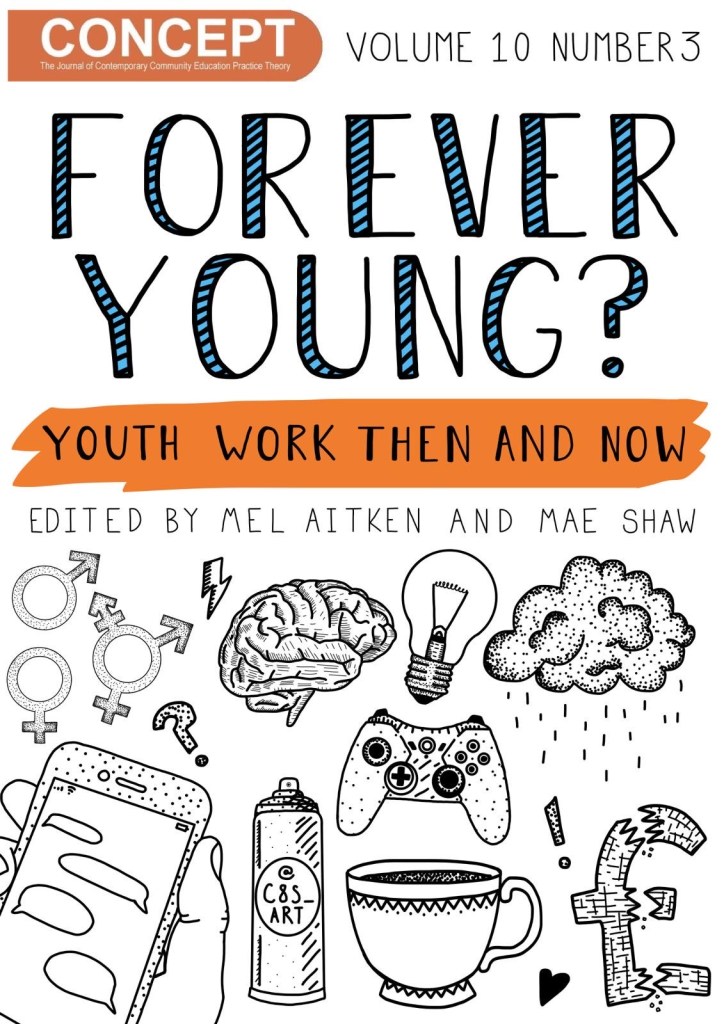
I’m pleased, even if the times seem dark, to have an article in this special edition of CONCEPT, the always challenging and diverse Scottish Community Education journal.
Entitled ‘The Decline of the Local Authority Youth Service in England – Reflections of an actor in its demise’ its conclusion written a few months ago is not too far off the mark.
Let me finish, though, on a fanciful if melodramatic note. Given the present political turmoil, it is possible that by the end of the year we will be governed by either an authoritarian, right-wing, populist administration or by a progressive alliance [Labour, SNP, Greens, Plaid Cymru] committed to a social-democratic programme of redistribution and renationalisation. In these contrasting scenarios, what price youth work, what price a Youth Service?
Mel Aitken and Mae Shaw, the editors explain:
This is a special issue of Concept which considers the changed and changing landscape of youth work in the UK. It includes contributions which take a backward look in order to locate present day developments, articles which reflect on contemporary themes, issues and practices, and interviews with current youth workers who are striving to manage the contradictions of politics and policy for young people, on the ground.












 CHATTING CRITICALLY