CRUSHING DISSENT AND RESISTANCE

I started to put this hardly controversial post together yesterday morning and it’s already been overtaken by numerous pieces despairing at Labour’s proscription of Palestine Action. A direct action group seeking to raise awareness of the obscene genocide in Gaza, of the war crimes of a terrorist State is without any due process defined as a terrorist organisation. Even the Guardian is forced to descend from the fence in an article, ‘It’s a complete assault on free speech’: how Palestine Action was targeted for proscription as terrorists’

The article notes, if the group is proscribed next week, as is expected, being a member of or inviting support for Palestine Action will carry a maximum penalty of 14 years. Wearing clothing or publishing a logo that arouses reasonable suspicion that someone supports Palestine Action will carry a sentence of up to six months.

In a week’s time we wait to applaud the Guardian’s recovery of its liberal tradition, whereby the paper explicitly backs the right of Palestine Action [PA] to exist and resist.

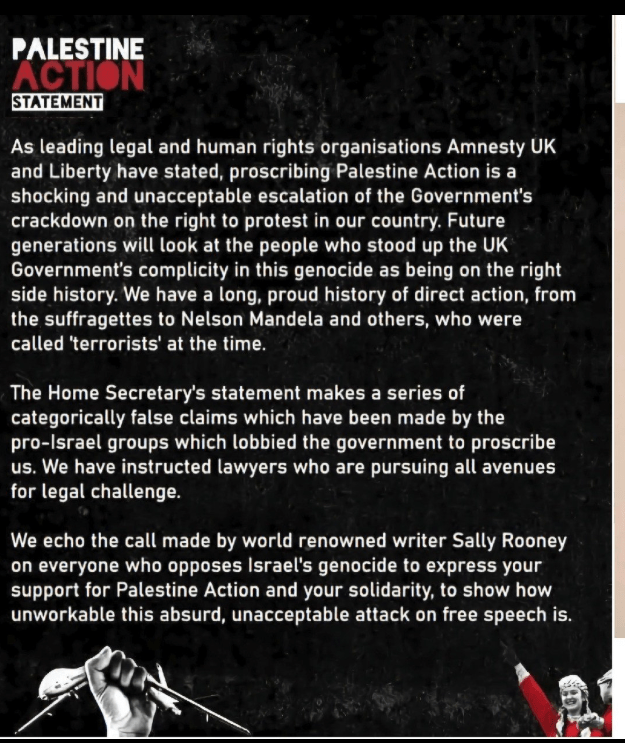
The arrogant and ignorant authoritarianism at the heart of today’s Labour Party is exemplified by the Home Secretary’s condemnation of PA’s militant tactics. In 2018 she spoke in the House of Commons, expressing her admiration for the suffragette movement, and celebrated its herstory by wearing a rosette in the suffragette colours of purple, white and green.

It seems to have slipped her mind that the suffragettes were not shy when it came to attacking the patriarchal state that denied them even a voice. Thus, at 6.10am on the 19 February 1913, a bomb exploded at the summer house that was being built for Chancellor of the Exchequer, David Lloyd George, at Walton-on-the-Hill, causing damage estimated at £500 (modern equivalent nearly £55,000 in today’s money). On the evening of the incident Emmeline Pankhurst, one of the leaders of the Women’s Social and Political Union (WSPU), claimed responsibility for the bomb at a meeting at Cory Hall, Cardiff, where she admits that they have “blown up the Chancellor of the Exchequer’s house”. Pankhurst was willing to be arrested for the incident saying “I have advised, I have incited, I have conspired”; and that if she is arrested for the incident she shall prove that the “punishment unjustly imposed upon women who have no voice in making the laws cannot be carried out”. We presume the Home Secretary might well retrospectively need to proscribe the WSPU as a terrorist organisation.

See this great piece that elaborates the story, Lloyd George and the Suffragette Bomb Outrage


And, let’s not forget……….

Greenham Common Women’s Peace Camp
1981 – 2000  

On the 5th September 1981, the Welsh group “Women for Life on Earth” arrived on Greenham Common, Berkshire, England. They marched from Cardiff with the intention of challenging, by debate, the decision to site 96 Cruise nuclear missiles there. On arrival they delivered a letter to the Base Commander which among other things stated ‘We fear for the future of all our children and for the future of the living world which is the basis of all life’.

When their request for a debate was ignored they set up a Peace Camp just outside the fence surrounding RAF Greenham Common Airbase. They took the authorities by surprise and set the tone for a most audacious and lengthy protest that lasted 19 years. Within 6 months the camp became known as the Women’s Peace Camp and gained recognition both nationally and internationally by drawing attention to the base with well publicised imaginative gatherings.This unique initiative threw a spotlight on ‘Cruise’ making it a national and international political issue throughout the 80s and early 90s.

The presence of women living outside an operational nuclear base 24 hours a day, brought a new perspective to the peace movement – giving it leadership and a continuous focus. At a time when the USA and the USSR were competing for nuclear superiority in Europe, the Women’s Peace Camp on Greenham Common was seen as an edifying influence. The commitment to non-violence and non-alignment gave the protest an authority that was difficult to dismiss – journalists from almost every corner of the globe found their way to the camp and reported on the happenings and events taking place there.

Living conditions were primitive. Living outside in all kinds of weather especially in the winter and rainy seasons was testing. Without electricity, telephone, running water etc, frequent evictions and vigilante attacks, life was difficult. In spite of the conditions women, from many parts of the UK and abroad, came to spend time at the camp to be part of the resistance to nuclear weapons. It was a case of giving up comfort for commitment.

The protest, committed to disrupting the exercises of the USAF, was highly effective. Nuclear convoys leaving the base to practice nuclear war, were blockaded, tracked to their practice area and disrupted.Taking non-violent direct action meant that women were arrested, taken to court and sent to prison.

The conduct and integrity of the protest mounted by the Women’s Peace Camp was instrumental in the decision to remove the Cruise Missiles from Greenham Common. Under the Intermediate Nuclear Forces (INF) Treaty, the missiles were flown back to the USA along with the USAF personnel in 91/92. The Treaty signed by the USA and the USSR in 1987, is in accord with the stated position held by women, in defence of their actions on arrest, when it states :

“Conscious that nuclear weapons would have devastating consequences for all mankind”

A number of initiatives were made by women in Court testing the legality of nuclear weapons. Also, challenges to the conduct and stewardship of the Ministry of Defence as landlords of Greenham Common. In 1992 Lord Taylor, Lord Chief Justice, delivering the Richard Dimbleby Lecture for the BBC, referring to the Bylaws case ( won by Greenham women in the House of Lords in 1990) said ‘…it would be difficult to suggest a group whose cause and lifestyle were less likely to excite the sympathies and approval of five elderly judges. Yet it was five Law Lords who allowed the Appeal and held that the Minister had exceeded his powers in framing the byelaws so as to prevent access to common land’.

The Camp was brought to a close in 2000 to make way for the Commemorative and Historic Site on the land that housed the original Women’s Peace Camp at Yellow Gate Greenham Common between the years 1981 – 2000.

Sarah Hipperson

This remarkable book tells how the women of the Yellow Gate peace camp at Greenham Common took on the law – and in some instances won.

They challenged the laws under which they were arrested and as Judge Hague said said in the County Court “…they are no strangers to litigation, both criminal and civil. In the courts they have sometimes had a considerable measure of success, and indeed they are immortalised in the Law Reports in connection with two of their successes in the higher courts.”

This book offers inspiration and encouragement to all who take part in non-violent direct action or want to challenge the powers of the state or large institutions. In its detailed descriptions of each case, it suggests how this can be done successfully.

The last chapter tells the story of the Commemorative and Historic Site, a garden of peace where once the women of Yellow Gate camp lived and confronted the Cruise Missiles – and the powers of the state.

To buy a copy of this book, send a cheque for £9.98 (+ £1.00 p & p) payable to ‘Greenham Publications’ to 15 Sydney Road, London E11 2JW or order one from your bookseller (ISBN 0-9550122-0-1)


AND AS OF NOW

https://www.theguardian.com/politics/2025/jun/25/mass-protests-uk-nuclear-deterrent-expansion

The biggest expansion of the UK’s nuclear deterrent in a generation will put the nation on the “nuclear frontline” and mobilise a new generation of anti-nuclear weapons protesters, campaign groups have warned.

Anti-nuclear and anti-arms campaign groups are planning mass protests against nuclear weapons – of a kind not seen since the days of the Greenham Common peace camp in the 80s – in response to government plans to significantly expand its nuclear deterrent by buying a squadron of American fighter jets capable of carrying nuclear weapons.

The Campaign for Nuclear Disarmament (CND) protested on Saturday, June 28th at RAF Marham in Norfolk, which is used by the US air force.

Campaign groups said the decision to buy 12 F-35A jets, which are capable of carrying conventional arms, and also the US B61-12 gravity bomb, a variant of which has more than three times the explosive power of the weapon dropped on Hiroshima, had been taken without parliamentary debate and undermined democracy.


Returning to Iran, Siya Vash, reports that within the convulsions inside the country suppression of dissent deepens.

The paranoid and humiliated Revolutionary Guards in Iran have been sending the following text messages to people’s mobile numbers:

Warning
Following or joining pages affiliated with the Zionist regime constitutes a criminal act and is subject to legal prosecution. Therefore, given the recorded activity of this number on virtual pages of the Zionist regime, you are hereby warned to immediately remove supportive comments and likes, and exit these pages without delay. Failure to do so will result in legal action in accordance with Article 8 of the Law on Confronting Hostile Actions of the Zionist Regime.
Deputy for Social Affairs and Crime Prevention, Judiciary of the Islamic Republic of Iran
Honourable People of Iran


In recent days, your exemplary cooperation and solidarity with your servants in the IRGC Intelligence Organisation—through public reporting—has not only altered the enemy’s calculations but has also led to their defeat on the battlefield. Therefore, we kindly ask you to continue this valuable approach and report any suspicious activity by contacting 110, 113, or 114, or through available channels on domestic messaging platforms.
IRGC Intelligence Organisation


In a philosophical atmosphere, all of the above would be open to criticism, agreement and disagreement. However the creeping authoritarianism I have sought to address since the ascent of neoliberalism in the 1980’s, its fetish of individualism and its hatred of autonomous collectivity has gathered pace across the decades, not least during the manufactured COVID pandemic. Central to the shift into an era of technocratic capitalism is the Expert, who takes different forms and cannot be questioned. To do so is to be beyond the pale. This demand for conformity and obedience is profoundly anti-democratic. And its prophets and disciples come from both the traditional Left and Right. If I get my act together I will try to put flesh on these bare bones.


What to think, what to write? It’s doing my head in!

Freedom is always and exclusively freedom for those who think differently” Rosa Luxemburg

On the subject of failing to put words on paper, the cliche is at hand. I am suffering from writer’s block, a psychological inability to write. One definition suggests this has to do with having nothing to say. Such a judgement scratches a raw nerve, its implication too close for comfort. Indeed I often feel wearily repetitive and stale. Haven’t others said much the same thing and better? Haven’t I said much the same thing and forgotten saying it? And, even when I think I’ve said it well, how many have noticed? Hence the obvious, why am I so bothered about the paralysis, both in thought and action?

Well, one reason for sure is that I seem to compose endlessly, from dawn to dusk and then in my dreams. Walking the dog, sitting on the terrace or in the kafeneio, or riding my bike, I string sentences and plait paragraphs into captivating prose, only to see the words slip from my grasp. This hardly matters. Unlike the novelist, I am not searching for an unexpected, yet unknown twist in a story. Unlike the poet, I am not seeking a subtle alliterative allusion.

The crude and sophisticated thoughts, sometimes pounding, other times petalling the interior of my head are here, there and everywhere. They are the stuff of gossip, of idle and animated conversations, of the media in all its forms, of propaganda, both good and bad. Whatever our education such ruminations are a messy mix of the psychological, social and political. All of us in one way or another psychologise, offering opinions about why people, including ourselves, say what they say, do what they do.

In my case the psychological, social and political explanations to hand owe still a great deal to my chance recruitment in the mid-70s to a small Trotskyist organisation, the Marxist Workers Group. There I tussled with the inextricable relationships between class, gender, race and sexuality – long before if I might say so, the appearance of intersectionality. Privileged later to spend a year in Higher Education I sought with Marilyn Taylor to sketch the outline of a grounded Marxist-Feminist psychology, which situated the unique individual within the constraints of her circumstances. The project remains incomplete but snatches of our exploration are to be heard in the tinnitus of voices accompanying me as I wend my way along the paths of my daily existence.

For now, though, I need to emphasise, that, although seen as something of a maverick, I saw myself as a man of the Left. Indeed I saw myself pretentiously as more Left than the majority of the Left. My increasing hostility to the authoritarian inclinations of the traditional Left, both social-democratic and revolutionary led me to seek out the dissident writings of the German, Dutch and Italian Left, dismissed by Lenin as ‘infantile’, the works of anarchists such as Bakunin and Kropotkin and somewhat later the autonomous provocations of Castoriadis. Steadfast I was always enamoured with Rosa Luxembourg, her overflowing humanity. In doing so I was fortunately able to discuss the importance or otherwise of these thinkers for over two decades in a pluralist caucus of activists, known in one of its incarnations as the Critically Chatting Collective. The group included Malcolm Ball and Steve Waterhouse, to whom this website is dedicated and I can still see them outside in the garden of Exeter Community Centre arguing passionately the toss. I wish so much they were here to take me to task for my ramblings.

Within Youth Work, which continued to occupy much of my time after ‘retirement’, my writing and activity remained rooted in a defence of a radical practice with social and political justice at its heart but one, which was ‘volatile and voluntary, creative and collective – an association and conversation without guarantees’. It was a direct refusal to bow to the diktat of behaviourism, the imposition of prescribed scripts and predictable, necessary and expected outcomes. Without quite knowing, it was a rejection of impact capitalism. Thus, almost to the dying days of In Defence of Youth Work, I focused on the destructive legacy of a destitute neoliberalism and the frightening dominance of behavioural psychology at all levels of practice and policy in welfare and education. I continued to hold to a view I expressed in 2008 that we were in danger of ‘sleepwalking into authoritarianism’. And I feared the Left was not unduly concerned. In fact, in retrospect, it was undeniably implicated.

Nevertheless, not being a purist in practice, I lent my genuine if cautious support to what now seem to be the dying moments of left social democracy, namely Corbyn’s Labour Party in the UK and SYRIZA in Greece, where I happened to live. Corbyn fell foul of foes within the Party itself and the media, not least the nauseous Guardian, hung him on the absurd charge of anti-semitism. Tsipras, the leader of SYRIZA, despite referendum support to resist the demands of the International Monetary Fund and its allies, capitulated. The night previous to his treachery my small Cretan village was abuzz with an uncertain feisty excitement. Within hours this gave way to a cynical disillusionment that persists to this very day.

During 2019 I was reading analyses that argued the economic crisis was much worse than in 2008. Quantitative easing, the relentless printing of money for money’s sake could not be sustained and needed to be hidden. What was the ruling class, the elite going to do? True to form the elite has gone to war. Historically the strategy has served them well. And the enemy, whatever the appearance of things, has always been the working class, the peasantry, the dispossessed, the oppressed and exploited.

Crisis capitalism was the order of the day. First, a respiratory virus of less than existential concern was used to manufacture unprecedented global consent by way of fear-mongering propaganda for an astonishing authoritarian programme of restrictions on personal and social liberties. The Left in the UK approved, simply frustrated that it was not the government of the moment. Immune to the soaring profits of Big Pharma, it would have been even tougher. As this threat to humanity faded, the virus shrank into the shadows and the climate crisis took centre stage. Unless fossil fuels were sorted, by whom and by when was not that clear, 2030 or 2050, Armageddon was at hand,. As best I can see, many in the better-off parts of the world are less than convinced, for those less well-off so what? However, if this catastrophic scenario is not inducing sufficient angst there is always proper, bombastic war – missile after missile, death after death. Entering from the Left or Right, it matters not which entrance, the conflicts in the Ukraine and Palestine boost immeasurably the profits of the armaments industry and serve to buttress the USA’s and its allies’ desire to retain global influence whilst dismissing the slaughter of the innocents and the views and needs of folk back home, wherever that may be. Democracy is a word to be cynically abused, a rhetorical device devoid of meaning.

Of course, these are sweeping assertions, replete with contradictions, which I acknowledge and would want to discuss. Indeed I have written about these, especially with respect to COVID, without any serious engagement with my mutterings. The main point I’m clumsily trying to make is that since COVID I have broken out of my Left bubble. I have followed, read and conversed with figures across the political spectrum, critical of the authoritarian arrogance of the elite, the ruling class and its army of compromised, careerist technocrats and its team of amoral, behaviourist managerial manipulators.

I’ve found these relationships, their contempt for the deceitful discourse of ‘misinformation’ spread by all of the mainstream media thought-provoking and heartening without knowing where any of it is going. I have gained a great deal from these encounters. Little more than a month ago I would have argued that an open and questioning dialogue across ideologies premised on a challenge to hierarchy, authoritarianism and the spectre of global governance is both possible and crucial. I still do but my naive optimism has been dented. Suddenly the Israeli/Palestine’s inevitable eruption has seen free speech advocates of the past few years rush to condemn and silence pro-Palestinian sentiment. It saddens me into despair.

Glyka

And thus on tomorrow’s favoured ramble through the olive groves, I will hear another swish of doubt amidst the swirl of thoughts between my ears. What the fuck is it all about and what can I say or do? Then the gritty voice of the goatherd and the tinny clanging of their bells will interrupt my self-centredness and my uncertainty. We will exchange greetings as we would have centuries before. Such ordinariness is heart-warming. It lasts for seconds yet forever. And, I know, as best I can, I should carry on struggling with uncertainty. And then, my dearest Glyka wags her tail and I know for certain she loves me and I love her. Time to head home for breakfast.

POSTSCRIPT

In lieu of any original offering from me, I’m determined to start sharing links to interesting and provocative articles you might well miss. I’m off for a week but hope to fulfil this promise soon.

Chatting Critically about Climate Change Continues: Settled or Unsettled?

At our last CC meeting on September 6th, we agreed to continue the discussion on Climate Change at our next get-together on October 4th. Participants were encouraged to provide further links and comments as a stimulus to our individual and collective thinking.

Brenda got the ball rolling by drawing our attention to the video circulated by Marie-Martine of an interview with sceptic, Steve Koonin.

Brenda ventured the Steve Koonin link Marie-Martine sent us is eye-opening, and I feel it would be really good if everyone listened to that before coming on 6th October. Real fuel for a debate! A “man in the know” expressing his opinions on whether climate change is even really a thing…

This prompted a welcome and critical response from Jane Roberts.

Regarding Steven Koonin.
A modern-day Freeman Dyson but arguably more extreme. Both are physicists who have chosen to criticise climate scientists. They’re not climate scientists.

Some flaws in the video:
Complains about models being insufficient as did FD. But in its place he suggests the simplistic approach of taking the 1.3 increase of the last century and therefore assuming we can do the same this century and just “adapt”. How many centuries can we continue like that? Where is the tipping point – or is he sure there is not one, if so he remai
ns silent on this.

Says it’s not his place as a scientist to discuss moral and political issues – then holds up unfairness on the third world as being a part of his argument.

Spent a lot of the discussion around anecdotal evidence. For example the argument that “there have always been extreme weather events” is made purely qualitatively- he makes no attempt to be quantitative.

Likewise his suggestion that deaths from extreme heat can be discounted because deaths from cold are greater. That may be true, but here is some quantitative data on deaths from heat, published this morning https://www.bbc.com/news/uk-66890135

Positioning a 1.5 degree temperature rise as “under 1%” must be deliberately disingenuous. He is referring to under 1% of a temperature scale which falls to absolute zero (ie – 273 degrees C). But the range of temperatures at which life can survive is much smaller that 300 degrees, so this is a transparent distortion of the % and potential impact of a 1.5 degree rise.

Arguments about the cost of action seem out of place for him as a scientist too – yes it is huge – but those arguments are not for scientists either. But perhaps he has little to say as a scientist, because he is not a climate scientist?

The interview is odd as the interviewer never challenges him. He appears to be conducting the interview purely to give Steven Koonin a platform.

My overall thought is that we simply cannot risk inaction. It’s true that climate science is a relatively young science. It is not as developed as physics – and he may find that deeply unsatisfactory as did Freeman Dyson. Having acknowledged that however either he’s right or the climate scientists are right. We have no real way of telling. Surely we owe it to future generations to act – in case the climate scientists are right?

All the best


Paula has suggested this controversial alternative perspective.

The claims made in this hard-hitting, uncomfortable yet extraordinary crowdfunded documentary by Dr Steven Greer shows how the industrial-military complex together with human nature have conspired to keep us all in the carbon age for our electricity and transport far beyond when the invention of ‘free’ energy became known. It explores the lost century and the science we have made secret for so long and asks how we can reclaim a lost century before it is too late.

Do not watch before bedtime as it is depressing and exciting in equal measure!

I’d be interested to hear if you think this is real or just another conspiracy theory.


Taking Action Through Process and Debate

The recent and concerning collapse of the once revered scientific process in large parts of the climate change and the medical community is detailed in a highly critical ‘open review’ paper from the Global Warming Policy Foundation (GWPF). Someday, charge the authors, there will need to be an inquiry into how so many scientific bodies abandoned core principles of scientific integrity, took strong positions on unsettled science, took people’s word for things uncritically, and silenced those who tried to continue the scientific endeavour.

Find the report here – a draft out in the public sphere for debate but ignored by the mainstream media.

From its Executive Summary

At present the UK has a Climate Change Committee (CCC) responsible to the Government for advice on both mitigating and adapting to future climate change. Again, this body has no ‘red team’ to challenge their many reports. One thing a ‘red team’ would have done is to insist on looking at the whole trajectory of the route to net-zero and try to estimate the financial, material, human resources, ecological and societal costs involved.Just to expand the electricity system (extra generation, transmission and distribution) to cope with the extra demands of electrified ground transport and both industrial and domestic heat is estimated at £1.4 trillion, with 40,000 professional engineers devoted to this project alone for 30 years from now until 2050 (https://www.thegwpf.org/content/uploads/2022/03/Kelly-Net-Zero-Progress-Report.pdf . There may be an error of as much as 50% in these estimates, but certainly not a factor of 10. The electrification of heat and transport is only one part of the net zero target. In spite of a decade of advice, this firm grip on the scale of the problems of getting to a net-zero economy by 2050 is not to be seen spelt out in any of the CCC advice. Indeed the competences of the committee members do not extend to these extra considerations.

A key issue with red teams is to keep them from being ‘stacked’ by biased individuals, including political
favourites or corporate shills. However, it is often very rapidly apparent from online discussion of research that there are some highly experienced and competent scientists who are dissenting – with logical criticisms of the ‘mainstream’. Indeed, these scientists can often be identified conveniently by the ferocity of online bullying and ad hominem attacks on their capacity and integrity by some of the enforcers of alleged ‘consensus’. In the early days of Covid some powerful dissenting voices emerged on social media such as Twitter (now X), who despite being vilified and censored have proved correct.


And a provocative excerpt from a disagreement between Rusere Shoniwa and Jonathan Cook

https://plagueonbothhouses.substack.com/p/jonathan-cooks-rebuttal-of-my-rebuttal

Cook’s precautionary principle trumps rational scientific assessments

Cook falsely claims that I and other sceptics demand “that we wait and see how things unfold”. He then articulates a common but highly ignorant and dangerous notion of managing risk in which he posits that “even if you imagine there is some room for doubt, you should still be pushing hard for things to be done to minimise climate change and related ecological catastrophes if only on the precautionary principle”. [emphasis added]. So let’s deal with this.

First, the “wait-and-see” accusation is both false and irrelevant because it is intended to obfuscate the point I wanted to stress – it would be incredibly foolish to incur huge costs to avoid a crisis without sufficient scientific evidence for the existence of the crisis. The precautionary principle does not come without a price tag, and this is what Cook is trying to sweep away. You simply do not incur costs to avoid a crisis until you have compared those costs with the cost of the risk you are seeking to avoid. The methods for doing that are scientific, and they involve probability assessments of both sides of the equation. The sweeping application of the precautionary principle is the product of an asinine, bloated, bureaucracy-infested professional managerial class whose primary purpose is to justify its existence by manufacturing and then exaggerating risks to manage.

The costs involved in averting a ‘climate crisis’ are colossal. They involve choking the economies of the entire world. Depriving all economies, but especially poorer economies, of cheap energy and fertilisers that enhance crop productivity raises the very real prospect of killing millions of people already below the poverty line. How can any sane person be content with that horrific prospect, especially when the risk being avoided – the climate crisis – is not based on a ‘settled’ scientific proposition? I would never advocate for that position even if the ‘climate crisis’ were ‘settled science’, partly because ‘settled science’ is an oxymoron, but mainly because it can never be acceptable to kill one group of people in the expectation that you might save another group, now or in the future. That’s the alibi that has been used by every evil tyrant since the dawn of time, and it appears to be the stock-in-trade of ‘progressives’.


Another provocative argument to be found in this article, The Left is losing the climate class war Punishing the workers won’t save the planet BY MATT HUBER

https://unherd.com/2023/09/the-left-is-losing-the-climate-class-war/

Why do these climate policy technocrats repeatedly shoot themselves in the foot? Because, at the heart of their thinking, there is a deeper moralism that won’t let political reality get in the way of their historic mission. Ultimately, such approaches might be dubbed “techno-behaviouralism” — insisting that the main challenge of climate change is to reform the immoral carbon practices of dispersed consumers throughout the upper, middle and working classes. Rather than tackling the problem of who owns and controls fossil-fuel-based production (a relative minority of society), carbon behaviouralism aims its sights on the “irresponsible” choices of millions of consumers of all classes. It hopes to use policy tools to get them to drive less (or drive more efficient cars), insulate their homes, eat less meat, fly less. One notorious study in 2017 even went as far as to advise individuals to not have children.

The first phase of this policy outlook was to use the disciplining force of the market — particularly the price mechanism — to “nudge” consumers toward low-carbon choices. But now the severity of the climate crisis is forcing these technocrats to ratchet up their strategy to outright coercion: banning fossil-fuel boilers, gas stoves, internal combustion engines, or forcing farmers to rapidly implement costly practices. Rather than winning them over to an attractive political project, the masses must be reformed into more virtuous low-carbon practices. And even when the climate technocrats focus on society’s rampant class inequality, they only morally reprimand the lifestyles of the rich — their private jets, for example. They hardly ever consider how the rich make rather than spend their money: organising investment and for-profit production with likely far greater effects on the climate.


Also, see this long but moving piece in the Guardian

https://www.theguardian.com/environment/2023/sep/23/the-climate-is-visiting-a-mental-unravelling-on-all-of-us-charlie-hertzog-young-on-the-dangers-of-activism-and-staying-sane-on-a-dying-planet

We may be getting better at talking about the mental health crisis, but few connect it to climate breakdown. Scientific studies show that young people are more likely to suffer from climate anxiety and a Lancet study of 10,000 young people living in 10 countries found that 56% believe humanity is doomed. “Most people who are polled think that mental health issues are something to do with either a chemical imbalance in the brain, some sort of neurological glitch, or genetic. That model is completely outdated,” says Hertzog Young. “There are so many demonstrable links between social, ideological, ecological and material realities outside the brain that have a far greater impact on mental health. Climate change is throwing so much pain, trauma, stress, angst and cultural toxicity at us. It can breed distrust, apathy and nihilism and it can also breed deep fear. Even for people who are experiencing the climate crisis at a distance, through the lens of the media, there’s a medically recognised causal pathway to depression, anxiety and PTSD.”


Looking ahead Steve and Brenda suggested possible topics for future discussion

There seemed to be a feeling it might be hard to come up with more topics for discussion. I thought these might be helpful.
Do social media cause harm?
Freedom of speech:
Is it under threat? If so, how can it be saved?
Democracy
Does it exist? Is it under threat? If so, how can it be saved?
How tolerant should the West be of other cultures, especially when there is a conflict with western ideals such as women’s liberation?

In the future, could we discuss the topic of reparations? And was self-censorship covered in the session on literary censorship which I had to miss? Is Euthanasia too old a chestnut to crack? What about, at least, care of the elderly? What would people think of having a train line from E to W Crete? Is recycling being conducted properly? One could go on and on.


Our next CC meeting is at Brenda’s on Wednesday, October 4th, starting at 10.30 a.m. I’ll send the details out again to the group via email with a map.

From the Archives, July 2009- Jean Spence explores what we mean by defence

My latest shoveling into the IDYW archives for pieces, I think, remain of interest and pertinence.

Back in June 2009, Jean Spence, a leading voice in youth and community circles through her endeavours as a lecturer at Durham University, through her valuable research – see ‘Youth Work: Voices of Practice, available as a pdf – and her pionering contribution to the emergence of ‘Youth & Policy’ in the 1980s, gave this contribution to a Leeds ‘In Defence of Youth Work’ seminar. Within it she engaged particularly with a certain anti-intellectualism within our work, which seems to persist , even unto the present, despite our status as a graduate professionHer thoughts are not past their sell-by date.

Jean on her retirement from the Y&P Editorial Board in 2016

I’m glad to be able to make an active contribution to the series of meetings organised in Defence of Youth Work.

The last meeting that I attended was in Newcastle a couple of weeks ago, where I think more than 90 people turned up. Meetings being picked up in other parts of the country suggest that the Open Letter has touched a nerve amongst those of us who have some commitment to youth work.

Clearly if we feel the need to defend youth work, we must be also feeling that it is somehow under attack. The nervousness, not to say antagonism of some of the managers of local authority services to the North East event highlighted the fact that organising to defend youth work cannot be undertaken naively – it cannot be assumed simply that defending youth work is a straightforward matter of supporting good workers who are working for the good of young people and not being appreciated. Life is more complicated than that. At the very least, if we are discussing attack and defence, we are inevitably engaging in conflict – and there is some need to understand who will be on what side in the conflict, and for what reason.

I don’t want to complicate things too much, but I do want to draw upon some of the issues which were raised for me through my participation in the Newcastle event. Later, and partly in recognition that this event is also to celebrate 20 years of Community and Youth Work education in Leeds, and Marion Charlton’s 30-plus years contribution to the education and training of community and youth workers, if I have time, I want to draw a little from a celebration event that I attended in the same week as defending youth work. This was a 30-year celebration of a voluntary youth project where I worked between 1979 and 1985 as a detached/neighbourhood youth worker with a remit to focus on work with girls and young women. These two personal experiences raised all sorts of questions for me and I want to offer some of these questions to you for debate in the hope that there are some universal concerns in them about youth work.

Firstly, to go back to Newcastle. That event was attended by academics, managers and practitioners from a wide range of projects, practices and working approaches. During its course, we addressed the question of what it was we wanted to defend which involved considering the focus of youth work. Among the various propositions, I heard an academic suggest that the focus should be upon civil society and democracy. This was countered by detached youth workers who wanted to focus upon the process of listening to young people and the following discussion in a small group became oppositional. The language used by the two parties was operating in two different planes. In response to an effort to create a conversation wherein the two sides might find common ground for conversation, I suggested the possibility of listening ‘in context’. Implicitly, listening in context is connected with questions of civil society and democracy because it is a listening which understands the circumstances not only of being young, but of being situated in sets of social relations which are inherently unequal. Listening effectively and actively requires some knowledge on the part of the worker. They might need to know something of youth subcultures, but under this, they might need to know something about class and poverty, about racism and sexism, about the realities of global displacement, about structural relations of power in which some voices are silenced and in which listening must be an active process of encouraging speaking, not just the speaking of individuals, though that is important, but the speaking which enables groups to find collective voices and thus to combine and act on their situation. Just as the ‘In Defence of Youth Work’ meetings are attempting to do for youth work as a profession silenced in a set of power relations. There is a direct connection therefore between questions of power, voice, listening and speaking, and issues of politics, democracy and civil society.

Now I know I must own up to being some sort of an academic – even if the academy has a highly ambiguous and grudging relationship with my area of knowledge relating to community and youth work – and therefore I might be perceived as someone who does not understand the realities of practice. However, I was shocked at the response to my efforts at finding common grounds for discussion. Firstly, the meaning of ‘context’ was misunderstood: it was assumed that I was referring to ‘place’ and therefore the protagonists felt it necessary to inform the group that not all young people congregated where they lived. Secondly, perhaps in pursuit of the point, the detached workers insisted that youth workers needed to know NOTHING. Apparently, all youth workers need to do is learn the skills of listening to young people. I hope I am not misrepresenting the case or offering a caricature here, but I was left with the distinct impression that the position that was being taken, that what we were being asked to defend, was a process of youth work as listening, in which the youth workers act as sponges, absorbing what young people say to them. I have yet to discover what youth workers are then to do with such listening. Of course, not all youth workers were taking this position, but it did force me not only to repeat to myself the question, ‘What exactly are we trying to defend?’ but it also make me ask, ‘Do I want to defend this? Am I on the same side as those detached workers?’

Here the ongoing and perennial tension between academics and practitioners, between theory and practice starts to raise its ugly head. This tension is not a new one. In some of the historical work which I have done the question emerges time and again as part of the struggle for professionalization. I digress for a moment, but it is interesting to see how the earliest youth workers in the late nineteenth century, who were integrated within the broad set of activities known as social work, which included community work, welfare rights work, campaigning and various other types of social intervention, and which even sometimes laid claim to the concept of socialism as a term to describe their interventions, it is interesting to see how for the pioneers of this work, there was no split between theory and practice. Indeed, practising social, community and youth workers were also pioneers of the new discipline of social science and it was only when social science began to be accepted within the academy that the split began to happen.

Anyway, to put that to one side, for a moment and return to the reality of the present tensions, in the plenary session, one of the organisers felt it necessary to say something about the fact that this was a grass roots organisation of workers and to underline the point, to say that they wouldn’t be using long academic words and jargon in their approach. No doubt this was said to encourage those who might be intimidated by academic pretensions, and later it was suggested to me that this was in response to the academic use of the word ‘hegemony’. Nevertheless, it came across as pandering to an assumed anti-intellectualism amongst youth workers which to my mind is part of the reason why the profession has been so weak and is now in so need of defending. Can anyone tell me why youth workers should not understand the meaning of hegemony? And if they don’t understand it, why they shouldn’t seek to understand it?

This question is particularly important given that one of the points most frequently reiterated in the feedback from the group discussions was that youth work needs to promote what it does more effectively, that youth work voices need to be heard in appropriate places, and that youth workers should make more effective use of the media in order that they should receive credit and status for their achievements. This is fine, but I do wonder if this is all. Indeed I wonder why we think that youth work is so unknown. There are some grounds for believing that on a day to day basis those who are not involved in youth work don’t really appreciate the complexity of the work, and sometimes confuse it with other social services. There are also some grounds for thinking that related professionals in health, social work, and teaching are sometimes, though not always, vague about youth work, but I am not sure that this can be said to be true of politicians and policy makers. There is now a distinct body of research which demonstrates what youth work does and what it achieves, some of which itself has been commissioned by government and there is a whole programme of policy which relates to youth work practice. The inclusion or omission of youth work from policy directives seems to me to be self conscious. And here we might do well to remember that some politicians don’t actually like some aspects of youth work which many youth workers consider central to their practice identity. To paraphrase an extract from Bernard Davies and Bryan Merton in an article about to be published in Y&P:

One Children’s Minister (Margaret Hodge) generated the headline ‘Youth clubs can be bad for you’ (Hodge, 2005; Ward, 2005); and another (Beverley Hughes) asserted that youth work must be ‘primarily about activities rather than informal education’, with ‘self-development’, though welcome, not seen as an essential goal (Barrett, 2005).

There are not a few MPs who themselves have been youth and/or community workers and often I hear youth workers speaking on the radio in response to some issue that has arisen about young people. So how does this square up with the idea that the work isn’t known? I would like to suggest that the tension between theory and practice in youth work has to be considered in order to understand why youth work is either misunderstood or dismissed. It is no good promoting it. What we have to do is demonstrate in practice that it is a profession with distinct characteristics and that includes, with intellectual credibility, with a historical tradition, with a discourse of its own, and with a desire to engage critically with lively, open and informed debate and action relating to young people and to the type of work we think is central to the profession. This debate is not about promotion. It is about professional, intellectual and political engagement in the areas that are relevant to our work. Ultimately it returns to questions of democracy and civil society.

And this brings me back to the fact that the academic in my Newcastle group has a particular interest in community development raising an enormous question about the distance between the language of community work and that of youth work. As Jeffs and Smith argued years ago, the thrust of policy since the Thatcher period has been towards an increasing individualisation of youth work. Incrementally, youth work has been moved away from working with groups, away from working with political issues, away from working with local cultures and questions of community identity, away from working with the large social issues of poverty, class and social inequalities. As I tried to argue in ‘Youth Work: Voices of Practice’, what is central to the self understanding of the youth worker, has become marginal in the contemporary conditions of practice. And those things which should be secondary, have been made primary. So instead of working with potential, we are required to work with problems. Instead of working educationally, we are required to offer support. Instead of seeking partnership with colleagues on the basis of issues arising from our engagement with young people, we are required to be integrated from an organisational perspective. And most importantly, instead of being able to use the privilege of professional status to build confidence, and trust, and to make professional decisions about risk and about sharing with others, we are required to act as technicians delivering policy directives and feeding information into highly dubious systems. Insofar as we are increasingly driven towards children’s services and social work, so we are incrementally driven away from community and community work issues. The consequence is an absence of political engagement. Do we think that work with young people is not political? Do we think that we can work with young asylum seekers without dealing with the disgrace of policy in these matters, without dealing with global issues, without thinking about racism and sexism, without considering community identities for instance?

So if we are keen to defend youth work, what do we want to defend? It really is the simple question but it is meaningless without considering what we need to build and what we need to attack and destroy. We can have no chance of answering these questions without engaging in critical and informed debate. So the second question must be:

How can we hope to engage in critical and informed debate if some of us continue to denigrate theory, if we do not acknowledge the value of intellectual understanding and the importance of continuous learning in what we do. So how do we challenge this tension between theory and practice? What can we do about it?

And linked to the need to develop a disciplinary discourse for professional youth work, is the question of where we would like our field of knowledge to reside. How do we think about the core of our practice? Is it within the disciplinary domain of social work, or education or politics or community work? Or is it worth thinking of it as different from all of these and if so, can we build a unique body of theory around its core practices drawing from the related disciplines and professions without being sucked into them as second-class actors?

And having asked these questions, I want to turn to the questions which emerged from my 30 years of Southwick Neighbourhood Youth Project anniversary experience. Firstly in this regard, I would like to say that there are some advantages to growing older and one is the privilege of being able to attend more of such events and through them to gain a view of the longer-term impact of youth work practice, education and training. It is easy at gloomy moments to think that we have little impact but a reunion or an anniversary celebration can really inject some optimism about the importance of youth work. I first had a sense of this when I went to the launch of Celia Rose’s book on the Clapton Jewish Youth Club. There was a gathering of people who had been members of the club from as long as 50 years ago. Some had even travelled from the USA to meet old friends at the Jewish Museum in Finchley where the event was held, and it was seriously moving to hear people’s testimony to the positive impact which the club had had on their lives. I once interviewed a man who was a member of a Sunderland boys’ club during the 1930s which was a hard time in Sunderland as everywhere. This man had returned to Sunderland on his retirement, having been an engineer and an FE teacher in Lewisham. I asked him what membership of the club had done for him, and he told me that it had made him believe that he could be somebody in a world where that message was coming from nowhere else. He retrieved and showed me the reference which the Warden of the club had written for him to help him in his search for jobs, and he firmly believed that any success which he had in life, had been a consequence of attachment to the club.

Southwick Neighbourhood Youth Project, known as SNYP, emerged from the Inner City partnerships of the mid 1970s. It started as a small youth club in a Neighbourhood Action Project (SNAP) and was successful in gaining Urban Aid funding for 3 years in 1979. I was appointed with one other full-time worker as a neighbourhood and detached worker in early 1979 and was very pleased to be given the brief to work focus my attention on work with girls. The project was situated in an area of Sunderland which had had a long history as a village, only joining with the town in 1923. It had retained a strong village mentality and community identity. Many of the people who lived there had done so for generations and they tended not to travel far. There was no way any outsider could work with the young people of that area without addressing the question of community, without being accepted by the community and without understanding something of the local culture and family relations. The industrial development and growth of Southwick had been built upon shipbuilding and mining. As a consequence, the local culture was strongly masculine in a very old-fashioned sense. Men and boys ruled OK and there was a general acceptance of this truth. The area was also almost completely white and most of its inhabitants were unselfconsciously racist. So as youth workers we had to work very self-consciously to know and understand local social relations, and this meant local history and culture as well as active relationships between people, and at the same time, in order to mobilise the principles of equality and justice which we brought as core values to our work, we had to work critically and developmentally with the sexism, racism and homophobia which were part of the everyday relations of that community.

By the time I left Southwick in 1985, these issues were becoming more acute and pressing as the industrial base which underpinned social relations and local culture and community disintegrated and the youth job market collapsed. Problems associated with displaced working class masculinity, including violence and crime increased, and racism became more active as a poor area became even poorer and as the young people became increasingly hopeless about their future. Although the language we used was not the same as today, the workers in SNYP understood their youth work with reference to both the context of the local community and with reference to a broader set of values about the type of social relationships we wanted to encourage. We were in no doubt that our work was political, that it was allied to community work, that it was educational and that it was concerned with groups, social change and social conflict as much as, if not more than with individual support and social cohesion.

So what did I find at the 30 year celebration and reunion. Firstly, I found lots of aging young people. And some of their parents. Those who I had worked with when they were in their teens, were now in their mid to late forties. One whole family had turned out, the parents telling us that they had just celebrated their golden wedding. Secondly, I found how poverty had taken its toll with tales of accidental deaths, suicides, alcoholism and serious ill health amongst some. In those tales, it was strikingly obvious how services failed to meet the needs of people in poor communities. I also heard tales of rags to riches and great escapes. However, what was most touching were the repeated tales of how SNYP had broadened the lives of so many of the young people who associated with it.

One woman talked with some passion about how we had shown her different types of food and how we had taken her to Kent, and shown her things she could never have seen otherwise when she had never previously been out of Sunderland. Actually, we took her to Belgium, but what was important was Kent. It was like the other end of the world to her.

Most significant for me, a woman who was a lesbian who just wanted to tell us how important it was to her that we showed her how to ‘get out’ and how she had been trapped and would never have found the way out had it not been for the youth project. Never in all that time did we ask her to address her sexuality, or refer to her sexuality, or make an issue out of it, even though we knew about it. But of course we were addressing it by providing a physical space for her to participate in a project in which she knew that prejudices were challenged, where justice was central and where there were opportunities for moving beyond what was given.

And I was left wondering at the end of that night, in the end, is this all that I want to defend in youth work? The right to work with people in a way which accepts and understands who they are and why, which addresses inequality and injustice and which offers opportunities for them to broaden their lives? I think it probably is. And ultimately, this is the right of a professional worker, based upon responsibility, knowledge and skill, to interpret the context in which they need to work with young people and strive with them for a justice in a wider world than that into which they were born. This means defending a whole understanding of the meaning of professionalism which is clearly at odds with the technical definitions of professionalism to which we are currently being asked to subscribe. And this leads me to my last three questions for informing your discussion.

The first is about the extent of our claims for the value of our engagement with young people. What do we really offer? Is it certificates, information, advice on applying for jobs, information about sexual health and healthy eating ? Or is it the space in which to experience difference, to consider alternatives and to learn about things which might not otherwise enter the frame of lives limited by poverty, silence and injustice?

The second is about organisations. Is it an organisation like SNYP that I want to defend, or is it simply a way of working that is expressed in some organisations? Is there a dange that in defending youth work, we simply try to hang on to our own organisations?

The third concerns the meaning of professionalism. How can we be professional youth workers if the space to take risks, to criticise, challenge and develop alongside young people is closed? What do we want to defend, and what do we want to open up? Do we think that the promise of professional status which is supposed to accompany the degree level qualification in 2010 means that we will achieve the type of professionalism that we need?

My final word today is my own view. Do not think that youth work can defend its practices in isolation or that it is the only profession under threat. One of the central threats to all the people professions, is the incremental removal of opportunity for self defined collective organisation, conversation and informal space in everyday practice. To quote a favourite academic of mine – Stuart Hall: Speaking at a seminar in Durham in 2001, and referring to the policy initiatives of New Labour, he said ‘This is the most deeply penetrative government we have ever had’ and to add to this insights from Jeffs and Smith, it is also one of the most deeply authoritarian administrations we have ever experienced. Government has colonised professional practice from the centre down. And if we do not think that our practice is and our action is political in this context, then our practice is not worth defending and our action will be pointless.

If I have to pull out three key questions from this, they are as follows:

  • Is all our practice worth defending and what should we defend?
  • Is there a need to address the tension between theory and practice, between the academic and the practitioner as an aspect of our defence? And if so, how do we do it?
  • What can youth work legitimately claim about its achievements, and how do we know or evidence these achievements and use them to support our defence of youth work?

Jean Spence

In Defence of Youth Work: Leeds 10th July 2009.

Share this:

Chatting Critically Meeting, May 24 – Immigration

Our next CC meeting will take place on Wednesday, May 24th at a new venue – Γάιδαρος ΚοινΣΕπ in Vamos – from 10.30 a.m to noon.

At the meeting, Pete Morton will be leading off a debate on “Immigration; build a wall or a door?”

As promised he has provided links to three articles about immigration that might help stimulate discussion on 24/5 and also provide some data to underpin such discussion.

Pete comments, “there are countless other possible articles. In choosing these I have tried to avoid extreme views at either end of the spectrum. See what you think”.

The first is a piece from the Pew Research Centre entitled “Key facts about recent trends in global migration” and is a data driven article. Pew Research describes itself in these terms “We are a nonpartisan fact tank that informs the public about the issues, attitudes and trends shaping the world. We conduct public opinion polling, demographic research, content analysis and other data-driven social science research. We do not take policy positions.”

The second item is a piece entitled “Multiculturalism is madness” which makes the case for greater controls on immigration and the defence of what the writer sees as the essential culture of the U.K. The source is a website called “Merion West” which was founded in 2016. It claims to bring a new and independent voice to the current media environment which it sees as too partisan and polarising. It claims that it is “nonpartisan and publishes critical commentary and in-depth interviews from across the political spectrum.”

https://merionwest.com/2023/01/19/multiculturalism-is-madness/

The third is a piece from the director of immigration studies at the Cato Institute which describes itself as a public policy research organisation that creates a presence for and promotes libertarian ideas in policy debates. It says that its “mission is to originate, disseminate, and advance solutions based on the principles of individual liberty, limited government, free markets, and peace.”

In addition, Brenda Foulds has sent Pete a number of articles translated from the Italian, of which this is one.

https://drive.google.com/file/d/13cepUVw1IWIZ5VBaD_YrK47favonqhUs/view?usp=share_link

No country for immigrants
By Laura Salvinelli

Thanks again to Pete and Brenda for the material, I hope to see you there for the discussion. If possible let me know if you are intending to come at tonymtaylor@gmail.com


Talking about Authoritarianism in a quiet, idyllic Greek village

A recent painting of a village house by Marilyn

A couple of days ago I gave a talk initially entitled ‘Sleepwalking into Authoritarianism’ in the surreal setting of a sleepy Greek village. As is my wont I had made heavy weather of putting together the presentation. Even the day before the event the floor around my desk was laden with discarded attempts to write something worth hearing.

Amongst the many considerations influencing my weary way – I still handwrite and forever return to my varied beginnings to start afresh – were two in particular.

  1. I felt overwhelmed with information. I didn’t view this mass of opinion as misinformed, disinformed or whatever. It was simply stuff I had to scrutinise to the best of my ability and in the full knowledge of my own ideological disposition. Somehow I had to pull something together that reflected my sense of what’s happening in society without boring folk to tears.
  2. And the folk in question, so it proved, were a motley bunch with no shared background, expertise or experience. Even if a majority were retired immigrants from the UK, others present were younger, alongside those for whom English was a second language.

In the event, it seemed to go well. I was forgiven for my age-old habit of preparing flip chart prompts, only to overlook them completely. There was exquisitely timed melodrama. As I uttered the exclamation, ‘all hell was let loose’ a plastic chair, not for the first or last time on Crete, collapsed under poor Ralph sitting in the front row. He went down with quite a wallop, his coffee flying in all directions. As ever in such circumstances hilarity mixed with concern. However, Ralph quickly regained his composure, aided by the provision of two chairs in one. In accord with the adage, the show went on regardless. I hardly had time to take a breath.

In truth, if I dare use such an abused phrase, this lively moment was probably a blessed relief, given the doom-laden content of much of my offering. Nonetheless, a number of people responded positively to the idea of a monthly discussion group, to the opportunity of meeting regularly to converse critically about what’s going on in the world.

Thus I will write up my notes under the changed title, ‘Authoritarianism: Chains Loosened, Shackles Tightened’. and incorporate some of the telling points made in the Q&A end to the morning. Hopefully, I’ll sort this out in the next fortnight. All being well we will meet in the week beginning Sunday, March 19th. Further details will be circulated soon.

Thanks to all who came, to the committee of the Kalamitsi village for the use of the Old School and to Phil and Fran [Kalamitsi Arts Group] for the arrangements.

Thoughts, writings and speeches of A.SIVANANDAN, 1923−2018 – an always unsettling treasure trove

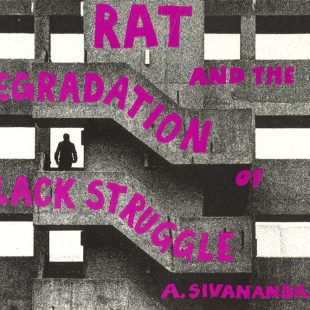
Ironically, only a few days ago I unearthed a faded photocopy of Sivanandan’s brilliant 1985 article, ‘RAT and the degradation of the black struggle’. Struggling to understand the demise of the Left today, I had gone back to reacquaint myself with its searing critique of post-modernism. In the mid-1980s I regarded it as an eye-opening seminal text. In 2022 my memory was not to be disappointed.

Lo and behold, this morning I got a message from Phil Scraton, informing me that a website had been created, containing all of Siva’s remarkable output.

HOME PAGE

ABOUT SIVA – his life’s journey

KEY SAYINGS

SIVA’S ARCHIVE

VIDEOS

A.Sivanandan  was one of the most important and influential black thinkers in the UK, changing many of the orthodoxies on ‘race’, heading the Institute of Race Relations for almost forty years, founding the journal Race & Class, and writing the award-winning novel, When Memory Dies, on his native Sri Lanka

As I opened up the website I was almost overwhelmed by the riches therein. For now, because grappling with contemporary identity politics is high on my agenda, two excerpts from the KEY SAYINGS page jumped out at me. More broadly I can only encourage you to explore, muse and act upon its contents.

Who you are is what you do

The politics of identity which led individuals to use an innate aspect (their gender, colour etc) as ipso facto a right from which to judge others, could itself become a way of setting up a hierarchy of oppressions. He opposed all forms of identity politics which did not reach out to try to transform society, for, not just the self, but for all. The transformation of the individual would take place in the process of a larger collective struggle but a politics based in the self would not open out in that way. Identity would not be confirmed in isolation. ‘Who you are is what you do’.

The personal is not political, the political is personal

In his take on the personal v. the political, Sivanandan was starting from the position that racialism, i.e. attitude or prejudice, was not what was meant by racism, which was structural, institutional and /or systemic. Whereas many people concentrated on discussing attitude, language and symbols as manifestations of racism, he felt that it was the effect, the impact of racism on people’s lives and life chances which should be the focus in a fight against racism. Attitudes and prejudices were a reflection of the way that the state had put its imprimatur on racism (especially through immigration controls, policing and the operation of the judiciary) and not vice versa. (And in the Information Society, which he located from the 1980s onwards, the role of the media and social media had become crucial in determining the narrative on race.) Techniques like awareness training which spoke to a supposed white racial unconscious bias could instil feelings of guilt rather than further a larger political struggle for justice.

End but not ending …

Siva was in poor health for some years, though still contributing remotely to the IRR and the journal. He died at his home in Hertfordshire on 3 January 2018. A celebratory memorial event was held on 23 June 2018 at Conway Hall to discuss how to take his principles on into the future. To find out more about how he impacted on a range of people – from the grassroots to the ivory tower, and across continents – look at the tributes page http://www.irr.org.uk/news/a-sivanandan-1923-2018/ and also the longer essays produced in a special issue of Race & Class to mark his  75th birthday, ‘A world to win’, (41/1and2)  July 1999.

Thinking about the Past, Present and Future of IDYW

For the sake of some sort of continuity I’m publishing here my final post from the In Defence of Youth Work website. It contains themes emanating from the authoritarian imposition of the COVID measures, which I will continue to take up in one way or another on this blog.

Below you will find the lead contribution I made to the final IDYW Steering Group meeting held on Friday, October 8th in Manchester. As it was the train of my thought was often, necessarily and fruitfully interrupted by the musings and memories of those present. These interventions made for a challenging yet always supportive critical, collective conversation. Unfortunately I can’t do justice to that process. Hence you are getting no more than my opening and closing remarks. The substance of my offering was an effort to trace major events and significant themes in the life of IDYW since 2009. These are to be found, now archived on this site.

A group discussion at our fifth national conference in Birmingham

Thinking About the Past, Present and Future of IDYW.

Opening Remarks

I’m anxious about this bit of an opening presentation, which might well seem ridiculous. I long ago gave up paid work, selling my soul to the State with all its attendant tensions. Why the disquiet!? The principal reason for my apprehension is that I’ve scoured back through all the IDYW website posts since March 2009. I stopped counting at 1500 plus. What riches, what a turmoil of contradictions, hope and despair and what a plurality of offerings. I was bemused. How could I possibly do justice to this fascinating potpourri? My confusion was not eased in finding myself listening to the videos of the first National Conference in February 2010 – Janet Batsleer welcoming us to an ‘unauthorised space’, Kev Jones introducing my rant, Tania de St Croix warning about surveillance and Bernard Davies making the youth work case. Thoughts and sentiments that would not be out of place today. In thinking about the inaugural Conference I remembered also meeting Sue Atkins on the Didsbury campus in the dark the night before. We had something to sort out. I remember not what. It might well have been 20 years since we’d last crossed paths. A tear in our eyes it was as if we’d never been apart.

So forgive me if my recollection of IDYW’s history is riddled with absences. If there isn’t a book there is certainly an MA, even, a PhD to be found in the IDYW archives. Although on second thoughts a PhD collecting dust on a shelf would hardly move us forward.

So why did IDYW emerge in late 2008 on the back of the Open Letter I penned. It ventured:

Thirty years ago Youth Work aspired to a special relationship with young people. It wanted to meet young women and men on their terms. It claimed to be ‘on their side’. Three decades later Youth Work is close to abandoning this distinctive commitment. Today it accepts the State’s terms. It sides with the State’s agenda. Perhaps we exaggerate, but a profound change has taken place.

The shift has not happened overnight. Back in the 1980’s the Thatcherite effort via the Manpower Services Commission to shift the focus of Youth Work from social education to social and life skills was resisted. In the early 90’s the attempt to impose a national curriculum on the diverse elements of the Youth Service ground to a halt. However, with the accession of New Labour, the drive to impose an instrumental framework on Youth Work gathered increased momentum. With Blair and Brown at the helm youth workers and managers have been coerced and cajoled into embracing the very antithesis of the Youth Work process: predictable and prescribed outcomes. Possessing no vision of a world beyond the present New Labour has been obsessed with the micro-management of problematic, often demonised youth. Yearning for a generation stamped with the State’s seal of approval the government has transformed Youth Work into an agency of behavioural modification. It wishes to confine to the scrapbook of history the idea that Youth Work is volatile and voluntary, creative and collective – an association and conversation without guarantees.

Of course, the idea of the Letter did not spring out of the blue. It was not at all my individual creation. The inspiration for challenging the neo-liberal consensus goes back for me to the late 1960s. I want to argue that IDYW was but a particular expression of a post-war liberal/social democratic belief that education ought to be child/young person-centred, process-led, holistic and questioning in its desire. IDYW was born too out of a frustration that this humanistic perspective had struggled to dent a behavioural tradition focused on social control and conformity. In my own experience back in the late 1970s, Roy Ratcliffe and I were disciplined for supporting the autonomous voice of an embryo Youth Council. We wrote about this setback and the lack of support from fellow professionals in a piece to be found within the Inner London Education Authority’s ‘Schooling & Culture’, entitled ‘Stuttering Steps in Political Education’. As the Youth Service Training Officer in Wigan, I fought a bitter battle with Youth Service officers and workers to rewrite a part-time youth worker training course that sought to introduce Carl Rogers to Karl Marx, to question liberal taken-for-granteds by way of socialist and feminist understandings. Over in the newly created Community and Youth Workers Union, the Women’s Caucus emerging from the social movements turned the organisation upside down, Stimulated by the sisters Roy and I (in perhaps the best thing I’ve ever done) drafted a member-led and democratic constitution which directly challenged in practice both hierarchy and bureaucracy. Yet despite the radicalisation of full-time training courses, behaviourism was reasserting itself by the late 1980s as the servant of neo-liberal ideology. Indeed some former advocates of a radical grass-roots agenda were to the fore in advocating the managerial imposition of its tenets.

To say the least, this analysis is sweeping. I’ve always tended to be that way inclined. Yet, as an example of the shift, when I went in 1990 as the Wigan Chief Youth Officer to a Confederation of Heads of Youth Services national conference with perhaps 100 managers in attendance I sat in a corner over a drink with at most half a dozen fellow travellers. The majority embraced prescribed outcomes and the accumulation of data as the only way to save the Youth Service and Youth Work.

As it is I fled the scene at the end of the 1990s because of Marilyn, my wife’s serious illness. However, I was not quite finished. With Malcolm Ball, Steve Waterhouse (tragically both no longer with us) Deb Ball, Tim Price and Steve Monaghan we formed the minuscule Critically Chatting Collective, continuing to question what was going on through a website and tiny gatherings. For example, I remember back in 2005 Bernard Davies addressing a central London meeting of no more than six people – hardly an indication of mass support for our meanderings. Be that as it may, this continuation of a critical perspective was essential to my subsequent scribbling of the Open Letter which was rejected by the National Youth Agency’s organ, ‘Young People Now’ as being too heavy for its readership. I declined the offer to rewrite.

Thus we circulated the Letter at the 2009 Youth & Policy History Conference in Durham, knowing that Y & P itself stood for an open and serious appraisal of the State’s relationship with young people. I have failed to track down the place where the signatories are housed, well over 700 as I remember. In short, the Open Letter opposed the behavioural and instrumental, the imposition of rules, norms and outcomes upon practice. As I argued, “we described a clash between the process of ‘becoming a person, individually, socially and politically aware’, which held good for ourselves and young people and neoliberalism’s desire to manufacture self-centred conformism and unquestioning obedience to the status quo amongst both ourselves and young people”.

All of which preamble leads to a specific engagement with the history of IDYW itself. As I have more than hinted there is a book to be written. I will have to content myself with a limited number of memories.

At this point in my contribution to the meeting, I began to explore all that we had done across the life of IDYW. In this context to do so here would come across as a list with little in the way of explanation and exploration. Hence, for now, I can only ask the reader to interrogate for themselves the IDYW archive. For my part I am committed monthly, if not more frequently, to post afresh gems from the archive and hope you might keep your eye on their appearance. Amongst the themes I touched upon were:

The Annual Conferences
The Regional Seminars
The range of questioning articles and books produced by IDYW activists
Our unstinting support for wider initiatives, exemplified by our involvement in Choose Youth and ‘Is the Tide Turning’
Our input into the European Youth Work debate

Concluding Remarks

Given I’m somewhat retired from the fray I don’t want to overstay my return to a discussion about IDYW’s future or indeed claim that my finger is on the pulse. My piece on ‘Resistance in a Climate of Anxiety’ conveys still much of my perspective.

Firstly, IDYW was born out of a spirit of resistance to and dissension from the mainstream behavioural narrative besetting our relations with young people.

Secondly, therefore, my question is whether IDYW remains a critical voice, given that the formalisation of the informal within Youth Work has continued apace? Or has it been slowly sanitised, swallowed up safely into the mainstream as symbolised by a Facebook page dominated by exchanges and requests far removed from the philosophy and politics of the Open Letter?

Finally, in my opinion, neither Youth Work nor IDYW itself can sidestep facing the implications for both young people and society as a whole of the consciously created COVID pandemic. As best I can see the profession meekly and unquestioningly complied with a flagrantly undemocratic, disgracefully unethical, utterly one-sided governmental response to a virus which, if placed in context, has been far from the 21st-century Great Plague predicted by that methodological absurdity, the Science, its cynical experts and obedient stenographers. We witnessed the overnight abandonment of a holistic, measured, informed Public Health Policy and the character assassination of those brave souls, who pointed this out.

In particular, youth workers and education professionals as a whole ought to examine on what unevidenced grounds they cooperated with the closing down and stifling of children and young people’s provision and ask themselves to what extent they were complicit in the transmission of the fearmongering propaganda disseminated by the behavioural psychologists and their ‘nudge, nudge’ advertising arm? For what it’s worth, even if this emergency dies down and the covid zealots retreat, I don’t think it’s possible to proceed as if not much has gone on, to accept their New Normal.

The logo of our friends at the now defunct National Coalition for Independent Action

Above all, a supposed democratic and emancipatory youth work is now put to the test in terms of its own integrity. Is it possible to abandon the pursuit of truth and critical reflection with hardly a whimper, then as the dust settles, claim to be its principled advocates? I ask this with some pessimism as more than ever in the light of the pandemic I believe that the struggle to defend and extend the power of the people against the technocratic authoritarianism of the ruling class and its supporters on both the Left and Right is now the overwhelming political struggle of our time. Indeed it is a struggle, which transcends simplistic political categories. It is a struggle, within and without youth work, which demands a renewed critical dialogue across a veritable diversity of voices. IDYW in its time sought to do so but fell short. Crucially we never developed a vibrant, living network of local and regional IDYW support groups. It falls upon a younger generation in particular to revive the spirit of its intent.

As the New Year dawns – being bullied into COVID compliance

New Year’s Day 2022 – an azure and windless sky beckons, promises and resolutions hang not yet tested in the still air. New Year’s Days I’ve had too many to mention but this one is different. It’s surreal, sinister and disconcerting.

I’m now into my 75th year on this god-forsaken earth. For more than half a century I’ve spouted forth about the evils of capitalism, even advocated revolution but my stance has not cost me dear. A tapped phone here, a night on a police station floor there, a few bruises on the picket line. Nothing to write home about. Indeed, it might well be argued that I’ve made something of a career out of being the useful ‘token ‘radical, not ‘in and against’ rather ‘in and compromised’ by the State. I’m of a post-war generation, whose lives were improved to different degrees by the struggles of our forefathers and mothers. With all its warts, and I railed against its shortcomings, the social-democratic society was a step forward. Neoliberalism has been closing down its gains for over forty years. I’ve sought to criticise this assault, arguing against the insidious influence of behaviourist psychology and worrying about the danger of us sleepwalking into an authoritarian and intolerant society. Again I have not been taken to task by the powerful for this dissension. As far as being troubled goes, it’s been wrought by my own self-doubt and anxiety. As a dear friend whispered gently, ‘being a couch revolutionary isn’t exactly uncomfortable’.

Two years ago I would have shaken my bald pate in disbelief at the predicament I face this New Year’s Day. The Greek government has determined that all the citizens and residents of the country, who are over 60 years of age will be vaccinated with the ‘booster’. Refusing to comply will lead to the following State punishments.

  • Each person resisting will be fined 100 euros each successive month until they give in. Over 25% of Greek pensioners, around 700,00 persons, receive less tha 500 Euros a month and even the average pension amounts to only 869 euros before deductions. In my case it seems that if I resist the 100 Euros will be procured for the government by my accountant.
  • Each person resisting will not possess therefore a valid vaccine passport. This means they will only be allowed access to supermarkets, grocery stores and chemists, to food and medicine. They will be barred from all public indoor spaces – tavernas, kafeneion, the beating heart of Greek life, even, I’m not sure, the Church – and public events. If this is enforced they will be excluded from the majority of what we might call civil society.

I want you to be shocked and angry in the face of such a draconian scenario, imposed by a government without an ethical leg to stand on. I worry that the propaganda machine churning out numbers, numbers, numbers will continue to cloud the issue. Mass testing alongside the emergence of a milder but more infectious variant will inevitably mean an upsurge in infections, leave aside the fact that the USA Centre for Disease Control has just disowned the PCR test, admitting its unreliability. A touch late, methinks.

In essence, the Mitsotakis government’s authoritarianism, whilst running deep in its historical blood, is inseparable from the influence of the corporate and pharmaceutical giants of our era. It is about power and profit. It is about politics. It is not about health. At this point, some readers may sigh. Am I in Covid denial? For now, I will only say that I believe that the COVID threat to society as a whole has been exaggerated enormously; that from a health point of view things could have been managed so very differently.

AgePeak Case Fatality Rate in winter 2020Case Fatality rate in June 2021
<204 in 100,0004 in 100,000
20-2914 in 100,00020 in 100,000
30-398 in 10,000 5 in 10,000 
40-492 in 1000 1 in 1000
50-598 in 10003 in 1000
60-693.3%1.4%
70-7914%3.8%
80 or above33%15%

Table 1: Proportion of people catching covid who die with it by age in England official gov.uk figures

The data presented above for June 2021 does not take into account booster vaccinations, early treatments and Omicron being less dangerous than earlier variants. These figures are calculated based on every ‘covid death’ including those where covid may well have been a bystander infection as often occurs with respiratory viruses. [Taken from ‘The Six Miracles of COVID’ Health Advice Recovery Team]

Thus, walking Glyka this morning, I felt my back was against the stone wall running down our lane, never mind that it was crumbling with the passing years. What to do? If I decline to be boosted I don’t think I am a health hazard. I don’t think I am being irresponsible. The growing evidence, given the vaccine has not lived up to the hype, is that the unvaccinated and the vaccinated are no more dangerous in terms of transmission to each other than each other. The mandatory vaccination of the over 60s here in Greece owes nothing to its democratic tradition, harking back much more to the dark days of the junta. As with all authoritarianism, it is industrial in its practice. The idea that treatment ought to be tailored to the particular history and circumstances of the individual is an anathema; that the principle of bodily autonomy, ‘our body, our choice’, is fundamental regarded as passe; that a healthy older person with no underlying comorbidities with legitimate concerns about the safety of an experimental drug has every right to demur is seen as utterly unacceptable; and as for the once cherished notion of informed consent that’s consigned to the historical bin.

Obviously, given my analysis of the situation, I should refuse the jab. Yet I prevaricate. I’m perplexed and angry. There’s nothing unique about the corner I’m in. Insofar as it’s special it’s to do with relationships, most intimately with my family. Becoming a ‘refusenik’ would curtail all sorts of simple social acts, just having a morning coffee down in the village. It would prevent me from travelling to see my children and grandchildren. Perhaps, if I was made of sterner stuff I would hold out. As things stand, in the absence of visible collective resistance, I suspect, I will shame-facedly comply. I have until the 16th of January to decide. Rather than be true to the active intent of the slogan, ‘educate, agitate, organise’ I’ll retreat passively into being agitated. I will persuade myself that I will live to fight another day. Will that be when the fourth jab is demanded? History will be the judge.

Searching for Understanding in the face of Power and Propaganda – Part Three: Doing as we are told

“There will be 500,000 deaths in the UK.”
Neil Ferguson, Imperial College. March 16, 202
0

“The perceived level of threat needs to be increased among those who are complacent. using hard-hitting emotional messaging.”
SAGE [SPI-B]. March 22, 2020

The coronavirus is the biggest threat this country has faced for decades. All over the world, we are seeing the devastating impact of this invisible killer. From this evening I must give the British people a very simple instruction – you must stay at home.”
Boris Johnson, March 23, 2020

These three utterances capture the conscious hyperbole and calculated cynicism inherent in the outpourings of both politicians and their hand-picked experts at the beginning of 2020. Despite the pronouncements of the World Health Organisation [WHO] and Patrick Vallance, the UK’s Chief Scientific Advisor [March 13, 2020], ‘a very mild illness for nearly all of us’, the die was cast. The people of the UK, man, woman and even child, were to be frightened, terrorised. That they knew little of what they should be afeard was by the by. The people were deemed too ignorant to understand. The democratic notion that they should be informed and decide upon the appropriate response, nothing but absurd. This was war and only the High Command could possibly know what was best.

“Is there any means known more effective than war, assuming you wish to alter the life of an entire people?” — minutes of the Carnegie Foundation, 1908.

As for the enemy, the virus did not play fair. It could not be bombed, or even. so it proved. vaccinated out of existence. The virus itself was irritated by the abstract name by which it was designated, COVID-19, but pleased as its offspring were graced with Greek epithets, Alpha, Beta, Delta. How long might this go on – even unto Zita? In truth, the virus doubted such a historic possibility. Its impact upon the mass of unfortunates who crossed its path was in the main little out of the ordinary – headache, cough, temperature, tiredness, lack of taste, the shivers if badly affected, hardly anything if not. Its forefathers and mothers had inflicted much the same. In truth the virus felt a mite guilty, its conscience pricked. Here, there and everywhere, in the end, COVID-19 was primarily a deathly problem for the old and/or vulnerable with underlying complications. The virus thought they were too easy a target for a pathogen, said to be an existential threat to humanity.

In Greece, where I live, as of November 1, 52 deaths were recorded in the last 24 hours, bringing the overall total of pandemic victims to 15,990. Of these, 95.4% had an underlying condition and/or were aged 70 or over. The official percentage figure is typical across Europe
.
It is time to put aside my personalization of the virus. Not least because treating the virus as a sentient being has been a staple throughout the mainstream narrative. The virus, it is said, has closed schools, youth groups and playgrounds, pubs and restaurants, parks and gyms. Indeed in its cunning, it leaves you alone when dining, mask set aside but stalks you to the toilet if you forget the face covering. For the virus is struck dumb in the face of masks, worn properly or otherwise, rendered impotent. Why this plastic face cloth should warn off the virus is irretrievably woven into the mythology of the pandemic. Evidence for its efficacy is thin on the ground – see Part Four of this rant. However the manufactured tension between the masked and the maskless, the good and the bad, the obedient and disobedient, the responsible and irresponsible has been deeply divisive. It has turned us against each other, serving to distract our attention from those who are responsible for the 18-month worth of imposed interventions into our daily existence. Divide and rule so the old saying goes. As I write the unvaccinated in Greece are being denied access indoors to kafenia and tavernas, the beating heart of community life.

All of which returns us into the arrogant hands of the medical and behavioural experts gathered together in March 2020. Pompously they ignored the fundamental premise of a holistic public health policy. This held that when faced with a specific health threat the response must, at one and the same time, deal with the particular whilst taking full account of any actions taken upon the general health of society as a whole. The consequences of this skewed strategy – the impact upon the mental health of so many people, not least children, to take but one example – was criminally ignored until the last few months. I must confess to a distaste for the crocodile tears shed lately. Anyone remotely in touch with the worlds of formal and informal education, health and social care, knew full well that lockdown would be harmful for the younger generation.

Thanks to heart.co.uk

No matter, the first national press conference set the scene, a nervous Prime Minister, deprived of buffoonery, flanked by his experts and following an ignorant, one-sided notion of the Science, warned us of catastrophe if we did not do as we were told. The assembled press concurred. These journalists, an embarrassment to their profession, the stenographers of our times, nodded and took dictation. Touching their forelock they asked the meek and mildest of questions. Criticism, even curiosity was frowned upon. The next morning the mainstream media from the Sun to the Guardian shared the shorthand and replicated in unison the government’s propaganda. Labour, desiring to prove its conservative credentials, to be tougher than tough on the virus, parroted the line.

On what you might regard as a flimsy personal aside, the order to stay at home didn’t seem quite right to me. Growing up as a child in the 1950s, Doctor Cull, the community’s and my family’s faithful GP insisted that when I had a cold I should get as much fresh air as possible. Later, in my teens, given my dad worked down the pit, I went with him several times to the Miners’ Convalescent Home in Southport. There we would push many a collier with respiratory problems along the seafront and the length of the magnificent prom. Taken away from the cramped terraced houses of their birth the bracing air was seen as vital to their recovery.

Translated as ‘Stay at home or you will end up infected’. Ta to Darren Wood from Wigan

As for the behaviourist vanguard leading the fight, knowing that the virus was nowhere near lethal for the majority, it determined that a marketing strategy was required. The plague needed to be advertised. In the absence of dead bodies on the streets, people might well not pay sufficient notice. The relentless brainwashing was set in motion. The slogans abounded, appealing to a smug sanctity.

STAY HOME, PROTECT THE NHS, SAVE LIVES
PROTECT YOUR LOVED ONES
I WASH MY HANDS TO PROTECT MY NAN
I WASH MY HANDS TO PROTECT MY FAMILY
I WEAR A FACE-COVERING TO PROTECT MY MATES
I MAKE SPACE TO PROTECT YOU

And, almost criminal in their lack of ethical concern.

IF YOU DO GO OUT YOU CAN SPREAD IT. PEOPLE WILL DIE
DON’T KILL GRANNY

CORONAVIRUS. ANYONE CAN GET IT. ANYONE CAN SPREAD IT
DON’T MEET UP WITH MATES. HANGING ABOUT IN PARKS COULD KILL

Without a doubt, these formulaic sound-bites marked young people’s cards in a time-honoured way. If they met in the park or wherever any rise in cases was down to their self-centred insubordination.

When it comes to assessing the ups and downs of the pandemic in statistical terms the mainstream media know only the language of spikes and surges. Nothing is contextualised. The Guardian, once the go-to bastion of liberal, progressive, pluralist journalism carries a daily banner indicating cases, hospitalisations and deaths. These categories are only revelatory if they are broken down. This is never the case. To do so would uncover all manner of inconsistency and distortion. Meanwhile, the Guardian eschews any idea that it should promote a critical exchange between differing analyses of the pandemic predicament. Rather it exudes sneering scorn for any departure from COVID-19 orthodoxy. It sinks to the level of the tabloids in running anecdotes, dripping with an ‘I told you so’ self-righteousness – ‘Anti-vaxxer, dies from Covid’ and ‘Anonymous, agonising parent says her child was bullied at school for having the vaccine.’ On the global scale, it ran in April with headlines such as ‘The system has collapsed’: India’s descent into Covid hell’ accompanied by stock photos of burning pyres of the dead. In fact, the images reflected only the traditional Hindu response to the end of mortality. After two days the Guardian conspicuously forgot about India. The sub-continent’s purpose was served.

The Guardian, the BBC and all profess not a word about the suppression of competing interpretations of the pandemic offered up by a diversity of alternative media sources. Evidently, anyone disputing the mainstream narrative, whatever their prestigious medical credentials or their biography of intellectual integrity is to be contemptuously dismissed as an anti-vaxxer or conspiracy theorist. It matters not that they are neither. The slander is sufficient. Depressingly, leading lights of the Left such as Owen Jones and Paul Mason define dissent as dangerous, even calling for the closing down of criticism. Meanwhile, the unelected, corporate arbiters of truth at Facebook or Google can censor any opinion at odds with the status quo without a questioning murmur. The Guardian, self-styled independent and investigative, remains silent. On April 23, 2020, OFCOM, the UK’s communications regulatory body issued the instruction that health claims contrary to the government’s policies should be perceived as harmful. The censorship is excused by the deeply contrary notion of ‘misinformation’. No such sense of contradiction can be found in the launch in the USA of Good Information Inc by ‘progressive’ billionaires Reid Hoffman, George Soros, and others. The public benefit corporation, led by former Democratic Party strategist, Tara McGowan will fund new media companies and efforts that cut through echo chambers with fact-based information. Presumably with a straight face and without a hint of doubt McGowan says that ‘the group’s goal in the next year is to raise more awareness about immediate solutions to counter disinformation before it spreads.

The behaviourists, intoxicated by their influence, are far from finished. They have hardly begun. On August 31, the Scientific Insights Group led by the influential Susan Michie published ‘Staying ‘Covid-safe’: Proposals for embedding behaviours that protect against Covid-19 transmission in the UK’. It concludes.

Embedding ‘Covid-safe’ behaviours into people’s everyday routines will require a coordinated programme to shape the financial, physical, and social infrastructure in the United Kingdom. Education, regulation, communications, and social marketing, and provision of resources will be required to ensure that all sections of society have the capability, opportunity, and motivation to enact the behaviours long term. [my emphasis]

Michie is quoted widely as stating in a June interview that face coverings and social distancing should become permanent.  Much has been made of her four decades-long membership of the British Communist Party. For those of us with a communist disposition, inspired by the young Marx, by Pannekoek, by CLR James, by Castoriadis, by Kropotkin and Bakunin, the vision’s corruption by its all-too understandable connection with the parties of that name is always frustrating. In essence, she is a ‘soft’ Stalinist, a technocrat and social engineer, utterly comfortable with knowing what is best for us. Hers is a bureaucratic collectivism. It is of significance that, starved of the elixir of militancy and clutching at straws, the Left as a whole has been seduced by her top-down version of ‘nudged’ solidarity. The orchestrated Clap For Carers, the apparent widespread adoption of masking has been interpreted as a prefigurative philanthropic expression of class struggle. I am less than convinced. For my part, I have come across, amongst others, the seriously scared, the pragmatic, ‘best comply or I’ll be fined’ and the misanthropic maskaloholics, who see the worst in all of us. Perhaps I’m not seeing the house for the bricks but I’ve not detected much political energy in the compliant. If I get to Part Five I’ll try to tangle with the crucial issues of what we might mean in this tumult by notions of solidarity and resistance.

Michie’s report follows the contemporary mantra ‘that till everyone is safe no one is safe’, which begs more than a few questions. For example, is it possible to be truly alive and fearful of existence? The goal though is to render the desired risk-free behaviour Normal, Easy, Attractive and Routine [NEAR]. There is much fashionable, shallow talk in the report of co-creation and co-production but only if you agree to the behavioural necessities in advance. In reality, the strategy will be delivered through a partnership between the state and corporations, who will deliver and monitor the desired changes in our individual and collective behaviour.

Susan Michie’s politics and ambitions are in tune with the desires of the Great Reset I touched on in Part One of these musings – the passage towards a global-led technocratic and surveillance capitalism. I have little doubt she supports the proposal that some form of global governance has to be achieved, a medium of control requiring ‘scientific’ regulation and a central role for experts. I have every expectation that she will be invited to speak about her research at the next Davos summit.

As I pen the last few words of this cry of concern about the insidious and insistent influence of behaviourism on our lives, the mainstream media continues to collude with its compulsory agenda of anxiety, After all, during the pandemic, the UK government has become its primary source of funding, hand in hand with Big Pharma sponsorship. Once more balanced reporting about the ‘experimental’ vaccines is shunned. In short the media’s unquestioning support for a vaccination programme from almost cradle to grave serves to deepen the divide between the vaccinated and unvaccinated, the latter collapsed into the reprehensible, even sinister category of ‘anti-vaxxers’. I will look more closely at the contentious medical issues raised in Part Four. For the moment the ‘othering’ of those, who for legitimate, informed and thoughtful reasons decline vaccination is deeply disturbing. The enemy is indeed within. It is one another. The SAGE group’s campaign of fear has willfully disregarded the British Psychological Society [BPS] code of ethics. In her formidable book, A State of Fear. Laura Dodsworth draws attention to Gary Sidley, a psychologist, who has challenged the BPS without success. In worrying about the tactics used by SAGE and the implications for our children and grandchildren, he says:

I don’t want to think about that really. It’s not a good place. There is something distinctive about using fear to get people to conform which is so distasteful and ethically unacceptable. Fear impacts on every aspect of our being.

In reality, behaviourism has no such qualms. It spreads its strangulating tentacles worldwide, confident in its certainty and immune to considerations of ethics or politics. It will serve authoritarianism, whatever its ideological hue. To take but the British incarnation the Behavioural Insights Team [BIT], affectionately or otherwise known as the Nudge Unit, initiated by David Cameron in 2010. According to Dodsworth, the Nudge Unit is  ‘now a profit-making social purpose limited company with offices in London, Manchester, Paris, New York, Singapore, Sydney, Wellington and Toronto.  It has run more than 750 projects and in 2019 alone worked in 31 countries.  It has conducted over 1000 workshops for governments around the world, training 20,000 civil servants in behavioural insights.’

If anything it is the debilitating influence of these pseudo-scientific experts that ought to render us fearful rather than cheerful. They are nothing but the purveyors of official propaganda, the enemies of democracy and of the open, argumentative education that creates critical citizens.

By knowing how people think we can make it easier for them to choose what is best for them their families and Society [Thaler and Sunstein [2008] ‘Nudge: Improving decisions about health, wealth, and happiness]]

.We are governed, our minds are moulded, our tastes formed, our ideas suggested, largely by men we have never heard of. This is a logical result of the way in which our democratic society is organized. Vast numbers of human beings must cooperate in this manner if they are to live together as a smoothly functioning society. …In almost every act of our daily lives, whether in the sphere of politics or business, in our social conduct or our ethical thinking, we are dominated by the relatively small number of persons…who understand the mental processes and social patterns of the masses. It is they who pull the wires which control the public mind.”

― Edward Bernays, Propaganda, 1928

A passionate riposte is demanded. Bernays’ rationalisation of the status quo refused. We will not be moulded and manipulated. We reject their assumed authority. We are not puppets, the playthings of the powerful. We will decide together in questioning dialogue with one another, what is best for us, our families and society. We commit ourselves to the struggle for an authentic democracy.

[Part Four will examine the medical evidence, whilst Part Five will explore in relation to the pandemic, the slide to authoritarianism and the shift to technocratic capitalism the questions of agency and resistance.]