Musings on the politics of youth work, community work and society at large – dedicated to the memory of Steve Waterhouse, Malcolm Ball and Sue Atkins, great youth workers, comrades and human beings
Clara Zetkin, the German delegate at the International Socialist Women’s conference in Copenhagen in 1910, was instrumental in establishing International Women’s Day. ‘The day must be international, she argued, because these sufferings are shared by all the oppressed, regardless of national borders. It is women’s day because, in her words, the inhuman burden of global capitalism weighs with especial heaviness on women.’ It may be that her political stance, her uncompromising opposition to capitalism, is perceived as outdated, even embarrassing to some of today’s sponsors of International Women’s Day.
However, as Dalia Nassar and Kristin Gjesdal argue, concerning 8 March and International Women’s Day, one of the takeaways from Clara Zetkin is that once her work is read within a broader context of women’s philosophical contribution, there is no tension between a radical fight for women’s rights and living conditions and a universalist analysis of oppression in its many shapes and forms. For Zetkin, 8 March could never be a celebration of womanhood. It was, instead, part of a sustained fight for a society under which women, of all colours and walks of life, could lead genuinely human lives. Her mission was radical; her message was universal.
One of the most important and formative moments of my political life was travelling down to London overnight to be on the Grunwick picket line – the year 1977. I did so in the company of a convoy of cars and coaches carrying trade unionists and supporters travelling to the Grunwick film processing plant in Willesden. Twenty thousand strong, we were there in solidarity with the courageous group of Asian women workers led by Jayaben Desai out on strike fighting for trade union recognition. They remain an inspiration today – an expression of Zetkin’s universal message,’ all for one, one for all’.
A couple of days ago I gave a talk initially entitled ‘Sleepwalking into Authoritarianism’ in the surreal setting of a sleepy Greek village. As is my wont I had made heavy weather of putting together the presentation. Even the day before the event the floor around my desk was laden with discarded attempts to write something worth hearing.
Amongst the many considerations influencing my weary way – I still handwrite and forever return to my varied beginnings to start afresh – were two in particular.
I felt overwhelmed with information. I didn’t view this mass of opinion as misinformed, disinformed or whatever. It was simply stuff I had to scrutinise to the best of my ability and in the full knowledge of my own ideological disposition. Somehow I had to pull something together that reflected my sense of what’s happening in society without boring folk to tears.
And the folk in question, so it proved, were a motley bunch with no shared background, expertise or experience. Even if a majority were retired immigrants from the UK, others present were younger, alongside those for whom English was a second language.
In the event, it seemed to go well. I was forgiven for my age-old habit of preparing flip chart prompts, only to overlook them completely. There was exquisitely timed melodrama. As I uttered the exclamation, ‘all hell was let loose’ a plastic chair, not for the first or last time on Crete, collapsed under poor Ralph sitting in the front row. He went down with quite a wallop, his coffee flying in all directions. As ever in such circumstances hilarity mixed with concern. However, Ralph quickly regained his composure, aided by the provision of two chairs in one. In accord with the adage, the show went on regardless. I hardly had time to take a breath.
In truth, if I dare use such an abused phrase, this lively moment was probably a blessed relief, given the doom-laden content of much of my offering. Nonetheless, a number of people responded positively to the idea of a monthly discussion group, to the opportunity of meeting regularly to converse critically about what’s going on in the world.
Thus I will write up my notes under the changed title, ‘Authoritarianism: Chains Loosened, Shackles Tightened’. and incorporate some of the telling points made in the Q&A end to the morning. Hopefully, I’ll sort this out in the next fortnight. All being well we will meet in the week beginning Sunday, March 19th. Further details will be circulated soon.
Thanks to all who came, to the committee of the Kalamitsi village for the use of the Old School and to Phil and Fran [Kalamitsi Arts Group] for the arrangements.
When I first discovered left-wing politics or more precisely Trotskyism in the early 1970s there was growing criticism that Marxism in practice prioritised class struggle above all else. The typical class militant was seen as telling women, black people, gays and lesbians that they must wait upon their demands till after the revolution. I was fortunate to join the Marxist Worker Group [MWG], a tiny organisation based in the North-West of England. Therein the question of women’s liberation was central. Within the group, we read and discussed passionately the works of Rosa Luxemburg, Clara Zeitkin and Alexandra Kollontai, along with contemporary figures such as Sheila Rowbotham, whose groundbreaking book, ‘Woman’s Consciousness, Man’s World’ was published in 1974. Over the decades I moved slowly and contrarily away from Marxism’s certitude towards Anarchism’s uncertainty. However, I will remain forever grateful to the members of MWG, such as the formidable Eileen Murphy for an argumentative, challenging beginning to my political life in which class, gender, race and sexuality were inextricably intertwined.
Thus, over the decades, I have sought to argue for this crucial intertwining in both practice and theory. In the Community and Youth Workers Union, along with Roy Ratcliffe himself a leading figure in MWG. we gained majority support in 1981 for a constitution, which placed the right to caucus at the very heart of the union’s democracy, emphasising the interrelatedness of class, gender, race and sexuality.
Ironically, given my opening remarks, as the years passed by, I found myself lamenting the disappearance of a class struggle analysis from both the professional and political spheres. For example, I wrote a piece for Youth & Policy’s History series, ‘Youth Work and Class: The Struggle that dare not Speak Its Name’, which argued at one point:
In focusing on a notion of the Class Struggle and its absence from Youth Work discourse I risk being seen as a geriatric Leftie, trying stubbornly to resurrect the discredited idea that class is primary, relegating the significance of other social relations. This is not at all my desire. My point is no more and no less than that the political struggle for equality, freedom and justice must have a rounded and interrelated sense of the relations of class, gender, race, sexuality and disability. None of them makes proper sense without reference to each other. If this inextricable knot is recognised, the silence about class within most Youth Work is deeply disturbing.
As best I can see and my glasses may need more than a cursory clean the outlook of the contemporary Left and its base in the professional classes is dominated by a version of ‘identity politics’, within which the inextricable knot is utterly undone. Identities compete rather than cooperate. Over forty years ago Heidi Hartmann worried about the unhappy marriage of Marxism and Feminism. She argued for a more progressive union. Today we witness a clash between trans and feminist politics that seems to defy any idea of reconciliation. In this context to ponder a relationship between trans and class politics seems to be off with the fairies. Whilst I am aware that trans activists have influenced the policies of trade unions, to what extent have they captured the hearts and minds of the memberships? On the ground the going might well be tough I remember the rows between women and men at one of the first 1984 national miners’ demonstrations in Mansfield. The miners were taken to task for chanting, ‘get yer tits out for the lads’. The women, the feminists didn’t write off the blokes. They argued their corner and, to use a trite phrase, good things happened. Perhaps I’m out of touch but as much as ever we need to renew a questioning yet forgiving dialogue across the identities. Such a culture of openness requires time, patience and guts. If we take courage, the rich need take care. For now, the ruling class remains delighted by our divisions, both feeding and feeding off our estrangement from one another. Certainly though, we can all, whoever we are, draw strength from the inspiring intervention in 1984/85 of the group, ‘Lesbians and Gays Support the Miners’. I can vouch for the impact of its courageous intervention upon the consciousness of both the men and women of the mining communities in Leicestershire and Derbyshire, where I was a committed activist.
Grateful thanks to Working Class History for reminding us of the following.
Yesterday, 11 February 1987, Mark Ashton, Irish communist and co-founder of Lesbians and Gays Support the Miners, died aged just 26. LGSM raised huge amounts of money for Welsh miners during the great strike of 1984-5, and both brought the ideas of the workers’ movement to the gay community and brought the idea of gay and sexual liberation to the workers’ movement.
Ashton died of complications related to AIDS, at a time when the UK government had failed to take action to combat HIV.
His friend, LGSM co-founder Mike Jackson, stated at a memorial event: “To this day, Mark’s loss remains deeply felt by so many family members and friends… Driven, principled and charismatic, Mark would have achieved so much more if he had not died so young.”
The group, and Mark, were immortalised in the fantastic 2014 film, Pride.
The armaments industry can’t believe its good fortune as its deathly goods pour into the Ukraine. To question any of this is to be derided as a Putin apologist. At the very least it’s worth reflecting on this article by Seamus Milne, which appeared in Comment is Free, well over eight years ago.
‘The reality is that after two decades of Nato expansion, this crisis was triggered by the west’s attempt to pull Ukraine decisively into its orbit … ‘ Illustration: Matt Kenyon
Milne begins:
The threat of war in Ukraine is growing. As the unelected government in Kiev declares itself unable to control the rebellion in the country’s east, John Kerry brands Russia a rogue state. The US and the European Union step up sanctions against the Kremlin, accusing it of destabilising Ukraine. The White House is reported to be set on a new cold war policy with the aim of turning Russia into a “pariah state”
He concludes:
The US and EU have already overplayed their hand in Ukraine. Neither Russia nor the western powers may want to intervene directly, and the Ukrainian prime minister’s conjuring up of a third world war presumably isn’t authorised by his Washington sponsors. But a century after 1914, the risk of unintended consequences should be obvious enough – as the threat of a return of big-power conflict grows. Pressure for a negotiated end to the crisis is essential.
In 2023 it is neither fanciful nor neurotic to fear an escalation into a nuclear conflict.
Today Milne’s analysis would not be offered the time of the day – least of all in the war-mongering Guardian.
In an era within which the powerful fall over themselves to claim that they are the victims of misinformation and disinformation it is revealing to read Phil Scraton’s eloquent and painstaking dissection of the cover-up, following the tragic 1958 Munich air crash, an event deeply embedded in sporting history. It confirms the necessity to be ever wary of the official narrative, to preserve an intuitive mistrust of the State. In addition, see the post, Perverting the course of justice: “cover-up of the cover-up of the cover-up” which contains Phil’s chapter ‘Sanitising Hillsborough’ from his acclaimed book, ‘Hillsborough: the Truth’.
Munich 6 February 1958
The remarkable sequence of events that led to the crash-landing of a highly sophisticated British Airways’ Boeing 777 at London Heathrow on 17 January 2008 was greeted with astonishment by aviation specialists. Some two miles out from its destination, 500 feet above the ground, Flight BA03Munich lost the power necessary to land normally. It happened without warning and the alarm system also failed. The pilot manually glided the plane down, dipping its nose to maximise length and lifting at the last minute to hurdle the 3 metre perimeter fence. All energy lost to the final manoeuvre, the plane literally belly-flopped from 10 feet onto grass, severing the undercarriage and ploughing a 400 foot furrow to the edge of the runway. It was highly skilled flying demanding the calmest concentration. Without doubt, both pilots and the 14 person crew saved the lives of 136 passengers. In the immediate aftermath ‘experts’ theorised the most likely cause to be a freak, localised weather glitch or pilot error. Unanimously they agreed that a system failure within the plane was highly unlikely. They were wrong.
Over the last decade we have become so accustomed to flying, reassured by statistics proclaiming an impressive safety record well ahead of road or rail travel. Planes are technologically so advanced, runways kept in excellent condition, pilots highly trained and the aviation revolution has opened access beyond all expectations. While the cost to the environment and to communities is hotly debated the advances in safety are uncontested. Fifty years ago, however, things were massively different with much of the technology experimental, knowledge limited and conditions arbitrary.
Few people flew. As a young child I remember waving off my sister from Speke Airport, now a Marriott Hotel, as she left for Lourdes. She was the sole member of our extended family to have boarded a plane. Most of the men had been to sea, docking in ports throughout the world, but none had flown. I have flown more air miles in the last eight months than in the first 35 years of my life. Living in Belfast I fly far more than I use any other form of transport. Flying has become habitual and within advanced industrial societies it embraces all classes.
Back then, football was my passion and Billy Liddell my hero. Liverpool were in the Second Division and not doing so well. Most of my mates were Blues although those kids whose families were less committed supported Wolves or Spurs or whoever else was winning.
When Dad took me to Anfield he’d buy a seat in the main stand and lift me over the turnstile. I’d sit on his knee for the game. From the Main Stand, the Kop was unbelievable to watch. In the top right corner the ‘Boys Pen’ – girls not welcome – looked frightening but exciting. Wee scallies flicked lit matches down onto cloth-capped heads below safe in the knowledge that they were untouchable in the pen.
One day both would be my graduation although I’d sometimes slip into the Paddock, close to the halfway line. If Billy and our yellow jerseyed goalie, Tommy Younger, were special, I looked to United’s Duncan Edwards as an inspiration. If he could play for England so young, so could I! We didn’t have a telly but I read the reports and out the back of our house I imagined I had all the moves – I still do. How I wished Duncan had played for us …
It was a cold evening in February 1958 when the radio broke the news that a plane carrying Manchester United’s team had crashed at Munich airport. The manager, the likeable Matt Busby, and his renowned ‘Busby Babes’, were among the dead and injured. It was devastating news especially as playing in Europe was a recent development. We were stunned and I remember going to bed that night, looking at the pictures of the team in my Football Diary and praying that the great Duncan would be alright. Soon we knew. Seven players, three United staff, seven journalists and three others had died. Duncan Edwards and Matt Busby were critically ill. Among the journalists the legendary Frank Swift, former Manchester City goalie, was gone. I’d heard stories about his incredible agility and massive hand span. Duncan passed away 15 days later, and a co- pilot also died in hospital. Nine players, including the young Bobby Charlton, survived – as did the Captain, James Thain, and eleven others. While I was oblivious to what was happening in Manchester – despite it being just ‘up’ the East Lancs I’d never been there – the tragedy left an indelible impression on my childhood.
The European Cup had been introduced only three years earlier and in the 1956-7 season United were the first English team involved. They made it to the semis and lost to the brilliant Real Madrid who went on to win the trophy. The following year, having won the First Division, the Busby Babes were favourites. They beat Dukla Prague, the Czech champions, 3-1 on aggregate and in the quarter finals returned to the Balkans to play Yugoslavia’s Crvena Zvezda, known to us as Red Star Belgrade. On 14 January United beat Red Star 2-1 at Old Trafford.
The midwinter return was in Belgrade on 5 February. The club chartered a British European Airways’ 47 seater plane for players, staff and journalists and flew via Munich for refuelling. Both pilots were experienced captains and knew each other well. They landed the plane in Belgrade in challenging weather conditions. So serious was the situation that airport control was unaware of the plane’s arrival until it appeared from the gloom taxiing across the tarmac. The match was played and despite being 3-0 up at half-time United were held 3-3, winning the tie 5-4 on aggregate. Several others joined the return flight to Manchester bringing the passenger list to 38.
Landing at Munich the runway was laden with slush. It continued to snow. Before leaving for Manchester the crew checked the wings, ensuring no ice had formed. The pilots agreed de-icing was unnecessary. As Captain Thain had flown the outbound flight his friend Captain Rayment was at the controls and they had changed seats. As the plane accelerated along the runway the pilots realised there were problems with the engines and the pressure gauges on the instrument panel. They abandoned take-off and braked heavily, skidding to a halt through the slush. Apparently the cause was ‘boost-surging’ within the engines, a problem previously experienced with this type of airplane.
Clearance was given for a second take off attempt but again, as the plane picked up speed, the pilots aborted. This time the plane returned to the parking bay for checks. Photographs show clearly that there had been a fresh fall of snow on the tarmac adding to the slush. All passengers disembarked. The pilots and the station engineer decided against retuning the engines. A third take-off attempt was agreed. The wings were considered to be ice free but the runway was holding more snow together with an uneven distribution of slush. A quick inspection by airport staff, however, gave the go-ahead.
Reluctantly the team and other passengers returned to the aircraft. To overcome the engine problem the pilot opened the throttles slowly as the plane sped down the runway. It picked up speed towards take off and the pilots successfully dealt with some engine surging. Hitting the undisturbed slush, the plane lost speed, and running out of tarmac it ploughed across snow-laden grass, smashed the perimeter fence then hitting a house, a tree and a garage. The plane caught fire in small pockets but the main fuel tank remained secure.
What followed were moments of great heroism as uninjured staff and players climbed back into the plane to rescue those trapped and injured, including Matt Busby. Already 20 people were dead. Once the rescue services arrived the fires were doused and Captain Rayment was cut free. He died later.
That evening the German accident investigators arrived. Without proper lighting, they examined the wreck concluding that the wings were iced up, covered by the subsequent fall of snow. This early determination was established as the sole cause of the disaster. BEA sent an investigation team to Munich. It found no engine deficiencies. All indications, including the opinion of the station engineer, was that slush on the runway had caused the plane’s deceleration. Captain Thain agreed.
Yet the West German Traffic and Transport Ministry announced that ‘the aircraft did not leave the ground’ probably ‘as the result of ice on the wings’. Captain Thain was criticised for not providing a satisfactory explanation as to why he did not ‘discontinue the final attempt to take off’. Thus the blame was laid entirely at the door of the pilots. A finding of snow accumulation and slush on the runway, alongside inadequate inspection would have placed responsibility on the authorities.
In April 1958, behind closed doors, a full German Inquiry was held. The German senior investigator selected witnesses and, remarkably, the airport controllers were not called to give evidence. After much controversy and contradiction by ‘experts’ regarding ice on the plane’s wings it became clear that the Inquiry judge favoured icing as the disaster’s principal cause. ‘Other circumstances’ might have contributed, but it was now too late to determine their relevance. A year and a month after the disaster the Inquiry report was released. Ice on the wings was the ‘decisive cause’ and the pilots, Rayment (dead) and Thain (alive), were held responsible.
The BEA Safety Committee, however, refuted the report’s conclusions although it accepted that icing on the wings might have been a contributory factor. Slush on the runway, however, was judged crucial. Captain Thain was criticised for not occupying the seat in the cockpit appropriate for the senior captain. A devastated Thain, under suspension and his career in ruins, was determined to clear his name. Yet a further hearing in 1960 criticised his failure to ensure that the wings were free of ice and he was sacked. He had breached regulations by occupying the wrong seat. Manchester United’s negligence case against BEA was settled out of court.
As scientific knowledge developed further, investigative trials were held. In November 1965 a second inquiry was convened in Germany to consider the new evidence. Some consideration of slush on the runway was accepted but ice on the wings ‘was still to be regarded as the essential cause’. The following April the British Ministry of Aviation retorted that the ‘strong likelihood’ was ‘there was no significant icing during take off’ and ‘the principal cause of the crash was the effect of slush on the runway’. A decade beyond the disaster a British inquiry was convened. A key witness, previously not called – an aeronautical engineer first on the scene, stated categorically that the wings were not iced. Not only had the German authorities failed to call him to their inquiries but his written statement had been altered to omit a crucial element of his testimony.
Photographic evidence, it seemed, also had been altered. In 1969 the British inquiry report concluded that slush had impeded the nose wheel of the aircraft and the subsequent drag on all wheels was the ‘prime cause’ of its failure to lift off. Once deceleration had happened there was insufficient runway to pick up speed and ‘blame for the accident is NOT to be imputed to Captain Thain’. The German authorities rejected the findings. Captain Thain died of a heart attack at the young age of 54.
Mike Kemble, whose research has been extensive, states: ‘there is no doubt … that a cover-up was engineered by the West German authorities, possibly even as high as the Federal Government in Bonn. There was never going to be any doubt about the outcome from the first inspection of the crash site to the publication of the report’. He raises ten important unanswered questions regarding the disaster and its aftermath. His detailed research has drawn on many other sources including Captain Rayment’s son, Steve.
Reading Mike’s work and a range of other material for this overview has answered many of the questions and concerns that troubled me in the late 1960s. I have always been uneasy that Munich was considered an ‘accident’ due mainly to pilot error. My analyses of disasters over the last 20 years have shown a clear and unambiguous reluctance of authorities to accept responsibility for their culpable acts or omissions, for their institutionalised negligent custom and practice. It suits those in power, whether public bodies or private corporations, to lay blame with individuals at the coal face rather than look to their institutionalised failings.
What is clear from the above is the depth of injustice endured by the bereaved and survivors of Munich, not least Captains Thain and Rayment and their families who fought for so long to clear their names. The parallels with Hillsborough are clear, right down to the failure to call witnesses and the review and alteration of statements. It is my view, and one I hope that is shared by all who read this, that our commitment to Justice for the 96 should bring compassion for all who died and suffered in the cold of Munich 1958. Our common purpose should unite us. Life and justice is all – and football is but our shared passion. That passion, however, should never spill over into hatred, the vilification of the dead or exacerbating the suffering of the bereaved and survivors. As I write this my tears are in sadness for those lost and injured and for those whose lives were cut short by their pain. They are tears also in anger towards those from both cities who have dared taint the memory of the dead and desecrate the experiences of the bereaved and survivors.
Some of the Busby Babes
Justice for Munich – Justice for Hillsborough Remembering those who died
Players
Geoff Bent Roger Byrne (Capt) Eddie Coleman Duncan Edwards Mark Jones David Pegg Tommy Taylor Liam Whelan
Non Players
Tom Cable (Club Steward) Walter Crickmer (Club Secretary) Tom Curry (Club Trainer) Alf Clarke (Manchester Evening Chronicle) Don Davies (Manchester Guardian) George Follows (Daily Herald) Tom Jackson (Manchester Evening News) Archie Ledbrooke (Daily Mirror) Bela Miklos (Travel Agent) Capt Ken Rayment (Pilot) Henry Rose (Daily Express) Willie Satinoff (Fan) Eric Thompson (Daily Mail) Frank Swift( News of the World) Bert Whalley (Club Coach)
Professor Phil Scraton is Professor of Criminology at the Institute of Criminology and Criminal Justice, School of Law, Queen’s University, Belfast. He is the author of two acclaimed works on the Hillsborough Disaster: “No Last Rights: The Denial of Justice and the Promotion of Myth in the Aftermath of the Hillsborough Disaster”and “Hillsborough: The Truth”.
I’ve copied this from the In Defence of Youth Work website, which I still maintain. It may be of interest to some.
Months ago I promised that I would begin retrieving posts from what we dubbed the IDYW archive. It is belated but hopefully, this is a start.
The challenging piece, ‘The Great Youth Work Heist’ appeared on the IDYW website in January 2010. I had come across the author Lenny Sellars on a youth work forum hosted to its credit at that time by the magazine, ‘Children and Young People Now’, a commitment to debate long past. However, I knew Lenny only by his pseudonym, ‘God’s Lonely Youth Worker’. We bumped into one another in the bar at the November 2009 Federation of Detached Youth Work conference held in a miserably wet Wigan. My recollection is that we were a mite uncertain about one another, our opening exchanges somewhat stilted. We did discover though a common bond from outside youth work, namely the pits, appropriate seeing we were sat at the centre of the once vital Lancashire coalfield. We were both from mining families. Lenny had worked down the pit and out of it during the historic NUM Strike of 1984/85. My dad was the last Taylor to go underground but I had been a committed activist in Leicestershire and Derbyshire during the dispute. Stories swapped we warmed to one another.
Lenny became very involved for some years in the IDYW Campaign. For example, he led a discussion on ‘Where Are We Up To?’ and ‘Where Are We Going?’ at a December 2012 Seminar in Manchester. I reported.
The opening contribution to the first session around the Campaign’s sense of identity and purpose was led by the self-styled ‘raggedy-arsed’ Lenny Sellars from Grimethorpe, home of arguably the greatest colliery brass band formed in the revolutionary year of 1917. His forthright challenge might be summed up as follows:
Has our commitment to defending democratic youth work been compromised by our involvement in the wider campaign to defend jobs and services in their increasing plurality?
Are the omens for the development of IDYW good or bad?
With the demise of New Labour, our initial foe, who or what is today’s nemesis?
Is IDYW failing to widen its support because it is viewed as too political and/or too intellectual?
Lenny kept true to this line of questioning and in the end felt that IDYW had lost its way. We parted company on the best of terms. We were poorer for his absence from our ranks.
The following has lost none of its necessary provocations.
So… I attended the Federation for Detached Youth Work Conference at Wigan in November last year and I must declare that I became increasingly charged throughout the weekend with a delightful positivity and felt an unusual level of intense inspiration from the radiant enthusiasm and passion of the guest speakers and other attendees. And then Tom Wylie spoke. He charged youth work purists with being hopeless romantics and scoffed at the thought that there was any value in the convivial relationship between youth worker and young person. My positivity plummeted and my hope wilted with every word that fell from his lips. There seemed to be a cruel irony in that a conference with the theme “Positive About The Street” should end with such a negative tone. Nonetheless, I took a lot from the conference and have managed to recoup some positivity by exorcising all those nagging despondencies by writing them down on a sheet of paper (or three) and sharing them with some poor recipient who probably doesn’t deserve the burden. It’s a lengthy diatribe and the first page of overcast reflection was written about 6 months ago so I’m actually recycling despair.
There’s an enthusiastic buzz in the conference rooms about a new youth initiative. It sits well on the handouts and the power-point presentation is dynamic. The power suits love it. They are impressed. Eagerly they display their new buzz-words and acronyms like kids display the labels on their designer clothes. I look forward to the meeting in 2 months’ time when we hear the feedback that despite the fact that they displayed the posters, posted the leaflets, spent £200 on a buffet, £80 on renting a room and £100 on hiring a scratch DJ… no one turned up. I could tell them now but that would seem arrogant, negative and curmudgeonly.
So I’m looking up at the mountain. The lofty peaks of middle-class strategy; the precarious ridges of output driven work; the sheer-face obstacles of tedious bureaucracy; the harsh climate of prescribed funding…. and I think, why can’t someone just give me the money and the resources to continue delivering the effective, front-line, needs-led work that I’ve been practising for the last 17 years?
Does it sound treacherous to declare my contempt for the Every Child Matters agenda and everything it stands for? I have to be careful about this. I feel as though I’m offending the deeply religious principle of some deeply religious disciples.
Something’s got to give. I’ve been at odds with the system for the past 15 years. In fact, we now seem to be walking in opposite directions. I’ve tried to push against it but it’s too big. I’ve even tried to ignore it but it owns the tools that I need to do my work. The system also seems to have become much more aggressive over the years. It wears an imperious sneer as it keeps wasting vast amounts of money on initiatives that defy logic and this is where I am defeated because I have one of those heads that refuses to engage with the illogical. So it isn’t that I won’t play it’s more that I can’t play.
It’s a pretty simple diagram. The more you get involved with the strategic levels the further away you move from the reality of your purpose. The closer to front-line delivery you work, the more ridiculous the strategic aims look.
What is the way forward? Well, having travelled this path of disenchantment for about 10 years I have something of a vague bearing.
And so, to the notion of creating a parallel youth service which engages with real young people with real issues leaving the more functional kids to the existing youth service. They can wallow in accreditations and create school councils for every day of the week. I wish.
I know in my heart that the proposed services will fail to have a sufficient impact on the young people who need the most support. But this is irrelevant to the bureaucrat. As long as services can feed the bureaucratic machinery with the right buzzwords and numbers that “add up” then the machinery will run smoothly. The machinery is concerned with breadth and not depth and it has no empathy with the disaffected and no sympathy with the front-line worker.
For nigh on seventeen years I was being educated – one way or another. Thence, in one way and another, for half a century I have been seen as an educator – a teacher, lecturer and youth worker, amongst other roles. Thus, it was to my acute embarrassment that I tripped over by accident, the existence of Francisco Ferrer. I had neither heard of him nor his notion of the Modern School. Such ignorance!
On the 10th of January 1859, Catalan educator and anarchist, Francesco Ferrer i Guàrdia was born. He is best known for his development of the idea of the Modern School: radical, secular education particularly for working-class children, which remains influential around the world today.
Born the 13th of 14 children, Ferrer’s formal education ended at the age of 13 when he began work, later working on the railways before becoming a Spanish teacher in France. At the age of 24 Ferrer became a Freemason, at a time when Masonic lodges were important organising spaces for secular radicals and anarchists.
In 1901 a wealthy student of Ferrer died and left him a property in Paris in her will, which Ferrer was able to sell to set up his first Modern School in Barcelona. The school opened in September 1901 with 18 boys and 12 girls, and Ferrer set about propagating its methodology elsewhere.
In 1909, a strike broke out in Barcelona in protest at the Spanish government sending poor and working-class conscript soldiers to suppress an uprising against Spanish colonialism in Morocco. The events culminated in the Tragic Week, when civil guards violently crushed the strike. A major force behind the stoppage was the revolutionary group Solidaridad Obrera (Workers’ Solidarity), which Ferrer had covertly funded. Despite Ferrer having minimal input into the strike itself, he was accused by the state of masterminding it, and was quickly sentenced to death by a kangaroo court and executed.
The above Ferrer Reader, edited by Mark Bray and Robert H. Haworth, looks to be a fascinating insight into his life and work and can be found at https://shop.workingclasshistory.com/…/anarchist.. I’m duty-bound to repair my ignorance and report back sometime in the future.
On October 13, 1909, Francisco Ferrer, the notorious Catalan anarchist educator and founder of the Modern School, was executed by firing squad. The Spanish government accused him of masterminding the Tragic Week rebellion, while the transnational movement that emerged in his defence argued that he was simply the founder of the groundbreaking Modern School of Barcelona. Was Ferrer a ferocious revolutionary, an ardently nonviolent pedagogue, or something else entirely?
Anarchist Education and the Modern School is the first historical reader to gather together Ferrer’s writings on rationalist education, revolutionary violence, and the general strike (most translated into English for the first time) and put them into conversation with the letters, speeches, and articles of his comrades, collaborators, and critics to show that the truth about the founder of the Modern School was far more complex than most of his friends or enemies realized. Francisco Ferrer navigated a tempestuous world of anarchist assassins, radical republican conspirators, anticlerical rioters, and freethinking educators to establish the legendary Escuela Moderna and the Modern School movement that his martyrdom propelled around the globe.
Reviews
“A thorough and balanced collection of the writings of the doyen of myriad horizontal educational projects in Spain and more still across the world. Equally welcome are the well-researched introduction and the afterword that underline both the multiplicity of anarchist perspectives on education and social transformation and the complexity of Ferrer’s thinking.” —Chris Ealham, author of Living Anarchism: Jose Peirats and the Spanish Anarcho-Syndicalist Movement
“This volume brings together for the first time a comprehensive collection of Ferrer’s own writings, documenting the daily life and aims of the Escuela Moderna, alongside reflections, often critical, by contemporary anarchists and other radical thinkers. Together with the editors’ thoughtful Introduction, the result is a fascinating collection—essential reading for anyone keen to go beyond the image of Ferrer the martyr of libertarian education and to understand the perennial moral and political questions at the heart of any project of education for freedom.” —Judith Suissa, author of Anarchism and Education: A Philosophical Perspective
The ruling class, the elite, the powerful [call them, what you will] wish to render us perpetually anxious. In the last few years energised by the ‘pandemic’, their propaganda has sought to leave us in a suspended state of fear. The next existential crisis, the latest emergency is always imminent, staring us in our oft-masked faces or lying suspiciously in wait just around the next corner. We are witnessing disaster capitalism in full flight from the consequence of its wilful, almost mindless exploitation of humanity and the earth.
Aided by their behavioural lackeys and the supine mainstream media, they use the time-honoured and still profoundly effective tactic of ‘divide and rule’. To this end, politicians, bureaucrats, psychologists and journalists [or rather stenographers] lie and deceive. In particular the unvaccinated were identified, chastised and depicted as a death-inducing threat to young and old, whilst children were told they could kill their grandparents. Medical practitioners, great and small, questioning the absurdity of governments’ claim to be following the Science had their reputations and prospects trashed.
As for ourselves how do we explain our embrace of or our resistance to this calculated conspiracy of contempt? On what I suppose is my side of the fence many took to Mattias Desmet’s theory of mass formation psychosis, in which a majority of society is said to have been captured and mesmerised by the dominant narrative. I am not so taken. Such a generalised view of human practice offends my decades-long, faltering attempt to comprehend the unique, yet always social individual. For my part I prefer to call on the idea of ‘uneven consciousness’ to express the differing degrees of consistency and contradiction in our thought and practice. I am loathe to accept that people are hypnotised into compliance with authoritarianism. I am loathe to see those, who have disobeyed the orders from above, as enlightenment incarnate. In the main, we are neither sinners nor saints.
Tellingly none of the draconian restrictions upon our existence suffered during the ‘pandemic’ were even subject to the illusions of representative democracy. Parliaments were utterly ignored. The demos was conspicuous by its absence. For now, the constraints have been largely lifted but continue to be available as the powerful see fit.
It seems to me, to borrow Malcolm Ball’s favourite opening caveat, that the dehumanising grip of technocratic authoritarianism can only be loosened by the emergence of diverse forms of direct democracy at local regional, national and international levels. To imagine such a revolutionary development demands humility on all fronts. It will demand being in critical dialogue across ideologies and faiths, which have seen themselves as in opposition to one another. It will require listening to one another, setting aside prejudices, refusing to jump to immediate judgements. It will necessitate cooperating in the service of a shared sense of purpose despite significant disagreements. For what it’s worth, back in the 1980s I was mortified by the refusal of feminists, whom I knew well, to support the 84/85 Strike on the grounds of the miners’ sexism. Yet, across ensuing years we worked together across a range of political issues. Today, given the emphasis on identity politics. is it possible to envisage relating to someone, who joins the public service picket lines, is involved in ‘Kick Racism Out ‘ yet continues to believe that biological sex matters? Is this person to be excluded from the oppositional alliances we need to create? We need beware the imposition within our own ranks of correct lines, which cannot be criticised, lest excommunication follows.
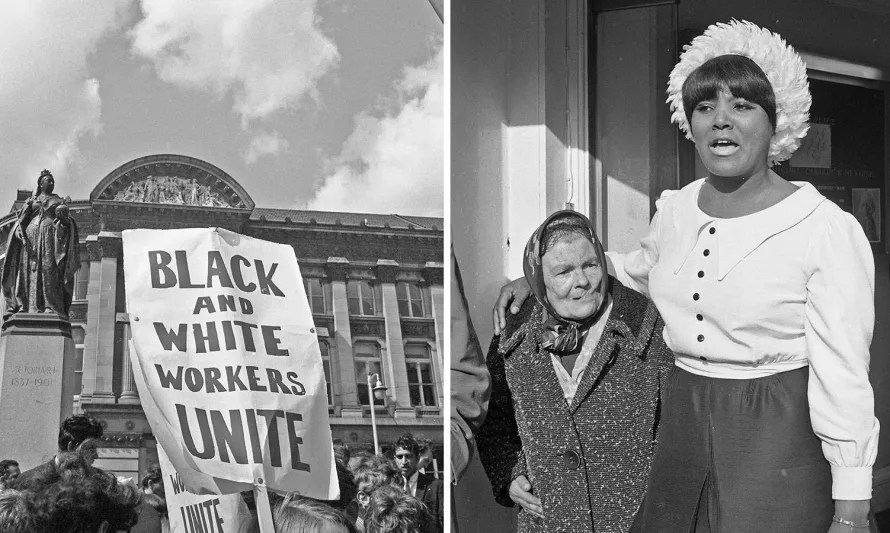
Images from the 1970s in Birmingham, I think – trying to find out more. Ta to the flatpackfestival.org.uk
Who you are is what you do
The politics of identity which led individuals to use an innate aspect (their gender, colour etc) as ipso facto a right from which to judge others, could itself become a way of setting up a hierarchy of oppressions. Siva criticised all forms of identity politics which did not reach out to try to transform society, for, not just the self, but for all. The transformation of the individual would take place in the process of a larger collective struggle but a politics based in the self would not open out in that way. Identity would not be confirmed in isolation. ‘Who you are is what you do’ [A. Sivanandan writing in the 1980s]
To paraphrase something I wrote long before I came across the idea of intersectionality. ‘My point is no more and no less than that the political struggle for individual and social autonomy, against technocratic authoritarian capitalism, must have a rounded and interrelated understanding of the oppressive and exploitative relations of class, gender, race, sexuality, disability and faith. None of them makes emancipatory sense without constant reference to each other’.
Time to take a breath I set off scribbling without knowing where I was going. Obviously, this erratic ensemble of assertions begs more questions than it answers. If only for my own sanity I’ll pursue these in future posts in 2023. We will see.
A Day in the Life of…….
One of Marilyn’s latest paintings, ‘A Village at Dusk’
Of course these perhaps pretentious and pompous pronouncements are the backdrop to ordinary folk getting on with their ordinary, sometimes weary, sometimes invigorating lives. On the ground, my somewhat pessimistic outlook is countered by people simply getting on with things. As for ourselves on the morning of New Year’s Eve, I walked our Glyka, disobeying my music teacher’s instructions not to warble a particular song because in doing so I compounded my mistaken entry – the piece being John Ireland’s setting of ‘Sally Gardens’. If this sounds stuffy I also tried ‘Georgia on my mind’.
After carefully cooked bowls of porridge dripping with honey poured over our very own oranges, managed expertly with cats on her knee, Marilyn fled the house, cash in hand, eager to exchange greetings in our local shops, where everyone knows everyone. Essentials purchased, word had it that some new horses and donkeys had appeared in a nearby village so Marilyn went off in search. To her joy she found them. To her frustration she couldn’t get near enough to inhale their seductive smell. Next time?
In the afternoon we joined hands, electric saw and axe at the ready, in cutting and chopping wood for our two stoves, our primary source of heating – a fall from environmental grace to be rectified, cost allowing, who knows when? After which Marilyn started a new water-colour and I amused as ever the blokes seated outside the village kafeneio by my ageing effort to race walk. To be fair their generous shouts of ‘Bravo’ spurred me on. As dusk fell I accompanied a sciatica-stricken friend’s dogs, Filos and Toula on their evening traipse. I’ve grown to love dogs and there’s something about the three of us having a roadside piss together that cheers me up no end.
Back home preparations for the evening were in full swing. As is only proper Marilyn was making a Hot-Pot with a suet crust, decorated with homemade red cabbage. It was beltin’. There being no real ale available it was washed down with a mix of sparkling plonk and the local village red. Thus fortified we watched an old black and white Agatha Christie film with Charles Laughton and Marlene Dietrich, compellingly all dialogue and no action. Not a car chase in sight. Fortunately, perchance the alcohol, we’d both forgotten the last-minute twist in the courtroom drama wherein Marlene executes her faithless lover. He had it coming. Thence to the highlight of any New Year’s Eve, at least in Germany, the comedy sketch, ‘Dinner for One’, featuring the wonderful Freddie Frinton as the drunken butler, a role he had honed on stage in Britain’s music halls. Evidently, first shown in 1962 on German television, it has acquired cult status in the country.
By this time midnight was still two hours away and the writing was on the wall. Not for the first time, we wouldn’t be welcoming in the New Year. After all nobody was likely to turn up as the first foot through the door with a piece of coal in hand. Hence Marilyn, head buried in her latest book, was in bed by 10ish with a cup of hot chocolate and the ever-faithful, Glyka. She was fast asleep by 11. Basking in the glow of the dying embers I watched a bit of football before putting on some soothing Satie. I was so soothed I fell asleep and wasn’t disturbed even by the rattle of gunfire and blast of explosions echoing across our valley. I crept to bed in the New Year to dream of revolution and the overthrow of capitalism. It’s getting to be something of a tradition.
Time’s running out for me but the fight continues on the streets of Iran, in the fields of Holland and India, on picket lines across the globe and in a plethora of places out of sight, out of mind as far as our ‘betters and experts’ are concerned.
Here’s to a New Year, in which we stop bickering amongst ourselves and renew our shared sense of solidarity in the face of a would-be tyranny, within which our existence will be increasingly policed ‘for our own good’.
One of the joys, amidst the stifling years of the ‘pandemic’, has been discovering stimulating voices, which I’d never have come across in the ordinary course of events. Prominent among these is that of the gay, pagan Marxist, Rhyd Wildermuth, who writes at From the Forests of Arduinna. I’d recommend the blog’s catholic content and dissenting discourse to anyone with an open mind. By chance, Rhyd has just posted a piece from 2019, The Chthonic King of Christmas, which begins with an anecdote about the Dublin tradition of getting ‘piss-drunk’ on Christmas Eve – news to me. at least! It’s the opening to a fascinating reflection on gods before Gods and in particular Saturn. The following is an excerpt, which might whet your appetite.
Saturn has a spectral quality in magical discourse, a haunting truth one cannot ever outrun, so it’s no wonder that Saturnalia itself long haunted European Christianity as just such a spectre. The Church’s war against its continued celebrations was long fought and never fully won. As Rome did for gods, the Christians eventually let in the parts of Saturn’s celebrations that they could not fully eradicate. A truce, as it were: the candles could continue, and also the gift-giving, and in some places even the most curious and dangerous of Saturnalia’s rites.
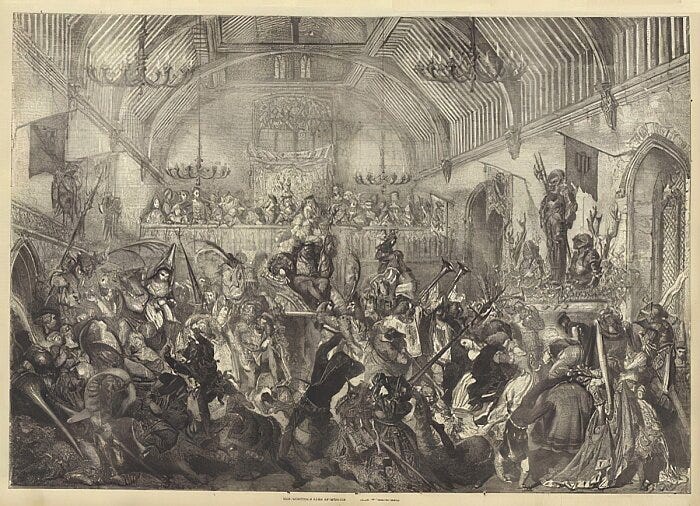
“The Christmas Lord of Misrule,” by Gustave Dore
There’s something I should now make very clear about Saturn, a thing I’ve saved until now. But rather than tell you directly, I’ll let a 2nd-century Roman historian do it:
“The first inhabitants of Italy were the Aborigines, whose king Saturnus is said to have been a man of such extraordinary justice that no one was a slave in his reign, or had any private property, but all things were common to all and undivided as one estate for the use of everyone. In memory of this way of life, it has been ordered that at Saturnalia slaves should everywhere sit down with their masters, the rank of all being made equal.”
The historian Justinius, then, ascribed Saturn to an indigenous people who lived in conditions we could quite easily call autonomous communism. No private property, no rank, no division of class, and no restricted access to the land and its wealth. Other Roman writers claimed Saturn the ruler of the “Golden Age,” a time before recorded history during which the land always provided food for people, labour was unnecessary, and humans were closer to the gods. Depicted sometimes with a scythe in hand, Saturn was the bringer of abundance from the land, sometimes named the father of agriculture (though more likely that of horticulture, rather than mass-scale farming). And most of all, he was the god of a time before slaves and masters, a propertied class and the landless, king of a time before kings themselves.
As such we can guess why Saturnalia’s most fascinating tradition was the most dangerous to the later Christians.
‘Saturnalia’ by Ernesto Bioni
It was not only customary during the Roman rites of Saturnalia for slaves to be treated as equals, but also often enough for lords and masters to become temporarily their servants. During Saturnalia, slaves ate at the tables of their masters (and were often served by them), and were given the right to wear clothing only the free-born and patricians could wear, thus annihilating the public distinction between the two classes.
We see this part of Saturnalia continued throughout Christianized Europe in a raucous aspect of Christmas that involved the selection of a “Lord of Misrule” or a “child bishop.” During these rituals, a peasant was named king—or in France and Germany a child named bishop—and given powers to overturn the normal order of things. These “world turned upside down” celebrations involved profane marriages between donkeys and priests, crossdressing, mischievous social disorder, carnivalistic riots, and the pillaging of the food stores of nobles and lords.
Closer to the present, these celebrations continued into Britain and Ireland for much longer than the Church or ruling classes were ever comfortable with. A particular ritual was greatly distressing to the powerful: carolling. As with modern carolling, groups of people would wander the streets singing songs. But the similarities end there: rather than singing hackneyed versions of “Oh Silent Night” in gaudy sweaters, carolers would chant bawdy, profane, and rather raucous songs at the doors of nobles who in return were expected to give the rioters at their gates cakes and brandy. Failure to do so meant the carolers had the “right” to break into the manses and take what they wanted.
This part of Saturnalia continued even into the 19th century in the United States, so much so that laws were passed in New England against carolling and being publicly drunk on Christmas Eve, laws which the Church in Europe had never fully succeeded in enforcing. By this time, however, the new order of capitalism had taken enough hold that the Calvinist-Bourgeois values of commerce, the nuclear family, and the sanctity of individual wealth were able to supplant survivals of Saturnalian revelry in most places.
One thing that’s always interested me about this transition is a particular story we all know too well, but whose meaning we tend to forget, that of Charles Dickens’ “A Christmas Carol.” As we moderns have lost the original meaning of carolling, the story seems merely a morality play, an admonition that greed will leave you lonely. But remembering that carolling was a continuation of the rites of Saturnalia, Dickens’ point becomes clearer. Scrooge was an industrialist, part of the new bourgeois order of capitalists who, as Marx noted, had freed themselves from the aristocratic code of noblesse oblige. Re-distributing wealth to the riotous poor during Christmas was an unwritten part of that code in England and elsewhere, but Scrooge and the rest of the new capitalist class refused to recognize their duty.
Rhyd ends the piece, Happy Yule. Merry Christmas. Good Solstice to you. And most of all, Io Saturnalia!
To which I can only add the words of the great Irish comedian Dave Allen, ‘May your God go with you’
Ironically, only a few days ago I unearthed a faded photocopy of Sivanandan’s brilliant 1985 article, ‘RAT and the degradation of the black struggle’. Struggling to understand the demise of the Left today, I had gone back to reacquaint myself with its searing critique of post-modernism. In the mid-1980s I regarded it as an eye-opening seminal text. In 2022 my memory was not to be disappointed.
Lo and behold, this morning I got a message from Phil Scraton, informing me that a website had been created, containing all of Siva’s remarkable output.
A.Sivanandan was one of the most important and influential black thinkers in the UK, changing many of the orthodoxies on ‘race’, heading the Institute of Race Relations for almost forty years, founding the journal Race & Class, and writing the award-winning novel, When Memory Dies, on his native Sri Lanka
As I opened up the website I was almost overwhelmed by the riches therein. For now, because grappling with contemporary identity politics is high on my agenda, two excerpts from the KEY SAYINGS page jumped out at me. More broadly I can only encourage you to explore, muse and act upon its contents.
Who you are is what you do
The politics of identity which led individuals to use an innate aspect (their gender, colour etc) as ipso facto a right from which to judge others, could itself become a way of setting up a hierarchy of oppressions. He opposed all forms of identity politics which did not reach out to try to transform society, for, not just the self, but for all. The transformation of the individual would take place in the process of a larger collective struggle but a politics based in the self would not open out in that way. Identity would not be confirmed in isolation. ‘Who you are is what you do’.
The personal is not political, the political is personal
In his take on the personal v. the political, Sivanandan was starting from the position that racialism, i.e. attitude or prejudice, was not what was meant by racism, which was structural, institutional and /or systemic. Whereas many people concentrated on discussing attitude, language and symbols as manifestations of racism, he felt that it was the effect, the impact of racism on people’s lives and life chances which should be the focus in a fight against racism. Attitudes and prejudices were a reflection of the way that the state had put its imprimatur on racism (especially through immigration controls, policing and the operation of the judiciary) and not vice versa. (And in the Information Society, which he located from the 1980s onwards, the role of the media and social media had become crucial in determining the narrative on race.) Techniques like awareness training which spoke to a supposed white racial unconscious bias could instil feelings of guilt rather than further a larger political struggle for justice.
End but not ending …
Siva was in poor health for some years, though still contributing remotely to the IRR and the journal. He died at his home in Hertfordshire on 3 January 2018. A celebratory memorial event was held on 23 June 2018 at Conway Hall to discuss how to take his principles on into the future. To find out more about how he impacted on a range of people – from the grassroots to the ivory tower, and across continents – look at the tributes page http://www.irr.org.uk/news/a-sivanandan-1923-2018/ and also the longer essays produced in a special issue of Race & Class to mark his 75th birthday, ‘A world to win’, (41/1and2) July 1999.












 CHATTING CRITICALLY