
Another Year of Increasing Authoritarianism begins. As Time Goes By. What to say?

As Time Goes By – a song to be added to my repertoire. Time slips by so quickly too. I’m conscious of losing touch with friends and comrades. Not only physically, inevitable though it is, given my presence on Crete but also via all the other means of communication [for better or worse] available to us. I’m conscious of finding it evermore difficult to write anything worthwhile or indeed to write in the absence of a culture of give and take, in a vacuum wherein speculative thoughts are treated as one’s final indelible word; within which forgiveness is forbidden.

However I am reading voraciously – as usual, to my detriment and to the disbelief of Marilyn, not fiction but article after limitless article of all manner of ideological persuasion. It might well be suggested that this promiscuity is at the heart of my political impotence, my failure to articulate much about anything. I don’t think so. It’s hardly insightful but we live in an increasingly explicit authoritarian world, where the compulsion to censor any expression of opposition to the imposition of varied forms of ideological certitude is rampant. Perchance I exaggerate. Yet, in my lifetime. I do not feel I have experienced such a level of intolerance to dissent or disagreement. And this hostility to heresy infects both the Left and Right with honorable exceptions on both sides of this increasingly redundant binary.

There are contemporary issues I ought to address, simply to share and check out my thinking, whatever its insights, whatever its flaws. I feel anxious, not such a parlous state, given the unbearable fear running through the lives of the people of Palestine, Iran and many places beyond. And, to be contrary, I would be granted permission by the Left to voice my solidarity in this regard, especially as my own political history of support, for example, for the Palestine Liberation Organisation [PLO] goes back to the 1970s. Yet, on other matters, I am advised to be silent. To voice any concern about transgender ideology or the climate change agenda is evidently beyond the pale. To do so is to ask for trouble, to risk excommunication from the ranks of the political righteous. In this instance my past political activism in support of the Gay and Lesbian Movement or my scathing critique of the capitalist imperative, ‘perpetual production, ceaseless consumption’ is irrelevant, not worth a sideways glance.

I am likely to be found guilty by association. After all, isn’t the Trump regime hostile to trans women and men, not to mention enthusiastic about fossil fuels?  Case closed, contradictions seemingly not allowed as evidence. Utterances are never placed in context, grounded in the circumstances of their uttering. Biographies, histories are not a source of memories to be both treasured and measured, respected and scrutinised for their past, present and future significance or otherwise. They are to be interrogated for unpardonable sins as defined by today’s Thought Police.  

Musing about all of this messy reality is accompanied by a feeling of oft-times hopelessness, which never quite admits defeat. I will continue, even if I fail to say anything useful myself, to point people to commentators I find stimulating from across the ideological spectrum. More than ever I endeavour to read and hear what is actually being said rather than assume to know what is being said on the basis of knee-jerk prejudice, bias and stereotype. I start from the content, not the source.  I favour not just freedom of speech but what the Athenians called parrhesia, frank and fearless speech. Foucault revived the concept in his later work – https://foucault.info/parrhesia/

To begin with, what is the general meaning of the word ” parrhesia”? Etymologically, “parrhesiazesthai” means ” to say everything –from ” pan” πάυ and ” rhema” [δήμα] (that which is said). The one who uses parrhesia, the parrhesiastes, is someone who says everything he has in mind : he does not hide anything, but opens his heart and mind completely to other people through his discourse. In parrhesia, the speaker is supposed to give a complete and exact account of what he has in mind so that the audience is able to comprehend exactly what the speaker thinks. The word ” parrhesia” then, refers to a type of relationship between the speaker and what he says. For in parrhesia, the speaker makes it manifestly clear and obvious that what he says is his own opinion. And he does this by avoiding any kind of rhetorical form which would veil what he thinks. Instead, the parrhesiastes uses the most direct words and forms of expression he can find. Whereas rhetoric provides the speaker with technical devices to help him prevail upon the minds of his audience (regardless of the rhetorician’s own opinion concerning what he says), in parrhesia, the parrhesiastes acts on other people’s mind by showing them as directly as possible what he actually believes.

Whether any of this comes to pass, hardly matters, and depends on 2026 being less turbulent personally than this past year. For the first time in my life I’ve been dogged by a variety of health problems, culminating in being rushed into hospital for fear of a stroke. Thankfully a series of scans and tests revealed no visible problems, apart from hinting that I am possessed by a hidden, troubled mind! Given my age, continuing problems with my sight and what Les Dawson with a knowing glance downwards to the prostate would dub a ‘man’s problem’ are hardly unique.

It’s tempting to seek refuge in my beautiful surroundings, walking and cycling as best I can. Sadly I am no longer accompanied on my rambles by dearest, sweetest Glyka, our 17 year old dog and loving companion , who died before Christmas. I was distraught as was Marilyn.  Over the years Glyka taught me to appreciate herself, her fellow creatures and indeed Nature itself. She taught me to take my time and take in my surroundings; to acknowledge the cats, which she never chased, the dogs, towards whom she was a bit stand-offish, to chat to the sheep and goats, who sometimes replied imploringly, to be quiet so as to catch the birdsong and to gaze across the olive groves to the splendour of the towering White Mountains. As for herself she watched and listened, ever by my side, but never barked. We were free spirits or so we believed.
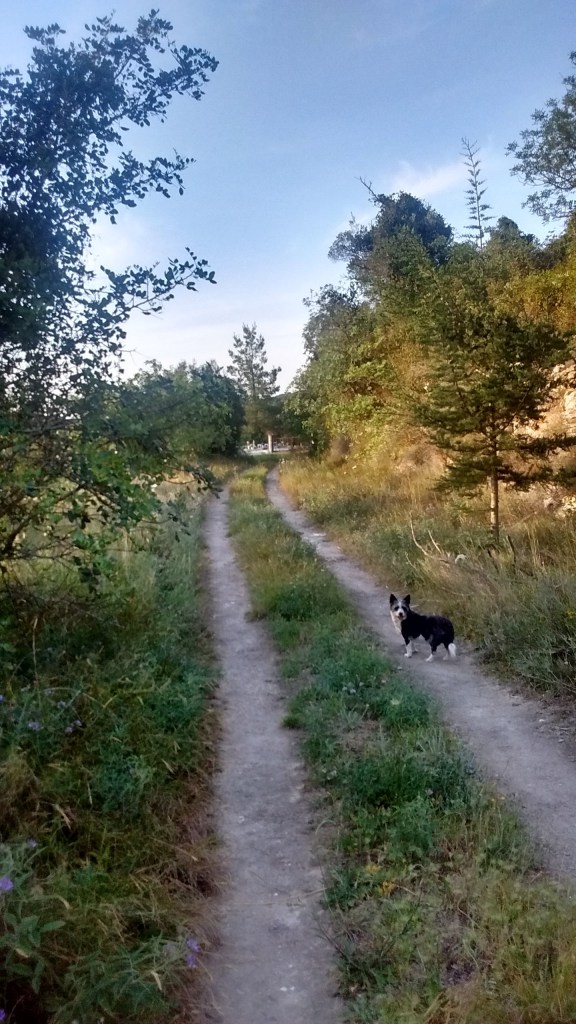
My dearest companion, Glyka

From my contact since the beginning of the COVID melodrama with dissidents of all colours I have been struck by how many are of a religious persuasion. Those to whom I’ve warmed have not been of an evangelical bent. However the conversations have often taken a spiritual turn. Over the years I’ve been quietly frustrated by what I see as religion’s appropriation of spirituality as its own. I’ve tried to be true to a spirit of human creativity, of cooperation, of justice and love. These past years closer to Nature, guided by Glyka, Leo, our aristocratic rescue horse, by the playful bin cats I feed, by Stelios’s adventurous goats, amazed by the way our brick-strewn barren garden has blossomed, I have sensed another level of spiritual awareness. Nevertheless I remain an atheist. I feel no need for a deity to give purpose to my existence. I remain a revolutionary humanist, a steadfast universalist, who has come to cherish the Earth in all its glory.

I do not know what I would do without music to soothe my spirits. Last week I sang ‘a capella’ in our village hall. I began with Dowland’s desire, ‘Music, music for a while, shall all your cares beguile’- somewhat truncated and hardly as beautiful as the wonderful Alfred Deller.

My generous neighbour, Ken Carpenter filmed some of the concert I gave to a small audience in our village hall. If I have the courage I will post a link to these videos soon. Listening and encouraging my effort, even entranced [!] were my very dearest friends, Maria and Linda Manousaki. Maria is an inspiration, not only as violin virtuoso but also as the driving force behind the diverse groupings of musicians she brings together here on Crete – for example, two very different string quartets, the Melos Ensemble play arrangements from the classical and jazz repertoires, whilst Tetracho improvise upon the indigenous Cretan tradition . In the next few weeks Linda at the piano and I will be rehearsing songs from American musicals. She will engage with my musical myopia, symbolised by the worried, ‘what key are we in?’ Who knows I might even sing accompanied sometime in the future!? We will see.
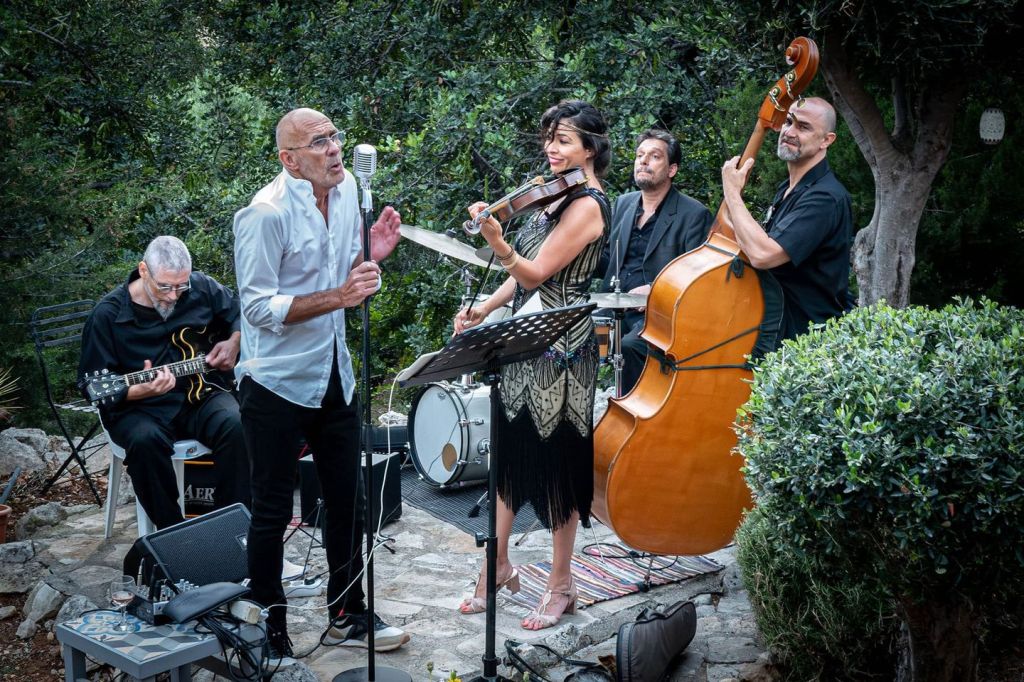
Privileged to be singing with Maria and the Swinging Strings

This piece is silent on the impact of Artificial Intelligence on our lives. It does not speak directly to the killings on the streets of Gaza, Teheran and Minneapolis. The silence is not by chance. I will break it but doing so is haunted by the knowledge that increasingly words, sounds and images tease, alarm as to their authenticity. It has always been necessary to be critical of what we read, hear and see. Today it is an unceasing and tiring obligation. And through the fog enveloping the truth I am inspired by the sight of ordinary people acting courageously in unison, striving against the odds to be agents of their own destinies. I refuse the concerted attempts across the ideological divide to deny them their autonomy, to cast them as mere pawns in the clutches of the oligarchs, the intelligence agencies, the corporations, the technocrats, the media, right or left-wing agitators or whomever.

Solidarity from an armchair radical, who needs to get on his bike.

Love & struggle,

Tony

On reading afresh this New Year’s ramble I’m afraid to say it’s more of the same navel-gazing as previous years – the same doubts and the same themes. Somewhat wearying, I fear. At the same time it indicates that the social and political situation isn’t getting better. Indeed it’s getting worse.


In an interview on Bad Faith, Gabor Mate suggests he has never experienced such darkness.


Chatting Critically about Climate Change Continues: Settled or Unsettled?

At our last CC meeting on September 6th, we agreed to continue the discussion on Climate Change at our next get-together on October 4th. Participants were encouraged to provide further links and comments as a stimulus to our individual and collective thinking.

Brenda got the ball rolling by drawing our attention to the video circulated by Marie-Martine of an interview with sceptic, Steve Koonin.

Brenda ventured the Steve Koonin link Marie-Martine sent us is eye-opening, and I feel it would be really good if everyone listened to that before coming on 6th October. Real fuel for a debate! A “man in the know” expressing his opinions on whether climate change is even really a thing…

This prompted a welcome and critical response from Jane Roberts.

Regarding Steven Koonin.
A modern-day Freeman Dyson but arguably more extreme. Both are physicists who have chosen to criticise climate scientists. They’re not climate scientists.

Some flaws in the video:
Complains about models being insufficient as did FD. But in its place he suggests the simplistic approach of taking the 1.3 increase of the last century and therefore assuming we can do the same this century and just “adapt”. How many centuries can we continue like that? Where is the tipping point – or is he sure there is not one, if so he remai
ns silent on this.

Says it’s not his place as a scientist to discuss moral and political issues – then holds up unfairness on the third world as being a part of his argument.

Spent a lot of the discussion around anecdotal evidence. For example the argument that “there have always been extreme weather events” is made purely qualitatively- he makes no attempt to be quantitative.

Likewise his suggestion that deaths from extreme heat can be discounted because deaths from cold are greater. That may be true, but here is some quantitative data on deaths from heat, published this morning https://www.bbc.com/news/uk-66890135

Positioning a 1.5 degree temperature rise as “under 1%” must be deliberately disingenuous. He is referring to under 1% of a temperature scale which falls to absolute zero (ie – 273 degrees C). But the range of temperatures at which life can survive is much smaller that 300 degrees, so this is a transparent distortion of the % and potential impact of a 1.5 degree rise.

Arguments about the cost of action seem out of place for him as a scientist too – yes it is huge – but those arguments are not for scientists either. But perhaps he has little to say as a scientist, because he is not a climate scientist?

The interview is odd as the interviewer never challenges him. He appears to be conducting the interview purely to give Steven Koonin a platform.

My overall thought is that we simply cannot risk inaction. It’s true that climate science is a relatively young science. It is not as developed as physics – and he may find that deeply unsatisfactory as did Freeman Dyson. Having acknowledged that however either he’s right or the climate scientists are right. We have no real way of telling. Surely we owe it to future generations to act – in case the climate scientists are right?

All the best


Paula has suggested this controversial alternative perspective.

The claims made in this hard-hitting, uncomfortable yet extraordinary crowdfunded documentary by Dr Steven Greer shows how the industrial-military complex together with human nature have conspired to keep us all in the carbon age for our electricity and transport far beyond when the invention of ‘free’ energy became known. It explores the lost century and the science we have made secret for so long and asks how we can reclaim a lost century before it is too late.

Do not watch before bedtime as it is depressing and exciting in equal measure!

I’d be interested to hear if you think this is real or just another conspiracy theory.


Taking Action Through Process and Debate

The recent and concerning collapse of the once revered scientific process in large parts of the climate change and the medical community is detailed in a highly critical ‘open review’ paper from the Global Warming Policy Foundation (GWPF). Someday, charge the authors, there will need to be an inquiry into how so many scientific bodies abandoned core principles of scientific integrity, took strong positions on unsettled science, took people’s word for things uncritically, and silenced those who tried to continue the scientific endeavour.

Find the report here – a draft out in the public sphere for debate but ignored by the mainstream media.

From its Executive Summary

At present the UK has a Climate Change Committee (CCC) responsible to the Government for advice on both mitigating and adapting to future climate change. Again, this body has no ‘red team’ to challenge their many reports. One thing a ‘red team’ would have done is to insist on looking at the whole trajectory of the route to net-zero and try to estimate the financial, material, human resources, ecological and societal costs involved.Just to expand the electricity system (extra generation, transmission and distribution) to cope with the extra demands of electrified ground transport and both industrial and domestic heat is estimated at £1.4 trillion, with 40,000 professional engineers devoted to this project alone for 30 years from now until 2050 (https://www.thegwpf.org/content/uploads/2022/03/Kelly-Net-Zero-Progress-Report.pdf . There may be an error of as much as 50% in these estimates, but certainly not a factor of 10. The electrification of heat and transport is only one part of the net zero target. In spite of a decade of advice, this firm grip on the scale of the problems of getting to a net-zero economy by 2050 is not to be seen spelt out in any of the CCC advice. Indeed the competences of the committee members do not extend to these extra considerations.

A key issue with red teams is to keep them from being ‘stacked’ by biased individuals, including political
favourites or corporate shills. However, it is often very rapidly apparent from online discussion of research that there are some highly experienced and competent scientists who are dissenting – with logical criticisms of the ‘mainstream’. Indeed, these scientists can often be identified conveniently by the ferocity of online bullying and ad hominem attacks on their capacity and integrity by some of the enforcers of alleged ‘consensus’. In the early days of Covid some powerful dissenting voices emerged on social media such as Twitter (now X), who despite being vilified and censored have proved correct.


And a provocative excerpt from a disagreement between Rusere Shoniwa and Jonathan Cook

https://plagueonbothhouses.substack.com/p/jonathan-cooks-rebuttal-of-my-rebuttal

Cook’s precautionary principle trumps rational scientific assessments

Cook falsely claims that I and other sceptics demand “that we wait and see how things unfold”. He then articulates a common but highly ignorant and dangerous notion of managing risk in which he posits that “even if you imagine there is some room for doubt, you should still be pushing hard for things to be done to minimise climate change and related ecological catastrophes if only on the precautionary principle”. [emphasis added]. So let’s deal with this.

First, the “wait-and-see” accusation is both false and irrelevant because it is intended to obfuscate the point I wanted to stress – it would be incredibly foolish to incur huge costs to avoid a crisis without sufficient scientific evidence for the existence of the crisis. The precautionary principle does not come without a price tag, and this is what Cook is trying to sweep away. You simply do not incur costs to avoid a crisis until you have compared those costs with the cost of the risk you are seeking to avoid. The methods for doing that are scientific, and they involve probability assessments of both sides of the equation. The sweeping application of the precautionary principle is the product of an asinine, bloated, bureaucracy-infested professional managerial class whose primary purpose is to justify its existence by manufacturing and then exaggerating risks to manage.

The costs involved in averting a ‘climate crisis’ are colossal. They involve choking the economies of the entire world. Depriving all economies, but especially poorer economies, of cheap energy and fertilisers that enhance crop productivity raises the very real prospect of killing millions of people already below the poverty line. How can any sane person be content with that horrific prospect, especially when the risk being avoided – the climate crisis – is not based on a ‘settled’ scientific proposition? I would never advocate for that position even if the ‘climate crisis’ were ‘settled science’, partly because ‘settled science’ is an oxymoron, but mainly because it can never be acceptable to kill one group of people in the expectation that you might save another group, now or in the future. That’s the alibi that has been used by every evil tyrant since the dawn of time, and it appears to be the stock-in-trade of ‘progressives’.


Another provocative argument to be found in this article, The Left is losing the climate class war Punishing the workers won’t save the planet BY MATT HUBER

https://unherd.com/2023/09/the-left-is-losing-the-climate-class-war/

Why do these climate policy technocrats repeatedly shoot themselves in the foot? Because, at the heart of their thinking, there is a deeper moralism that won’t let political reality get in the way of their historic mission. Ultimately, such approaches might be dubbed “techno-behaviouralism” — insisting that the main challenge of climate change is to reform the immoral carbon practices of dispersed consumers throughout the upper, middle and working classes. Rather than tackling the problem of who owns and controls fossil-fuel-based production (a relative minority of society), carbon behaviouralism aims its sights on the “irresponsible” choices of millions of consumers of all classes. It hopes to use policy tools to get them to drive less (or drive more efficient cars), insulate their homes, eat less meat, fly less. One notorious study in 2017 even went as far as to advise individuals to not have children.

The first phase of this policy outlook was to use the disciplining force of the market — particularly the price mechanism — to “nudge” consumers toward low-carbon choices. But now the severity of the climate crisis is forcing these technocrats to ratchet up their strategy to outright coercion: banning fossil-fuel boilers, gas stoves, internal combustion engines, or forcing farmers to rapidly implement costly practices. Rather than winning them over to an attractive political project, the masses must be reformed into more virtuous low-carbon practices. And even when the climate technocrats focus on society’s rampant class inequality, they only morally reprimand the lifestyles of the rich — their private jets, for example. They hardly ever consider how the rich make rather than spend their money: organising investment and for-profit production with likely far greater effects on the climate.


Also, see this long but moving piece in the Guardian

https://www.theguardian.com/environment/2023/sep/23/the-climate-is-visiting-a-mental-unravelling-on-all-of-us-charlie-hertzog-young-on-the-dangers-of-activism-and-staying-sane-on-a-dying-planet

We may be getting better at talking about the mental health crisis, but few connect it to climate breakdown. Scientific studies show that young people are more likely to suffer from climate anxiety and a Lancet study of 10,000 young people living in 10 countries found that 56% believe humanity is doomed. “Most people who are polled think that mental health issues are something to do with either a chemical imbalance in the brain, some sort of neurological glitch, or genetic. That model is completely outdated,” says Hertzog Young. “There are so many demonstrable links between social, ideological, ecological and material realities outside the brain that have a far greater impact on mental health. Climate change is throwing so much pain, trauma, stress, angst and cultural toxicity at us. It can breed distrust, apathy and nihilism and it can also breed deep fear. Even for people who are experiencing the climate crisis at a distance, through the lens of the media, there’s a medically recognised causal pathway to depression, anxiety and PTSD.”


Looking ahead Steve and Brenda suggested possible topics for future discussion

There seemed to be a feeling it might be hard to come up with more topics for discussion. I thought these might be helpful.
Do social media cause harm?
Freedom of speech:
Is it under threat? If so, how can it be saved?
Democracy
Does it exist? Is it under threat? If so, how can it be saved?
How tolerant should the West be of other cultures, especially when there is a conflict with western ideals such as women’s liberation?

In the future, could we discuss the topic of reparations? And was self-censorship covered in the session on literary censorship which I had to miss? Is Euthanasia too old a chestnut to crack? What about, at least, care of the elderly? What would people think of having a train line from E to W Crete? Is recycling being conducted properly? One could go on and on.


Our next CC meeting is at Brenda’s on Wednesday, October 4th, starting at 10.30 a.m. I’ll send the details out again to the group via email with a map.