
Siyavash Doostkhah, an Iranian refugee himself, sends this thoughtful and provocative piece from Australia, which seeks both to engage with contradiction and to peer beneath the surface of things.
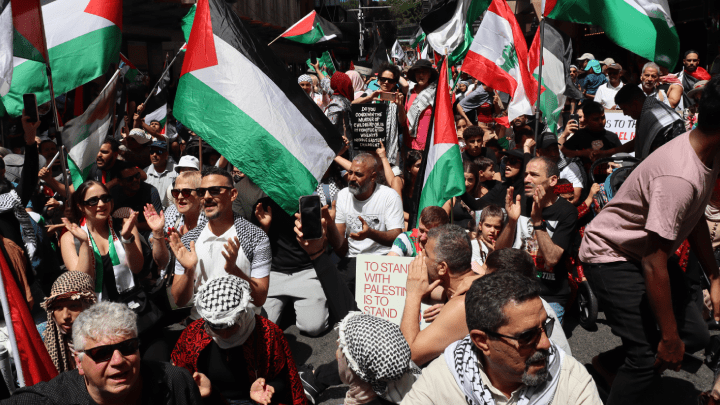
In recent months, Australia has witnessed an unprecedented rise in both impassioned pro-Palestinian activism and deeply troubling anti-Semitic incidents. Tens of thousands have marched through the streets of Sydney, Melbourne, and Brisbane, voicing legitimate grief and fury over the ongoing humanitarian catastrophe in Gaza. At the same time, Jewish schools have been defaced, community centres targeted, and Jewish Australians report growing fear and isolation.
This dual reality, empathy for Palestinians and anxiety within Jewish communities, demands careful and principled reflection. But equally important is this: Why is the Israeli government, self-proclaimed protector of the Jewish people, not doing more to counter this rising tide of antisemitism?
The silence, or, at best, tepid response, from Netanyahu’s administration isn’t just puzzling. It may be strategic.

There is a long, uncomfortable history in which fear has been used not only as a political tool but as an engine of migration. The Israeli state’s Zionist foundations have always relied, in part, on Aliyah, the migration of Jews to Israel, as both a demographic imperative and a spiritual calling. Throughout the 20th century, waves of migration were often triggered or accelerated by persecution: from Nazi Germany and post-war Europe to crises in Arab countries, Ethiopia, and the former Soviet Union. Often under the banner of rescue, but always with a demographic calculus in mind. Fear has long been a midwife to the Zionist project. In this vision, a swelling Jewish population is not merely a response to antisemitism, it is a geopolitical lever.
In the current moment, with the concept of Eretz Yisrael HaShlema “Greater Israel” driving Israeli policy and settlement expansion, we must ask: is fear again being used to accelerate Aliyah? Could the Israeli state be tolerating, or even quietly capitalising on, a global climate of antisemitism to encourage Jews to migrate “home”?
The Aliyah narrative has become more than a cultural call; it is a lever of statecraft. If Jews in Paris, New York, or Sydney no longer feel safe, Israel presents itself as refuge. But if Israel actively stokes the conflict that fuels that fear, through disproportionate violence, provocative incursions, and refusal to engage in diplomatic solutions, then we must ask: Is it still acting in the interest of Jewish safety, or in the interest of a nationalistic expansion project?
For progressive Australians, particularly those committed to Palestinian justice, the challenge is delicate. Solidarity must not slide into complicity. There is a fine but vital line between opposing the Israeli occupation and inadvertently legitimising oppressive actors such as Hamas or the Islamic Republic of Iran, both of whom exploit Palestinian suffering while offering no vision of human rights or freedom. Hamas’s violent tactics and Iran’s authoritarian repression cannot be sanitised simply because they oppose Israel.
Just yesterday, a protestor in Sydney was seen holding a poster of Ayatollah Khamenei, the brutal dictator of Iran, at the pro-Palestinian rally across the Harbour Bridge. That image, with thousands of Australians in the background, will no doubt be used by the Iranian regime and its supporters to manufacture legitimacy. This is how protests are hijacked.
I first encountered this tactic in the 80’s, when I was a refugee in India. On a crowded train platform, I witnessed a man tossing handfuls of coins into the air. Predictably, a crowd quickly gathered. Then, suddenly, placards bearing the image of Rajavi, the leader of the MEK organisation, were raised in the crowd, and someone began photographing the scene. These photos would later be used to suggest mass support for the MEK among Iranian dissidents in exile, an illusion created with a bag of coins and a camera.
We cannot afford to be naive. In Australia, outrage at Israeli state violence must not drift into antisemitism, overt or coded. When Jewish businesses are attacked in Melbourne, when graffiti defiles synagogues in Sydney, or when Jewish Australians feel compelled to hide symbols of their identity, it does not weaken the occupation, it strengthens it. It reinforces the Israeli narrative that the diaspora is unsafe and that Aliyah is the only answer.
There is an old strategy at play: If Jews feel unwelcome elsewhere, the Zionist project gains strength. If Palestinians are framed as irredeemable threats, then Israeli expansionism proceeds unchecked. The answer, for those of us who reject both antisemitism and colonialism, is to break this cycle, not feed it.
We must hold the Israeli government to account, yes, but we must also call out those who hijack solidarity for their own bigotry. We must demand justice for Palestinians, but not by echoing the authoritarian rhetoric of Hamas or Tehran. And we must ensure Jewish Australians are not collateral damage in a geopolitical game they did not consent to play.
True solidarity is principled. It condemns ethnic cleansing and occupation without resorting to hate. It recognises that antisemitism, even when disguised as anti-Zionism, serves no liberation. And it sees clearly how fear, if left unchecked, can become a weapon in the hands of those who seek to redraw borders, not build bridges.
If we are to help build a future where both Palestinians and Israelis can live with dignity and peace, then progressive Australia must sharpen its lens, and its conscience.
With their permission I attach the dialogue between Siyavash and Rasheed, which unfolded on Facebook following the appearance of Siyavash’s original. I do so because such a healthy exchange of opinion is all too rare in the intolerant and suffocating atmosphere dominant today.
Rasheed Abu Hamda responds to Siyavash:
In Brisbane where the protests took place in the last two years there were many jewish voices who spoke against the Israeli occupation of Palestine. And no one made them feel unwelcome otherwise they would’ve stopped attending the protests.
Anecdotally, at least in Brisbane I don’t think that antisemitism is disguising as anti-Zionism.
There was a shop in Paddington that was named and shamed because they were very open about supporting Israeli practices in occupied Palestine. This was an example where an Australian Jewish were overtly in support of Israeli terrorism. I haven’t heard of a single account in Brisbane where Australian Jewish were targeted because of their faith. Targeted because they sided with the apartheid state? Yes, especially the ones who went to Israel to serve in the IDF. My other take on the article is Iranian regime and HAMAS painted with a similar brush is not tactful. HAMAS was a direct produce of 50 years of occupation. It’s like a foster kid who was removed from a violent home and continued to move from family to another. A foster kid that was failed by the system – the international community that let Israel go on and on ( for decades) in their barabric attacks on Palestinians. And when the foster kid grown up and have more power to cause damage to the system, what do we do? We incarcerate the kid. Without taking responsibility (as international community) to acknowledge the systematic failure. The latter continue as we speak 77 years and counting. Addressing the symptoms is less effective than addressing the root cause of this chronic problem.
Siyavash replies:
Hey Rasheed, I really appreciate you taking the time to reflect and share your thoughts, there’s clearly deep care in your words and I totally respect that. I just want to clarify a few things, not defensively, but to continue the dialogue with honesty.
Firstly, I never said Jewish people were being targeted at the protests themselves. In fact, I fully acknowledge and celebrate the many Jewish voices who stand in solidarity with Palestinians, those voices are powerful and necessary. But outside of those protest spaces, there have been disturbing incidents across Australia with many families reporting feeling unsafe just for being visibly or knowingly Jewish.
As someone who’s been part of anti-Zionist activism in Brisbane since the early days, when it was just a small handful of us, I’ve observed a real shift in recent years. There’s been a creeping conflation of “Israeli” and “Jew,” even in educated circles. I get where it’s coming from, people are angry, traumatised, and rightly horrified by what’s happening to Palestinians. But I think it’s dangerous when that anger is redirected, intentionally or not, at Jewish people more broadly.
You mentioned that Hamas is a result of decades of occupation. I hear that analogy, and yes, the international community absolutely bears responsibility for abandoning Palestinians. But I still think it’s important to be honest about how Hamas came to power. Its rise wasn’t entirely organic. Israel once saw Hamas as a counterweight to the PLO, helping it grow in the 80s to weaken secular Palestinian nationalism.
That’s what I was getting at when I grouped Hamas and the Iranian regime together, not because they’re the same, but because both have been propped up in various ways by external powers (including the West and Israel) when it suited their strategic interests. And now they serve as convenient “boogeymen” to justify continued military aggression and repression.
I also worry when I see some on the Western left romanticising these authoritarian groups simply because they oppose Israel. I’ve lived through this myself, as a refugee from Iran, I watched the left in my country get crushed by the very theocracy they once helped empower. The Iranian left thought they could ally with religious fundamentalists to bring down the Shah, and they were the first ones the regime turned on after the revolution.
It’s a tough, messy landscape. But I think we owe it to ourselves, and to the Palestinian people, to stay sharp, to question all forms of power, and to be wary of letting righteous anger cloud our ethics. We can (and must) be anti-occupation, anti-colonial, and still protect Jewish communities from harm and fear. The two things are not mutually exclusive.
Let’s keep talking.
Over to Rasheed
Thank you Siyavash for sharing your thoughts – I do appreciate you and your thoughts. The Jewish people participating in protests was just an example to demonstrate that tolerance exist providing they are not pro-zionism – sorry I should have clarified that in the first place, a room for improvement. And to hear there are Jewish families who are not pro Zionism are being harassed, it doesn’t sets well with me. As this is what Palestinians are been subjected to and this is what we are protesting against. Except what Palestinians are enduring is more than harassment. As a Palestinian who lived as a refugee for most of my life and lost family members and farming lands to the occupation forces, the question remain in front of mind is do we focus our efforts to expose and hopfully remove the Apartheid system – the main cause of disease, get distracted with addressing the by products of the occupation, or address both while lives are lost on a daily bases in Gaza, West Bank and more Palestinians inside Israel are further marginalised? I personally belive that we need to stop the fire first and stop the one who caused it in the first place prior to get the house back in shape. I’d love to hear your views in that regards especially the ones that are different from what I just shared. After all, I don’t know what I don’t know and multiple perspectives helps us to see the picture better. P.S. I do admire Jewish people who can see right through the fake face of Zionism considering the fears and traumas of many generations while living in Europe. It takes a huge amount of courage to do so.
All of which prompts Siyavash to respond:
Thank you for your heartfelt and grounded message. If I were to sum up my response in a spirit you might relate to, given your deep love for dance, I’d offer the quote often attributed to Emma Goldman: “If I can’t dance, I don’t want to be part of your revolution.”
It speaks to the kind of liberation we both long for, one where joy, dignity, and humanity are not sacrificed in the process of resistance.
You asked an important question about whether we should focus our energy on the system of apartheid or deal with its toxic by-products too. I think the two are deeply linked. From my experience in Iran, I saw firsthand what happens when we think the “enemy of my enemy could be our friend.” We threw our lot in with religious fundamentalists just because they opposed the Shah. That miscalculation cost us deeply. We didn’t realise that by fighting one form of oppression, we were handing power to something even more repressive. That enemy of our enemy quickly became our jailer.
In Persian we say: “از چاله به چاه افتادن” — “to fall from a pothole into a well.” And another saying: “اول چاه را بکن بعد مناره را بدزد” — “Dig the well before you steal the minaret.”
They’re old phrases, but they feel painfully relevant now.
I worry deeply that the incredible sacrifice and resistance of the Palestinian people might one day be co-opted or hijacked by forces that do not represent their dreams for freedom and dignity. I say this not from afar, but from the lessons carved into the Iranian soul over the last 45 years. I look at what Hamas has become, and who benefits from its existence, and I sincerely hope that the secular and nationalist movements can once again take the reins and chart a course for true liberation, free of both occupation and authoritarianism.
Your personal story touches me. Losing land, family, and a sense of home is a grief I cannot claim to fully understand, but I see its depth and weight in your words. Your clarity and refusal to let that grief turn into hate or tunnel vision is powerful. That’s the kind of strength that builds bridges, not just in politics, but between hearts.
I truly hope that in our lifetimes, we’ll sit together in a café in a free Gaza, maybe even during a Waziz reunion concert, and look back on these conversations with gratitude, for having spoken honestly, and for having listened with open hearts.
Much love and respect
And Rasheed closes the conversation:
Thank you Siyavash for your kind and sweet response. I must say your writing style beyond being objective is charming and engaging. How did you do that?
 CHATTING CRITICALLY