Musings on the politics of youth work, community work and society at large – dedicated to the memory of Steve Waterhouse, Malcolm Ball and Sue Atkins, great youth workers, comrades and human beings
The powerful, the ruling class of any historical period has spread fear as an essential element in the maintenance of its social and political control. Hence I’m stretching a point to suggest that we are living through an unprecedented era of Anxiety. And yet, even today, I’ve been warned to beware a possible proliferation of epidemic-catalysing viruses, all given the COVID script being existential threats, and instructed to fill the larder with supplies sufficient to last 72 hours in case of war.
We imagine the world as unsafe, and then we dream the world as unsafe, and then feel in our bodies that the world is unsafe. And this is an inverted order of things, the opposite of how our bodies come to knowledge. Rhyd Wildermuth
Sometime, perhaps never, I will seek to explore the contemporary phenomenon of algorithmic- created anxiety. For now, in the past few weeks I’ve sought to escape being suffocated inside the virtual by way of being scared of reality, namely giving another solo concert in my Cretan village. The nerves did indeed jangle. If you are kind enough to watch the two videos below you might well discern my tension. In terms of the songs themselves, it’s most obvious in my rushing through the Schubert composition, ‘Der Leiermann’, losing on the way much of its ambiguous mystery. Next time…….
A couple of people have asked for details of the latest programme. If I wasn’t so nervous about singing in the correct key I would relax and say more about the songs at the concert itself.
1. 0 Waly, Waly
Somerset folk song
2. Somewhere a Voice’s Calling and Smilin’ Through
American Parlour-Songs recorded in 1914 and 1919 by John McCormack, the famous Irish lyric tenor and sung by me as a boy soprano in 1957!!
3. Unbelievable, The Nearness of You and Bewitched, Bothered and Bewildered
American classics and often jazz standards – Livingstone, Carmichael and Rodgers
4, Hands, Eyes, Heart and Tired – Vaughan Williams and Now Sleeps the Petal – Quilter.
English Art Song
5. I am a Poor Wayfaring Stranger
North American folk song and spiritual
6. Ti eínai aftó pou to léne agápi from the Boy on a Dolphin, If I Loved You from Carousel and Summertime from Porgy and Bess
Songs from film and musicals – Morakis, Rodgers and Gershwin
Interval.
7. Im Wunderschönen Monat Mai – Schumann, Das Wandern and Der Leiermann – Schubert
German Lieder
8. Danny Boy
Irish folk song
9. My Funny Valentine, When I Fall in Love and The First Time Ever I Saw Your Face
Classic Love songs – Rodgers, Young and MacColl
10. Whither do I wander – Vaughan Williams, Sea Fever – Ireland and Come Again – Dowland
English and Elizabethan song
11. One Little Quarrel and Guilty
Tribute to Al Bowly and 1930s dance bands
12. Πάμε μια βόλτα στο φεγγάρι or Let’s take a walk to the moon
Greek classic – Hadjidakis
———————————————————————————————————————————————
Our villagekafeneio, H Elpida, the cafe of Hope
There seems little doubt, in my mind, that preparing for and giving this little concert, despite the blemishes, kept me out of what Anthony Rella calls the ‘psychic pollution’ infecting our relation to the internet and social media. OK, I admit, the warbling kept me away only for some of the time. Certainly I would suggest that prioritising time away from the screen in all its forms is a necessary form of resistance to the Machine. Lately I’ve gone back to printing off copies of stuff I’d like to read and taking them to peruse in the village kafeneio. A precious bonus is that Georgos brews a fine cappuccino and I get to pass the time of day with our village’s motley characters.
I must close by thanking Ken Carpenter for filming and editing the videos – all out of the goodness of his heart.
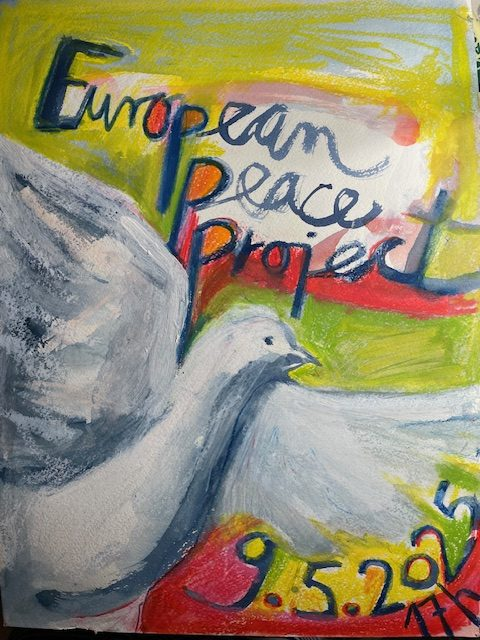
“On May 9 at 5 pm – it’s time to set an example for the peaceful future of Europe!”
The Manifesto – European Peace Project
Today, on May 9, 2025 – exactly 80 years after the end of the Second World War, which cost the lives of 60 million people, including 27 million Soviet citizens – we, the citizens of Europe, raise our voices! We are ashamed of our governments and the EU, which have not learned the lessons of the 20th century. The EU, once conceived as a peace project, has been perverted and has thus betrayed the essence of Europe! We, the citizens of Europe, are therefore taking our destiny and our history into our own hands today, on May 9. We declare the EU a failure. We start with citizen diplomacy and refuse the planned war against Russia! We recognize the co-responsibility of the “West”, the European governments and the EU in this conflict.
We, the citizens of Europe, together with the European Peace Project, oppose the shameless hypocrisy and lies that are being spread today – on Europe Day – at official ceremonies and on public broadcasters.
We are reaching out to the citizens of Ukraine and Russia. You are part of the European family and we are convinced that together we can organize peaceful coexistence on our continent.
We have the images of the military cemeteries before our eyes – from Volgograd to Riga to Lorraine. We see the fresh graves left behind by this senseless war in Ukraine and Russia. While most EU governments and those responsible for the war are rushing and suppressing what war means for the population, we have learned the lesson of the last century: Europe means “Never again war!”
We remember the European reconstruction achievements of the last century and the promises made in 1989 after the peaceful revolution. We call for a European-Russian Youth Exchange, modelled alike the French-German Youth Office of 1963, which ended the “hereditary enmity” between Germany and France. We demand an end to sanctions and the reconstruction of the Nord Stream II pipeline. We refuse to waste our tax money on armaments and militarization at the expense of social standards and infrastructure. Within the framework of an OSCE peace conference, we call for the creation of a European security architecture with and not against Russia, as laid down in the 1990 Charter of Paris. We call for a neutral Europe, emancipated from the USA, which takes on a mediating role in a multipolar world. Our Europe is post-colonial and post-imperial.
We, the citizens of Europe, hereby declare this war to be over! We will not take part in the war games. We will not turn our men and sons into soldiers, our daughters into nurses in military hospitals and our countries into battlefields.
We offer to immediately send a delegation of European citizens to Kiev and Moscow to start a dialog. We will no longer stand by and watch our future and that of our children being sacrificed on the altar of power politics.
Long live Europe, long live peace, long live freedom
“Give me the liberty to know, to utter, and to argue freely according to conscience, above all liberties.” ― John Milton , Areopagitica
Last week I gave a talk, entitled ‘Free Speech in Authoritarian Times?’ to an audience of 24 or so people, mainly but not exclusively English, brought together by Phil and Francesca Harrison under the banner of the Kalamitsi Arts Group in the old village school of Kalamitsi Amigdali. It was sweeping, ridden with obvious silences and contradictions. I had no intention of posting it here. My desire was no more than to raise questions in an often unquestioning world. However, whilst walking this morning, worrying about to what extent I am doing anything useful politically anymore, it struck me that, if nothing else, I should continue to scribble. Trying to write personally and politically is some sort of activism. And it’s long overdue that I cease self-censorship, that I rid my head of today’s puritanical authoritarians, housed in both corporate and state institutions, academic and bureaucratic or employed as no more than stenographers in the mainstream media. Being immersed in John Milton and J. S. Mill recently has strengthened a conviction that I should cast caution to the winds in order to speak freely and eccentrically.
“In this age, the mere example of non-conformity, the mere refusal to bend the knee to custom, is itself a service. Precisely because the tyranny of opinion is such as to make eccentricity a reproach, it is desirable, in order to break through that tyranny, that people should be eccentric. Eccentricity has always abounded when and where strength of character has abounded; and the amount of eccentricity in a society has generally been proportional to the amount of genius, mental vigor, and moral courage which it contained. That so few now dare to be eccentric, marks the chief danger of the time.” ― John Stuart Mill, On Liberty
In the next few weeks or so I’ll revisit my scattered, handwritten notes and post a revised version here.
In the meantime I’ll begin, as frequently promised but rarely delivered, drawing your attention to writing I find challenging, precisely because it is often but not always at odds with much of my ‘Left’ history.
Jeffrey Tucker, the author of this article, is described as a libertarian anarcho-capitalist and is the president of the Brownstone Institute, which, in its words, is a nonprofit 501(c)(3) organization founded May 2021. Its vision is of a society that places the highest value on the voluntary interaction of individuals and groups while minimizing the use of violence and force including that which is exercised by public or private authorities. This vision is that of the Enlightenment which elevated learning, science, progress, and universal rights to the forefront of public life. Presently, it is constantly threatened by ideologies and systems that would take the world back to before the triumph of the ideal of freedom.
It represents a liberal tradition, which has been sidelined by both neoliberalism and social democracy. Given both these ideologies are in crisis and sliding deeper into authoritarianism, the supporters of the Institute see the possibility of a renewal of its creed. Certainly at this particular moment their interpretation of the Trump phenomenon is generous, contrary and even naive. Yet theirs is a voice that needs to be heard.
These few paragraphs in themselves deserve discussion.
As it turns out, generations of ideological philosophizing had been chasing fictional rabbits. This is true for all the main debates about socialism and capitalism but also the side debates about religion, demographics, climate change, and so much more. Nearly everyone had been distracted from seeing the things that matter by hunting for things that did not actually matter.
This realization transversed typical partisan and ideological boundaries. Those who did not like to think about issues of class conflict had to face the ways in which the whole system was serving one class at the expense of everyone else. The cheerleaders of government beneficence faced the unthinkable: their true love had become malevolent. The champions of private enterprise had to deal with the ways in which private corporations participated and benefited from the entire fiasco. All major political parties and their journalistic backers participated.
No one’s ideological priors were confirmed in the course of events, and everyone was forced to realize that the world worked in a very different way from what we had been told. Most governments in the world had come to be controlled by people no one elected and these administrative forces were loyal not to voters but to industrial interests in media and pharma, while the intellectuals we had long trusted to say what is true went along with even the craziest of claims, while condemning dissent.
Rightly or wrongly I’ve felt a certain disdain from both Left intellectuals, politicians and activists towards the notion of the deep state. I’ve found this perplexing, especially as Chris Mullin, a Labour MP wrote a successful novel, ‘A Very British Coup’ back in 1982. Within its pages Harry Perkins appears as the left-wing Leader of the Labour Party and Member of Parliament for Sheffield Central. Beating all the odds, Harry becomes Prime Minister following a landslide victory in the 1989 general election, and sets out to dismantle media monopolies, establish Britain as a neutral country through withdrawal from NATO, the removal of American military bases from British soil and unilateral nuclear disarmament, achieve public control of finances, revive manufacturing by withdrawing from the Common Market and imposing import controls, and create an open government. Many people in the media, financial services, and the intelligence services are deeply unhappy with Harry’s win and his policies, and they unite with the United States government to stop him by any means.
For those of us involved in the labour movement of the time, often Leninist in our outlook yet supportive of the charismatic Methodist Socialist, Tony Benn, the scenario painted was certainly credible. However its diagnosis of the political situation was deeply worrying, especially for the Labour Party’s leadership at all levels and its membership. It suggested, at the very least, that the parliamentary road to socialism was fraught. The conclusion that the Party could not be a vehicle for radical change was too much to bear. Perhaps the demise of Corbynism has put paid finally to the illusion that there is a party political path to emancipation.
In recent years, as Christian Parenti, a professor of economics at the John Jay College, CYNU. notes, in the following article, the idea of the deep state has become a key part of MAGA [Make America Great Again] politics. My belief of four decades ago that a deep state stood firmly in the way of revolution was described as Far Left. To argue still that the deep state is a profound obstacle to implementing the demands of working people is to be Far Right.
War has come to the deep state or so it seems. During Donald Trump’s first weeks in office, he summarily fired a dozen top FBI officials and a similar number of US attorneys deemed hostile to the White House, and nominated deep-state critics including Tulsi Gabbard, Kash Patel, and Robert F. Kennedy Jr. for cabinet posts, while issuing executive orders to declassify all documents related to the assassinations of the Kennedy brothers and Martin Luther King Jr. Meanwhile, Elon Musk’s Department of Government Efficiency dismantled the CIA’s favorite cutout, USAID.
Given the centrality of the “deep state” to the MAGA worldview, merely uttering the phrase will immediately code you as a Trump partisan. But until quite recently, the concept was the province of the political left. Understanding its origins and evolution makes clear that the stakes are far greater than the political fate of Donald Trump and the MAGA movement. The deep state is a cancer that undermines popular sovereignty. Those who wish to restore democratic rule, regardless of political orientation, must therefore take it seriously.
He ends:
“The deep state is a cancer that undermines popular sovereignty.”
A robust national debate is also essential if we are to prevent the deep state’s relaunch from within the “reformed” remnants of old agencies. In short, this surgery cannot be left to the experts: It requires the disinfecting sunlight of declassification and public discussion. If the vaults of files are not disgorged, then it will be clear that Trumpian efforts against the deep state are nothing but limited insider-vs-insider score settling. Popular pressure must be exerted now to help us avoid that fate.





 CHATTING CRITICALLY